PERFORMANCE 7th September 2025
The Descent of Inanna – From the Great Above, to the Great Below
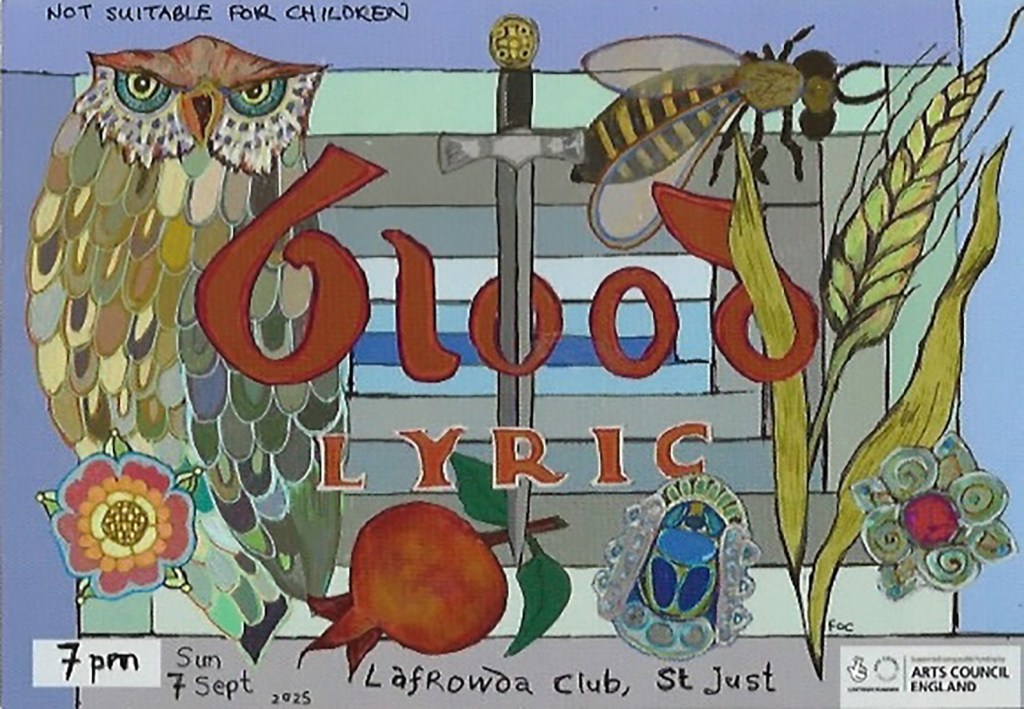
The booked performance date coincided with the total eclipse of a Blood Moon, which felt most appropriate for a show focusing on a mythological take on rebirth and restoration.
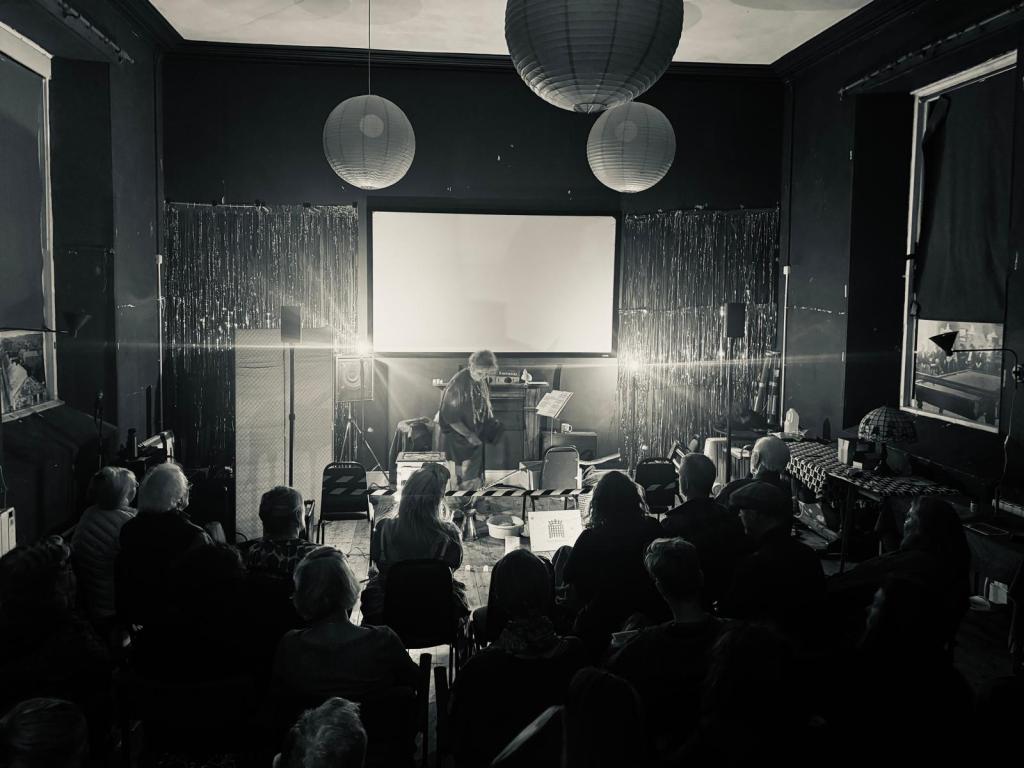
Gearing up for ritual (©Rosie Vanier)
The stories of Inanna were first written down around 4000 years ago, in cuneiform script upon clay tablets. Despite the story origins lying at the beginning of the literate historic period, I am going to talk about the divinities as manifesting in the present, as their myths are still active.
Inanna is a Sumerian goddess; Queen of Heaven and Earth. Her twin sister, Ereshkigal, is the Queen of the Underworld. It does not feel unreasonable to consider Ereshkigal to be the shadow self of Inanna. Inanna’s later incarnations included Astarte, Isis, and Aphrodite. Isis also has two forms; the Dark Isis and the Light Isis.
The story of the Descent of Inanna models a powerful Mystery narrative. You can read a beautiful and poetic translation of it in: Inanna Queen of Heaven and Earth; her stories and hymns from Sumer by Diane Wolkstein and Samuel Noah Kramer.
When Inanna brings about the death of her sister’s husband, the Bull of Heaven, Inanna chooses to descend into the earth, the Underworld, to pay her respects. As a precaution, she leaves her loyal servant, Ninshubur, at the top, with instructions to go the gods for help if Inanna doesn’t return within three days.
Learning that her sister is on her way, Ereshkigal, furious, demands that all seven gates to the Underworld be locked. To pass through each one, Inanna must relinquish one item that she has with her. At the first gate she hands over her crown, and with it the power that the crown contains; her sovereignty. At subsequent gates she hands over a necklace of lapis lazuli beads, a double stranded necklace, a pectoral, a golden arm ring, her divining rod and, finally, at the seventh gate, her robe. She enters the Underworld with nothing, just as we are born naked and empty handed.
There in the darkness, she faces her desperately unhappy sister, whose rage kills Inanna on the spot. Ereshkigal hangs Inanna up on a meat hook, where she rots for three days. Ninshubur follows instructions and goes to seek help, beseeching: “Do not let the holy priestess of heaven be put to death in the Underworld”. Only Enki, the god of magic, proves supportive, however. He creates two tiny magical creatures from the dirt underneath his fingernails, ‘neither male nor female’. One, the kurgarra, carries a crumb of the food of life. The other, the galatur, carries a drop of the water of life. These minute entities are able to slip past the guards of the gates of the Underworld and arrive to find Queen Ereshkigal, alone and in pain, in labour. As she moans and cries out, they echo her, repeating her words. Amazed that she has been heard – that somebody has listened to her pain – she tries to reward the little creatures. What will they accept? Only the corpse on the hook, they say. That belongs to Inanna, says the queen, but you may have it. So they feed Inanna the essential food and water, and she is brought back to life.
In order to leave, however, the demons stipulate that Inanna provide a substitute self, as nobody leaves the Underworld. First, they suggest Ninshubur. Inanna won’t hear of it; this is a most loyal friend. They suggest Inanna’s sons, one of whom is her beautician, but they, too, are loyal, having been found mourning her death. Dumuzi, the husband of Inanna, has certainly not been mourning, however; he is found in his best finery, on his throne, listening to music. After a long chase, during which Dumuzi is protected by his extremely loving sister, Geshtinanna, the demons finally get their man and haul him off to the Underworld. Later, Geshtinanna plea bargains, and offers to take Dumuzi’s place in the Underworld for half the year.
Inanna is restored as Queen of Heaven and Earth. She has met her twin self, died and been brought back to life through magic, while in mother earth – and she returns to the waking world far more powerful than when she left it.
My interpretation of the myth
This is a myth of renewal through retreat back to the essential self, and the linking of that self with the raw earth, the immense unmanifest, the source of our creativity, power and life itself. By tapping into our root system, we can grow back, renewed and empowered.
For me, the earth represents both our individual origin within the bodies of our mothers, and the origin of our species within the planet. It can also link the individual to the collective unconscious. ‘From the Great Above, to the Great Below’ may relate to both the microcosm and the macrocosm and the loaded ambiguity of that, to me, feels immensely powerful.
While my performance was just that, a performance, I chose to create it as if performing a real ritual. The experience of an initiate entering an altered state of consciousness, however much shaped by archetype, is essentially subjective. So are poetic responses. Both are responses to the world around us, a narrative framing of actual conditions and events. So it was important for me to be sure about why I wanted to enact this particular ritual.
My personal experience of freelance and casual work is that it often feels feudal. People appear sometimes to feel constrained to make accommodations with arbitrary power to gain access to scarce resources, and de facto hierarchies can arise that can normalise surprisingly quickly. The process is also gendered; when the security of salaried work protection is absent, people can resort to old-fashioned interpretations of the roles of women in production. My own experience has led me to interpret as internalised misogyny some very unhelpful behaviour by some women involved in earlier freelance work – including, most distressingly, my own project. Rather than fall into negative counter measures that only reinforce the depressing divide-and-rule effect of patriarchal values in the workplace, I wanted to create something that symbolises strengthening all women. If everyone feels secure and sure of their own place in the world, they will have less reason to undermine others.
Portraying the story/ritual
Inanna divests herself of a set of ritual items that incorporate her physical and spiritual power. I recreated the items as best I could and attributed personal significance to each.
As each gate is a step on the way from day-to-day reality to the underworld roots of matter, it was helpful to make correspondences with another paradigm of descent through the body; the chakra system. These are the subtle equivalences of parts of the body.
So:
| Gate | Chakra | Inanna’s item | Attributed significance |
| I | Crown | Crown | Sovereignty/social autonomy |
| II | Brow | Lapis necklace | Psychism/the Underworld |
| III | Throat | Double strand | Communication/ integration |
| IV | Heart | Pectoral/ breastplate | Love in bloom |
| V | Solar plexus | Gold bracelet | Will and strength |
| VI | Sacral | Divining rod | Innocence and passion |
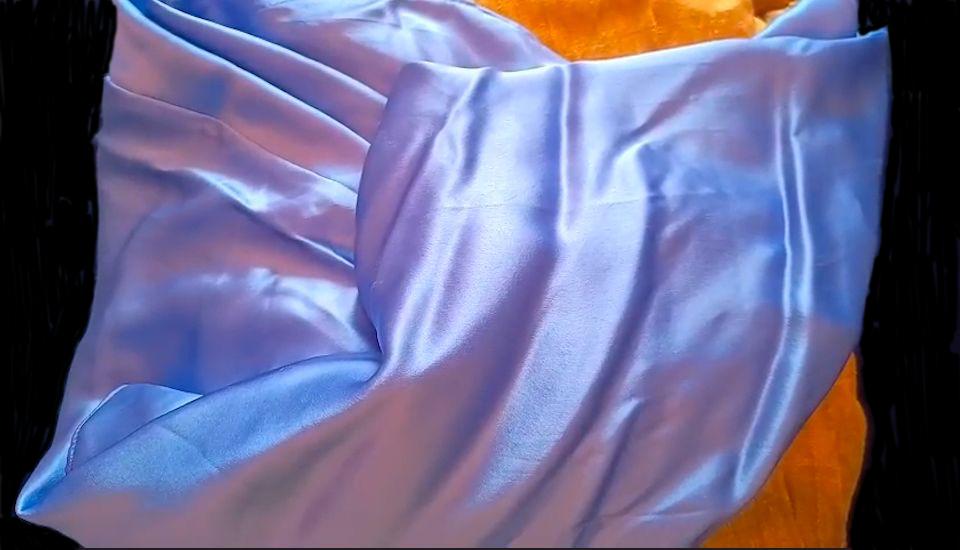
| VII | Chakra | Robes | Security/ rootedness |
Each gate is represented by a film, showing associations with the gate, and containing the words of the poem for that gate. Some are spoken and some are sung. All of the words for the ritual are in Cornish.
At the end of each film, the live Inanna asks: [“Pyth yw hemma?” What is this?] The reply, spoken from the film, is: “Perfydh yw fordhow Annown” [The ways of the Underworld are perfect]
At this point, Inanna hands over her item, and moves to the next film.
The seven gates:
After arriving, considerably less clothed and decidedly vulnerable, in the Underworld, Inanna dies and is reborn, reuniting with the root of her power in the earth. I have added, symbolically, elements of creating a golem, a protective magical creature from Jewish mystical tradition. Following ritual cleansing, virgin clay and spring water are combined into an anthropomorphic figure. This is animated with a spell (sung poetry!) and then named and then let loose upon the world. From her clay grave, this Inanna covers herself with local Cornish china clay and local water.
Inanna then returns through the gates, reclaiming her powers at each gate, to arrive back in the here and now, reborn, protected and restored to full power over herself, and ready to take her place in the world.
Background reading
The original story: Inanna: Queen of Heaven and Earth – Her stories and hymns from Sumer. By Diane Wolkstein and Samuel Noah Kramer. In the words of Kramer, this is “an effective cooperation between … a folklorist [Wolkstein] who has collected and recorded the tales, legends, and songs of modern contemporary societies, and a cuneiformist [Kramer] who has devoted his entire scholarly career to the restoration and translation of the written tales, legends, and songs of the ancient Sumerians.” It includes pictures of the cuneiform text alongside translations, with commentaries and Wolkstein’s beautiful poetic retelling. It’s a wonderful book.
The following provided food for thought:
Journey to the Dark Goddess: How to return to your soul. By Jane Meredith. This is a practical soul-oriented book by a contemporary priestess of the Goddess. By the same author: Aspecting the Goddess: Drawing down the divine feminine http://www.janemeredith.com
Secrets of Sumerian Magic: the Enuma Elish. A strange but interesting book, with no obvious author or publication information, other than a header on every page: https:/llhmedia.com/mvp/pmfmagickandtarot-mvp.html
Casting Sacred Space – the core of all magickal work. By Ivo Dominguez Jr.
Aetheric Magic: a complete system of elemental, celestial & alchemical magic. By Ike Baker
Dion Fortune’s Rites of Isis and of Pan. Edited by Gareth Knight.
The Tarot Architect: How to become the master builder of your spiritual temple. By Lon Milo DuQuette
The Celtic Golden Dawn: an original & complete curriculum of druidical study. By John Michael Greer
Ancient Myths and the new Isis Mystery. By Rudolf Steiner.
The Song of Eve: an illustrated journey into he myths, symbols, and rituals of the goddess. By Manuela Dunn Mascetti
Ecstatic Witchcraft: magic, philosophy & trance in the shamanic craft. By Fio Gede Parma
Elements of Magic: reclaiming Earth Air Fire Water Spirit. Edited by Jane Meredith & Gede Parma
The Demonisation of the Goddess: and her refusal to be subjugated. By Wyn Abbot
The Cornish Folklore Collection. Volume One; Witchcraft, spells, charms, cures and superstitions. By Kelvin I. Jones.
The Training & Work of an Initiate. By Dion Fortune
The artefacts:
Performance and ritual, woven together, can draw upon all of the arts and aesthetic experiences valued by people. Adding artefacts to the mix draws in the visual and, depending on performer-audience relationship, the sense of touch as well.
If lyric poetry has opsis as one of its aspects, Frye’s visual principle of verbal organisation that involves ‘imagery, pattern and the containing spatial’, then perhaps imagery can fill in for missing lyric, words that a non-speaker of the language can only infer. Or, put another way, might it be true that a picture is worth a thousand words? If so, add more props! Not everybody in the audience speaks, understands or hears the performer’s language to the same degree.
Artefacts encode the symbolism of the process in the scenery of the performance; every artefact is both scenery and hero prop.
Each of the seven gates has its artefact, very explicitly; these are the things that Inanna gives up, the items that are the sources of her powers.
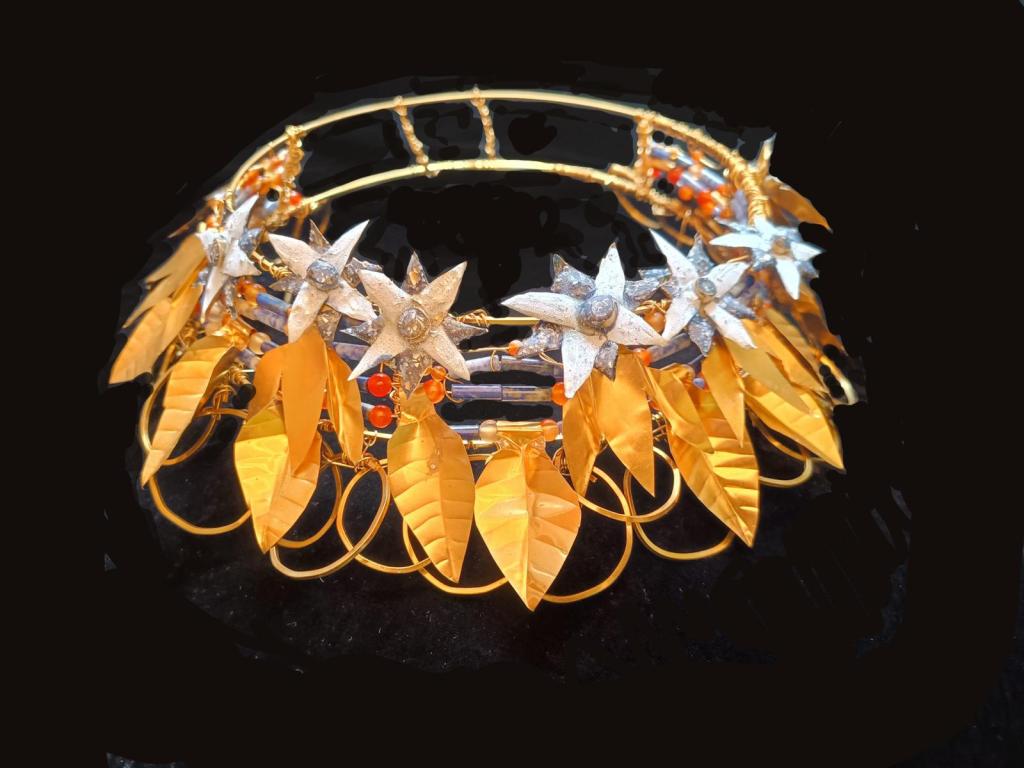
At GATE ONE, Inanna hands over her crown. This one is loosely copied from one found in the tomb of Queen Puabi in the Royal Cemetery at Ur, and currently in the Penn Museum, Philadelphia. I kept the lapis lazuli and carnelian beads, but used sheet brass instead of sheet gold; the petal shaped cabochons of two-tone lapis are made with what can best be described as a type of modern faience (it uses araldite). It was still quite expensive to make!
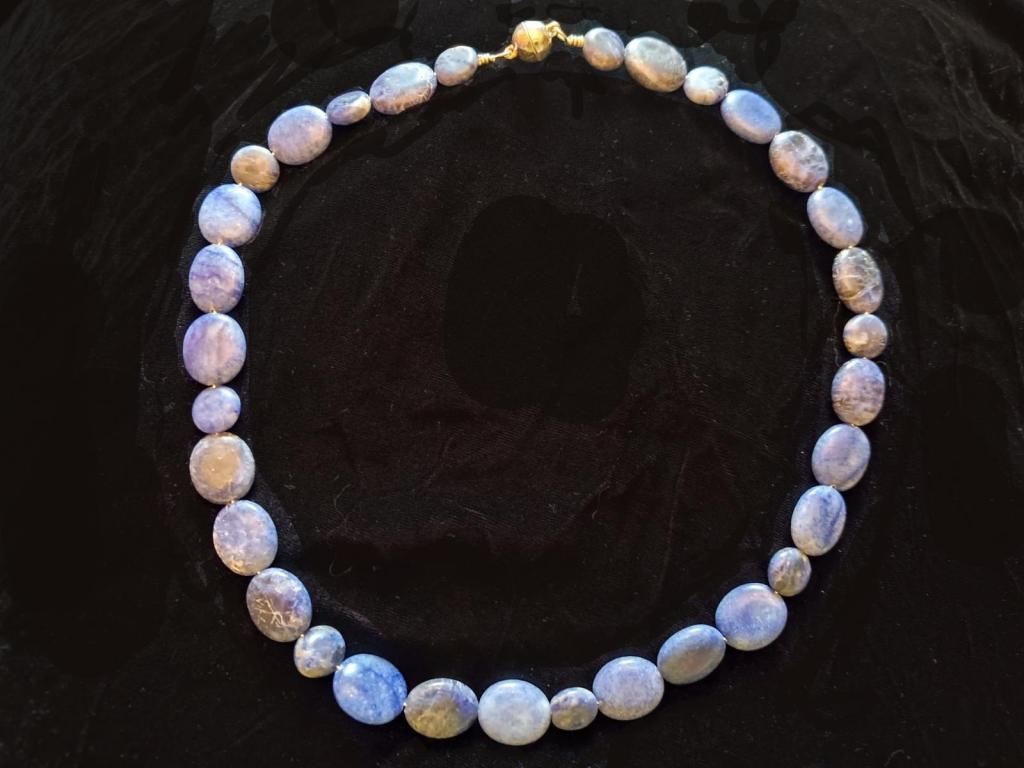
At GATE TWO, Inanna hands over a necklace of lapis lazuli beads. These are lapis lazuli strung on solid silver wire:
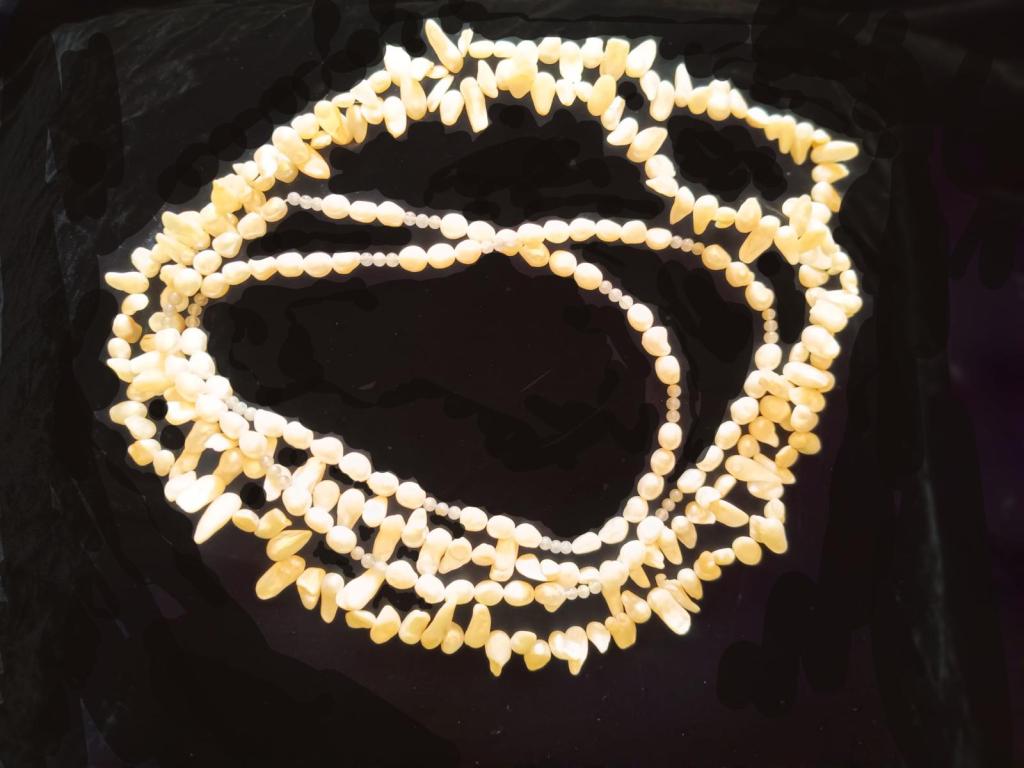
GATE THREE sees the handover of a double stranded necklace. These are pearls, with some small moonstone beads.
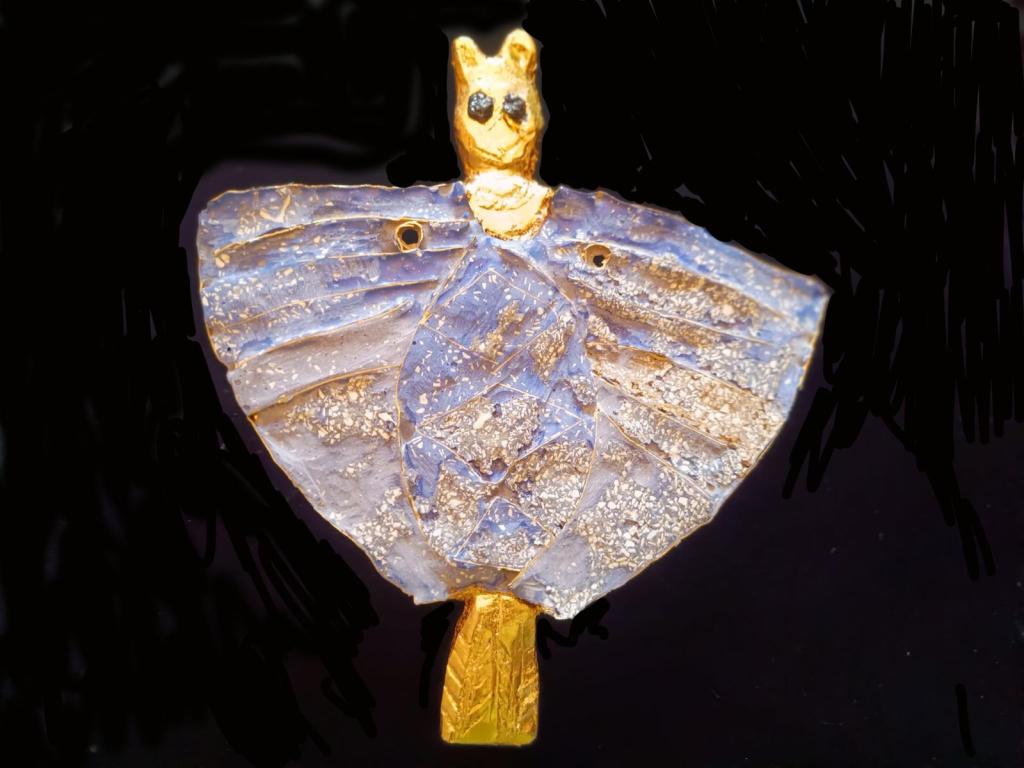
This pectoral is relinquished at GATE IV. It is made of carved bass wood, gilded, with the wings made of brass inlaid with the questionable faience paste – the blue is from proper ultramarine and cobalt pigments, though, which is (I think) from lapis lazuli. I had no idea what Inanna’s pectoral would look like. This looks a lot like a bat in a cape, but it’s meant to represent a lion-headed eagle, a symbol of the Sumerian goddess Ningersu. The original, from 2500BCE, is made of gold (head and body), copper (wings) and lapis lazuli. One consequence of trying to reproduce artworks from the past is that a real appreciation of the expertise of ancient artisans develops.
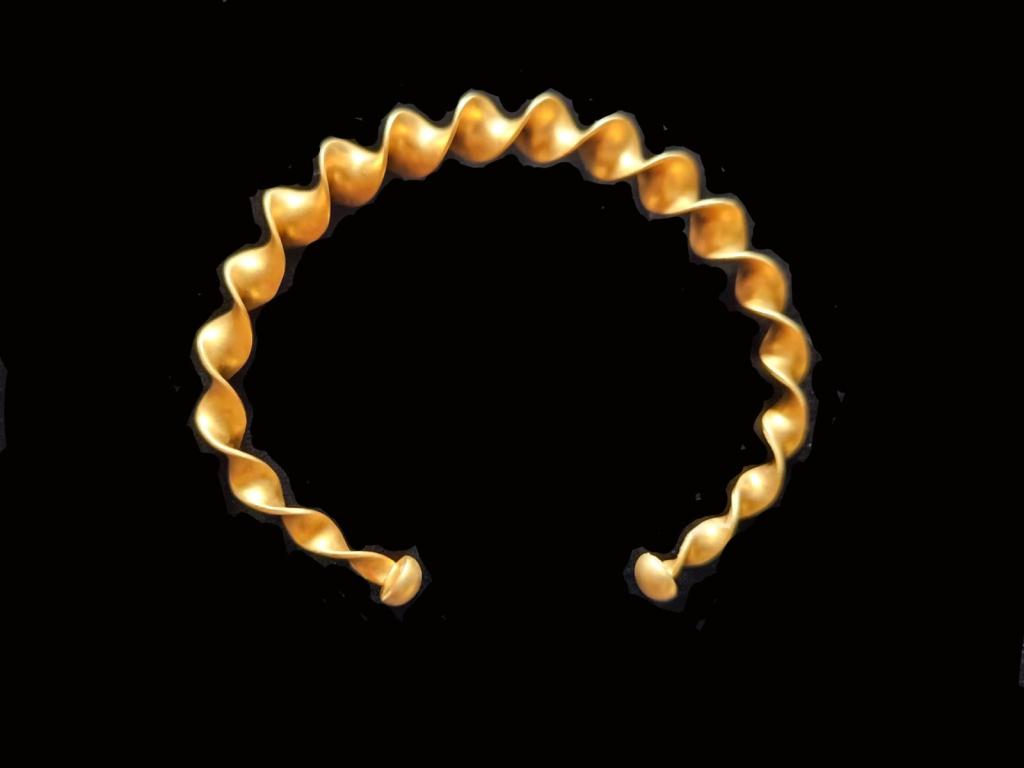
I did not make the artefact for GATE V; it came from the British Museum shop and I was given it. The design is based on a golden Scandinavian bracelet.
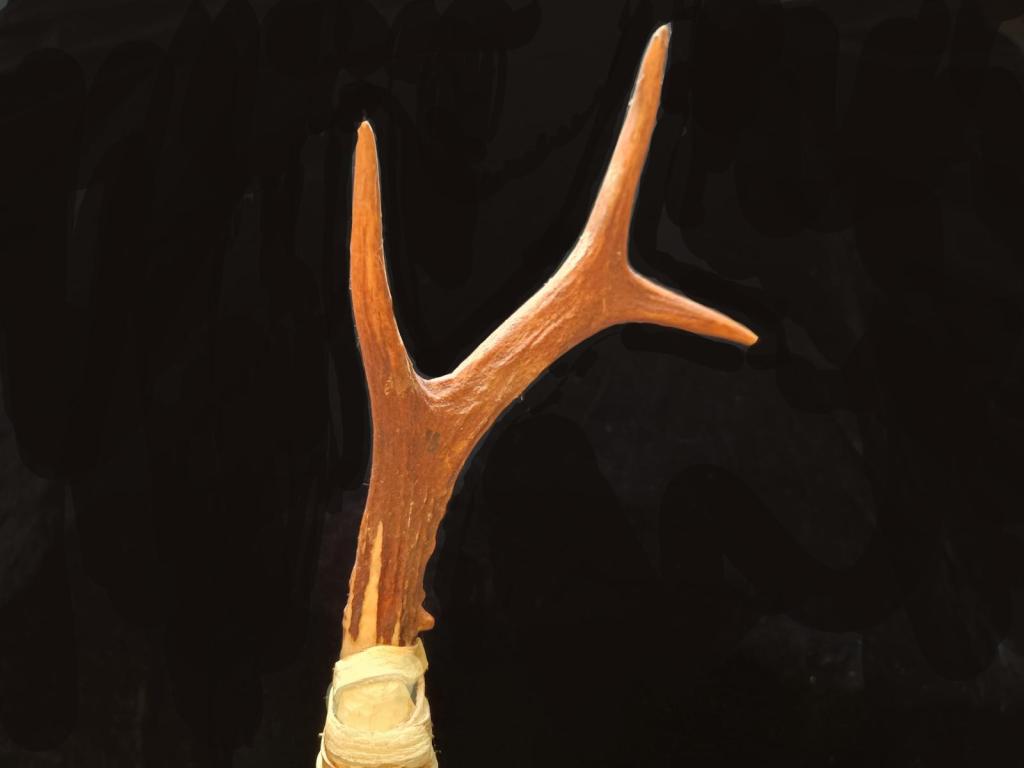
At GATE VI, Inanna hands over her divining rod. This is a deer antler mounted onto a long holly branch. It has been used in the past to rescue bees in summer, when they find themselves trapped behind a window. They hop onto the end quite happily and can be transported to safety outdoors.
Gate VII: silk robes in gold and more purple/blue. Their significance is that they get taken off and there aren’t going to be any photographs of that shared here.
 Lyric Cornish