Sung poetry around the world
It is only when the poet feels the divine spark of inspiration once more strong within him that he deviates from the ordinary course of village life… He removes himself to some lonely spot, there to avoid all contact with man or woman. He eats nothing but the flesh of coconuts, and drinks nothing but water …. For three days he thus purges his body of its vicious humours. On the fourth morning he marks out a twelve foot square on the ground …. This is his “house of song,” wherein he will sit in travail with the poem that is yet unborn. All the next night he sits there, bolt upright, facing east … Dawn breaks. As the edge of the sun’s disc appears over the eastern sea, the poet lifts his hands at arms’ length …. And intones [his invocation to the sun] …. This incantation …. He repeats three times, then rinses his mouth with salt water, thereby making his tongue “pure for songs.” Immediately after …. He goes to the village to seek five friends …. He brings them back to his “house of song.” They carry with them …. withered dancing wreaths, together with the feathers of frigate birds, and of this strange fuel they make a small, acridly smoking fire in the middle of the “house.” The poet sits, in such a position that the smoke may be blown upon him …. and his five friends face him in a semicircle …. Without further preamble, he beings to recite the “rough draft” of his poem …. His friends … interrupt, criticize, interject suggestions, applaud, or howl down, according to their taste…. They will remain without food or drink …. until night falls, searching for the right word, the balance and music to convert [the poem] into a finished work of art …. When all their wit and wisdom has been poured out upon him, they depart. He remains alone again – probably for several days – to reflect upon their advice, accept, reject, accommodate, improve, as his genius dictates. The responsibility for the completed song will be entirely his.
This description of the making of a poem was written by Sir Arthur Grimble, in his memoirs of a working life spent in Kiribati, then known as the Gilbert Islands.
He does not describe practices from the mists of time, but the state of things in Oceania at the turn of the twentieth century. This is not an isolated example.
Around the world, poetry has been seen as a way of acknowledging the vicissitudes of life, of recognising and celebrating events in the moment, and of marking significance. The urge to create can be seen as part of the human condition, as a skill to be practised with a view to professional performance, and as a spiritual condition.
Willard Trask, writing in The Unwritten Song in 1966, cites examples:
‘They say [in Fiji] that, while asleep, they visit the world of spirits, where a poetic divinity teaches them a poem, while, at the same time, they learn a dance corresponding to the song.’
[Inuit] magicians may compose their songs during trances.
‘In the old days – every autumn – we [Inuit people] used to hold great festivals for the soul of the whale, and these festivals were always opened with new songs which the men made up. The spirits had to be summoned with fresh words – worn-out songs must never be used when men and women danced and sang in homage to this great prize of the huntsman – the whale. And while the men were thinking out the words for these hymns, it was the custom to put out all the lights. The feast house had to be dark and quiet – nothing must disturb or distract the men. In utter silence all these men sat there in the gloom and thought, old and young – ay – down to the very smallest urchin, provided he was old enough to speak. It was that silence we called karrtsiluni. It means waiting for something to break forth. For our forefathers believed that songs are born in such a silence. While everyone is trying hard to think fair thoughts, songs are born in the minds of men, rising like bubbles from the depths – bubbles seeking breath in which to burst. So come all holy songs.’
In Laos: ‘Any interesting event calls forth a number of songs. There is very little imitation, very little use of poetic verbal counters. The form is more or less stereotyped as in our sonnet form: and there is as much emphasis on originality of content and of words used for expression as in our own literary tradition. The song-maker is proud of his creation, proud of its originality.’
‘Every one [in the Andaman Islands in the Indian Ocean] composes songs. A man or woman would be thought little of who could not do so. Even the small children compose their own songs. Each person composes his own.’
‘Mapuche songs [in south America] cover a wide range of topics, including … grief
resulting from … failure to have offspring.’
‘So desirable is corpulence as a sexual trait that I have frequently heard men make up songs about the merits of a fat vulva.’
But sometimes putting poetry together is not enough:
I got my poem in perfect order.
On the threshold of my tongue
Its arrangement was made.
But I failed, indeed, in my hunting.
(A Greenland paddler’s song on bad hunting weather)
What is a sung poem? What is a poem? A great conference on poetry came to only one point of agreement on the difference between poetry and prose: in a poem, the line break is determined by the author, and in prose, the line break is determined by the printer.
The language of poetry has been a point of contention for many. According to Wordsworth, it “became daily more and more corrupt, thrusting out of sight the plain humanities of nature by a motley masquerade of tricks, quaintnesses, hieroglyphics, and enigmas.” Wordsworth liked poetry to sound natural. Coleridge, however, seems to have felt that the people most likely to call a spade a spade are the least likely to say anything very creative.
Considering this, Andrew Welsh asks: “If the language of poetry is a selection of natural speech, then what do we mean by “selection,” or by “natural,” or, for that matter, by “speech”? Asking “What is the poet’s language?”, Wordsworth replied to himself by saying that a poet is “a man speaking to men” and his language is “a selection of the language really spoken by men.”
Incorrect use of the word hieroglyphic aside, this idea of poetry as a medium of communication seems fair enough; it assumes that the poet is aware of their own place within humanity and that they are playing with a common language. To which people is the poet speaking? A notional fellow-human, a mythologised self, the spirit of humanity, and/or particular others? Is it a person writing for/to their own perception of their own class of person, for people just like them? Sappho wrote poems addressing Aphrodite, and her poems were sung.
So, what is a sung poem? It is a poem that is sung. In every case cited by Trask (and, despite the terrible subtitle of the book – see the bibliography! – it is a very wide-ranging collection of translated poetry), the content is driven by the words. It couldn’t not be, given that none of the tunes are given. Each sung poem is distinguished, in the book, at least, by its words.
Treating sung poetry as a story – where, when, what, why, who and how – might help to compare and contrast sung poetry with other poetry.
| Written poem | Sung poem | |
| Where | In literate cultures | All over the world |
| When | In exclusive circles, since writing began; to a wide, potentially unknown audience, since the beginning of printing | Most likely for a very, very long time – memorable chanting would have been a useful way of transmitting information in a pre-literate age – which is most of the time that humanity has been on earth |
| What | To be determined | |
| Why | Personal expression;Entertaining others;Prayer;Changing thoughts and feelings of others;Invoking tradition | Personal expression;Entertaining others;Sharing useful information;Prayer;Magic;Changing the group mood;Invoking tradition |
| Who | Created by a limited number; received by anybody who can read | Created by anybody; received by a location-limited number |
| How | Mostly read or heard via third parties (books, those who recite poetry in person or via public media) | Performed in person to a known or knowable audience |
One answer to the question ‘what is a sung poem?’ could be that it is poetry that is highly contextualised by its purpose, agents and means of transmission.
Lyric poetry
The Poetry Foundation (www.poetryfoundation.org) defines lyric poetry as:
Originally a composition meant for musical accompaniment. The term refers to a short poem in which the poet, the poet’s persona, or another speaker expresses personal feelings.
However, as well as the distinction between poem and sung poem, there is another to consider. What is the difference between a sung poem and a song?
The words of a poem have two main aspects:
- Meaning
- Sound
And, being creatures of experience, sounds can have associations which lend meaning, and this includes the sound of words.
Ezra Pound – melopoeia, panthopoeia, orthopoeia – writing triggered by sound, by image, by the arrangement of thoughts. What about rearranging it?
There is onomatopoeic language, there is language that has emotional resonance, there is language that sounds like rhythms.
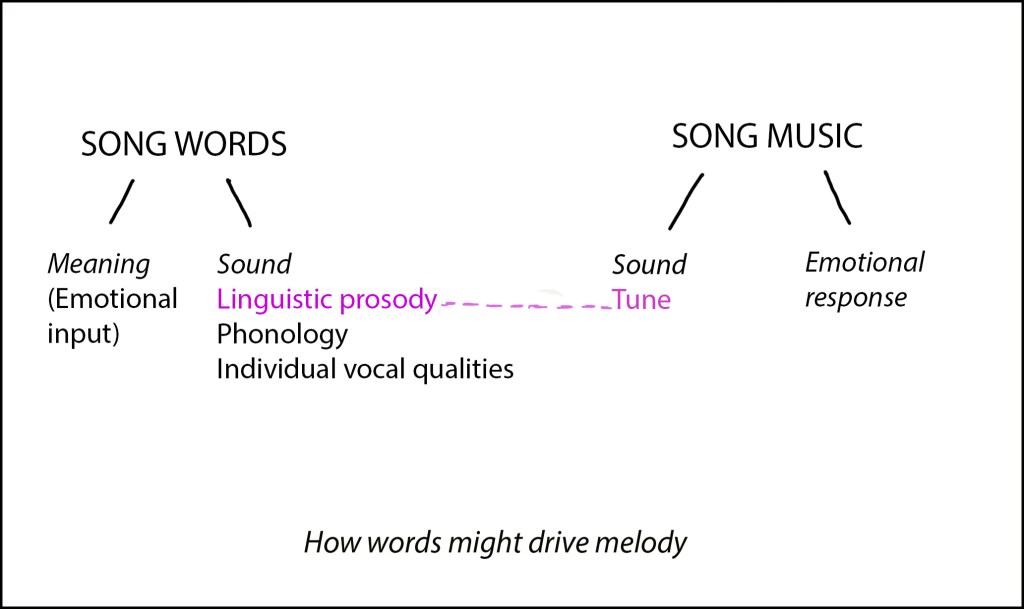
But in sung poetry, the song-poem is driven by the words. The words come first. They might be chosen to sound nice, and perhaps, ideally, they will harmonise sound and meaning.
The music derives then from the sound of the poem out loud. Are words chosen because they will sound great when intoned melodically? Are words chosen primarily for accuracy of conveying information and does the tune have to follow whatever the sound of those words might be?
Does the structure of the poem suggest the musical line? If writing in a set metrical form, that metre drives the rhythm of the sung creation. It also will shape the poet’s word choices. The words in turn may well suggest a melody, especially if the language in which the poem is written is pitch-inflected. Ancient Greek was pitch-inflected and reconstructed poem-music work
From the Experience of Poetry (Attridge, 2019, page 28), as part of a consideration of Homeric epic poetry: We tend to think of a complex metrical scheme and a melody as the end-product of a process of composition; but in imagining Greek heroic song we need to think of them rather as vehicles for composition, providing familiar frameworks that would aid in the conjuring up of words and phrases. Whereas we are accustomed to finding sun language more difficult to grasp than spoken language, the singing of Greek according to this system was probably a means of increasing comprehensibility in front of (or in the middle of) large audiences, exaggerating as it did the normal pronunciation of the words. What the melody would not do, of course, is provide an interpretation of the words; the singer would no doubt find ways of bringing out their emotional qualities by means of vocal quality, speed, and dynamics, but the tune itself was locked into the phonetic features of the text.
It is easy to think of modern music as keeping the meaning in the words and the feelings in the emotional response to the beauty or drama of the music, especially if the lyrics are in a language with which the audience is unfamiliar.
However, might the situation be closer to the ancient Greek model described above, even taking into account the lack of pitch-inflection in English or Cornish? Are writers soulless thinkers and are musicians immune to the sound of language?
The link between words-music-dance-spirit has been an accepted practice from antiquity. In the global north, this changed over time.
Not plainsong, but birdsong!
What have we lost? Why sing a poem? Why sing at all?
Possibly our physiology has the answer. According to Iain McGilchrist, the division of the brain into left and right hemispheres, each with its essential area of expertise, has created a very modern experiential dilemma. We are like birds that have their eyes focused on different things as they feed. The bird’s right eye, linked to the hyper-focusing left hemisphere, is watching the details; after all, picking up tiny bits of grain with one’s beak requires some supervision. The left eye, meanwhile, is giving its expansive right hemisphere attention to whatever else is going on; winking at friendly birds nearby, keeping an eye out for predators or competition etc. The right brain sees the big picture and the left brain sees the details. The hemispheres have other areas of expertise and this has big ramifications for music and language.
We live in the world via our right hemisphere. This is the one that has most to do with music – harmony, melody and complex rhythm – as well as most emotions. We process that experience with our left hemisphere – the one that forms concrete thoughts and is known to handle most aspects of language.
However, we do not have to use language to think or, often, to communicate. McGilchrist speaks of communities whose languages do not have numbers above three, but whose members are perfectly capable of performing complex calculations. In a conversation between two people, the majority of communication is non-verbal and more reliant on body-language and intonation; on the musical prosody of our speech.
Our language capabilities rely on two key parts of our anatomy – the voice apparatus of larynx and tongue etc, that we share with birds but not apes – and the bump at the front of the right hemisphere, that we also share with some apes but not birds.
McGilchrist states that many anthropologists now believe that we did not develop language ability in order to speak, but in order to sing. Like birds, we communicate with song.
If much of our emotional communication is done via the melody of our speech, then it makes sense to communicate feeling by singing it. If we want to describe abstractions or events, objects or people not present, then we need to engage the power of language. But how much more meaningful would that be if it uses the body’s natural empathising apparatus, the right hemisphere that interprets our birdsong? If speech is intended for an audience, then it makes sense to deliver it in a way that is accessible, and that honours our shared participation in the world, itself a preoccupation of a great deal of poetry.
It feels more human and holistic and wholesome. In his book Ways of Attending, McGilchrist concludes that an increased reliance on left-hemisphere perspective is creating social problems. “There would be a simultaneous increase in both abstraction and reification, whereby the human body itself, and we ourselves, as well as the material world and the works of art we have created to understand it, would both become more conceptual and yet be seen as mere things.”
(Interestingly, the musician’s reliance on the right hemisphere is reduced for professional musicians. Whether composing according to the rules of classical music, or practising guitar chord changes like Eric Clapton, things get technical quickly. For performers, catering to the logistics of sound and space also require left brain detail and organisation. McGilchrist says more about this in his book, The Master and the Emissary.)
With this in mind, the integration of experience and ideas about experience, and the sharing of this through song, the poetry of the body, feels like a radical and most necessary social art.
TIME
The way in which a performance engages with time determines what the performance is to the audience.
The audience is not a passive presence. A play is received, as a gift is received or a loan repayment is received. Acting to an empty house is dispiriting, not just because it means the world does not acclaim one as a heroic genius, but because the engagement with the action of the work, literally the performance, is missing.
Similarly, a song is sung to its listeners and the way in which the audience hears the song makes it a very different experience. Wembley Stadium, a folk session or a streaming service; it is not just about the type of music played at the venue, but about the way in which the audience and performer engage at the venue. And what this boils down to is to do with time and intimacy. The stadium and the folk club are both happening in the great now, although the session is a lot more spontaneous; the folk club and Spotify share a degree of intimacy. What the stadium lacks in spontaneity, it makes up for in ritual.
Ritual is about the enactment of intention, willing an idea and bringing it to bear on the world. Some prayer falls into this category; it isn’t about casting magic spells (although it might be), but about engaging with an understanding, a representation of the world in order to shift one’s own perspective, which in turn will change engagement with the world, and vice versa. If an audience is present, the audience participants both witness the transaction and serve as representatives of the world. This has to do with the will of the performer; the pouring forth of the soul in a focused way.
What does this have to do with sung poetry? I think that the key is the moment in time. Generally, as Katrina has indicated in her poem, poets don’t ask other people to write for them, and it is unusual to perform other people’s poems. There is an intimate connection between the poem and its creator. For instance, when Ben Sutcliffe and I wrote the songs for the Breselor Stations of the Cross, Ben, as the composer, became identified with the performance of the music. The writer, however, became identified with the context of the poems and so I was drafted onto the Parochial Church Council in the church where we performed the Stations. Nobody expected Ben to join the PCC.
Historically, the poem was constructed in real time; Trask’s description of the poet making a house of song, a demarcated space in which to construct the poem, bounds space but it is also about the time spent in it. The space has no walls and no amenities; it is simply a way of creating somewhere to be for the duration of a process. The poem might be performed repeatedly in different ways, but it is always an enactment of intention.
Most poems nowadays are read, either by the audience reader, reading to themselves, or by the poet. The reflective, reflexive nature of a lot of poetry that is read out loud creates an intimacy that might not have arisen in the moment; a poem about heartbreak might have been written while the poet thrashed in torment or it might have been a contemplation of a memory or observation of someone else. An audience will often sit quietly and consider the outpouring from the poet as if it were a snapshot of their current state of mind; the poet is equated with the poetry much more than if a singer sings of heartbreak. I doubt that anybody in the audience would assume that Elvis Presley were suffering romantically every time he sang Always on My Mind. If anything, they would be connected to their own feelings through the song, and possibly through the music, with the words creating the meaning for the music to move us to.
Now this is back to the idea of human birdsong; the music is the communication and the words shape where the mind lets the feeling take it. The first human communication was physical body movements, acts of doing, and later our evolved natural birdsong, our clucking with pitch and rhythm, shared feelings. Language was used to describe absent or abstract things, but that came later again. Poetry spans anything that can be spoken of; the abstract, the ethereal, the prosaic. Traditionally, poetry and song have been distinguished by their sound. They might also be compared and contrasted by their purpose and the way in which they happen in the world.
It makes sense that language gave greater shape to our natural urge to communicate with music, and communication is really at the heart of this. A poem that is sung is actually a form of communicated speech, if all speech is music. A song is a construction that can be taken away and reperformed in other spaces, at leisure. A sung poem has an inherent element of communication and performance.
There are archives of recorded poetry and this is a good thing. Some poets were famous for being driven by the sound of the poem; Wordsworth and Yeats are both said to have wandered about muttering potential lines to themselves. This treats a poem like a song; a recording that can be accessed remotely.
A sung poem – the thoughts of the poet communicated with an awareness of the musical qualities of the speech – is what interests me. I want its immediacy of connection, even if it is a pre-constructed poem. I want my audience to connect with the work in the now. If I create work, it presumably has some meaning to me. If I want to share my ideas, I want to share my connection to those ideas, and the relevance of those ideas, as well as what the idea actually is. This brings the ritual element in. What do I have to do to create a space for people to engage with an idea in order for the idea to change both the relationship of the performer/poet (me, in this case) and the relationship of the audience to that idea and the world it lives in?
Perhaps the idea of singing a poem, to follow the natural prosody of the language is backwards. If we sang when we had no words, our birdsong must have a grammar of meaning of its own. Was there once a golden age of dreams in which anybody anywhere, could they only cross the vast distances on foot, could communicate with anyone else? Did language divide as well as bring people together? Does writing about something shift the focus too much from the audience?
Perhaps, rather than examine language to see how it can be re-birdified, it would be helpful to sing without words and find a way of feeding them in. How did our birdsong equivalent evolve into speech so complex that epics could be sung?
My personal take on this, in terms of going forward artistically, is to acknowledge that I can’t un-invent the wheel and I don’t want to. But I do want to make the wheels take me to where the birds sing.
I will still look at the sounds that are articulated in Cornish, and consider how these vary between people, between languages and between song and spoken poem. In fact, I’ve been doing this and the more I do it, the more I come back to the need for the song-poem to exist for the audience in the moment.
Objects could play a part in this. If an artefact is created to accompany a poem, or, in fact, embody the poem, then audience members could handle it as they hear the poem. Objects have been used as items of ritual focus (prayer beads and rosaries, for instance) for a long time. While they might be a way of stilling the mind in prayer, they might also encapsulate an idea, in the way that a wedding ring has a significance far beyond its value as jewellery.
My career has involved writing of one sort or another for decades, but I would say that I am primarily a visually-minded person. Visual and abstractions. Plato’s cave makes sense to me and I do wonder if all of the fighting over philosophical viewpoints really comes down to how different people think. Sometimes a change of perspective is what is needed. Not a different belief system, but a different way of sitting with it.
A quadrant chart for performed ideas, with time and intimacy as the axes:
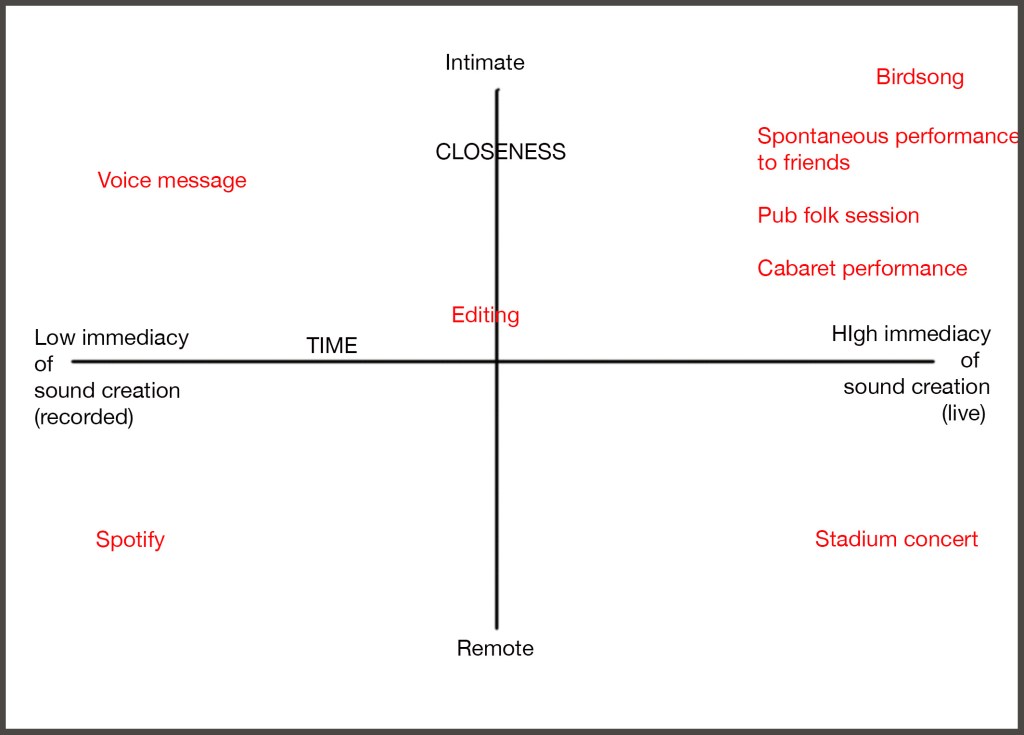
The streaming services exaggerate the degree of remoteness of recorded music. It may be why vinyl records, while more hassle than Bluetooth streaming, are popular again. Although pre-recorded, they have a feeling of being real. Although the object that can be touched is a recording, it is experienced, as an object, in the here and now.
I am convinced that many people want to engage with the world more immediately. If a person struggles after leaving university, is it really the demands of a job that bother them, or do they miss a big community where everybody has a place? At university, you can sit in a library all day and still feel part of a bigger picture; the same is not true of many jobs, where there may be a sense of relationship to very little.
Almost all images of allegedly glamorous occupations involve a perception of free choice and living in the moment. (It may not always be an accurate image; touring musicians can be like beasts in harness, and not fancy-free at all, but they do generally love what they do.) We cannot choose to have everything we want at all times, but perhaps if we live in the moment more, we may not want the same things. The cure for feeling sucked in to consumerism is to do something creative, or get outdoors, and to make the meaning that you really want; it makes for much more exciting engagement with the world.
So, there are different ways of approaching the question ‘what is a sung poem?’
We can consider the distinction:
- Structurally, in terms of acoustics and linguistics, prosody etc
- In terms of purpose, which has historic, anthropological and possibly spiritual aspects (in terms of the relationship between the reflexive human consciousness and the world it perceives), and which could lead to practical applications
I hope to do both.

