…ὀρράνοθεν
…κατίοι[σα
δεῦρυ μ†μ’ ἐς Κρητας .π[ ]ναῦον
ἄγνον, ὄππ[αι δὴ] χάριεν μὲν ἄλσος
μαλί[αν], βῶμοι †δ’ ἔνι θυμιάμε-
νοι [λι]βανώτῳ·
ἐν δ’ ὔδωρ ψῦχρον κελάδει δι’ ὔσδων
μαλίνων, βρόδοισι δὲ παῖς ὀ χῶρος
ἐσκίαστ’, αἰθυσσομένων δὲ φύλλων
With a Cornish take:
This was my first attempt to create a song directly from the sound of a spoken poem. It should come as no surprise to learn that I did not write the original words. The very loose translation into Cornish (from a translation to English) is mine, and that is what I set to music.
After this, I wanted to consider how to enhance the spoken word with music in a more systematic fashion. Understanding what is happening would make for the most natural-sounding sung poem.
First of all, I wanted to consider what words will be easiest to sing.
‘Singability’, according to the singers I asked, comes down to:
- Vocalic openness – how open or closed vowel sounds are, which affects ease of singing
- Lyric diction – the clarity and suitability of pronunciation in sung text
- Prosody – how the natural rhythm, stress, pitch, duration and loudness of language fit into the melody
The vowels are the easiest to sing, but they have a hierarchy of their own.
Of the Cornish vowels, the easiest is [a]. The jaw drops and is nicely relaxed.
This is followed by [e] a mid-mouth vowel.
Hardest to sustain is an [i], a vowel made high in the vocal tract; the muscles need to tense to hold this position.
Cornish has a lot of /n/ in it. Is this a bad thing? Not necessarily; while the nasal resonance detracts from the oral resonance, it is really just a different quality of sound. As spoken Cornish has exactly the same degree of /n/ as when sung, the singing of it will reflect the nature of the language well. If the aim is to sing classically, it won’t sound like Italian, but then nor does German, which is another key operatic language. German input is sometimes blamed for the messiness of English, but really the problem must be that English is a blur of many languages; vowels and diphthongs mushed up all over the place. If language is birdsong, English probably has a good deal of cuckoo in it, and also a degree of corvid.
Sound, meaning, feeling
We might assume that words, as narrative, give meaning and music gives the feeling, through the sound. But is it this simple?
Some words have a meaning that induces a lot of feeling (I love you / You’re fired). But words have sound as well as meaning.
And what determines the sound? Lyrics have a prosody. Music has a sound, and a prosody. Both induce feeling. Perhaps music induces emotion in a kind of reflex arc – we don’t have to intellectualise it. Perhaps words have more obvious meaning. We associate meanings with musical sounds as well, however, just as we arbitrarily attach meanings to the sound of words. If someone starts playing the theme tune to: Eastenders, Doctor Who, Black Beauty, a western, you pretty much get in the zone for that thing. Those are by association. But words and phrases can also be used to invoke a style or sentiment: ‘freedom and democracy’, ‘alternative’, ‘back to basics’. None of these say very much, without further elaboration. They are used as codes to direct people to complex sets of associations.
Western music tends to see slow music in a minor key as sad. Feeling comes from both the meaning of the words and the sound of the music. How does the actual sound of the words interact with their meaning and the sound of the melody? The key question is; is all of this automatically encoded into speech? Because, if it is, then it should transfer fairly naturally into song, if we let the prosody of the speech drive the melody.
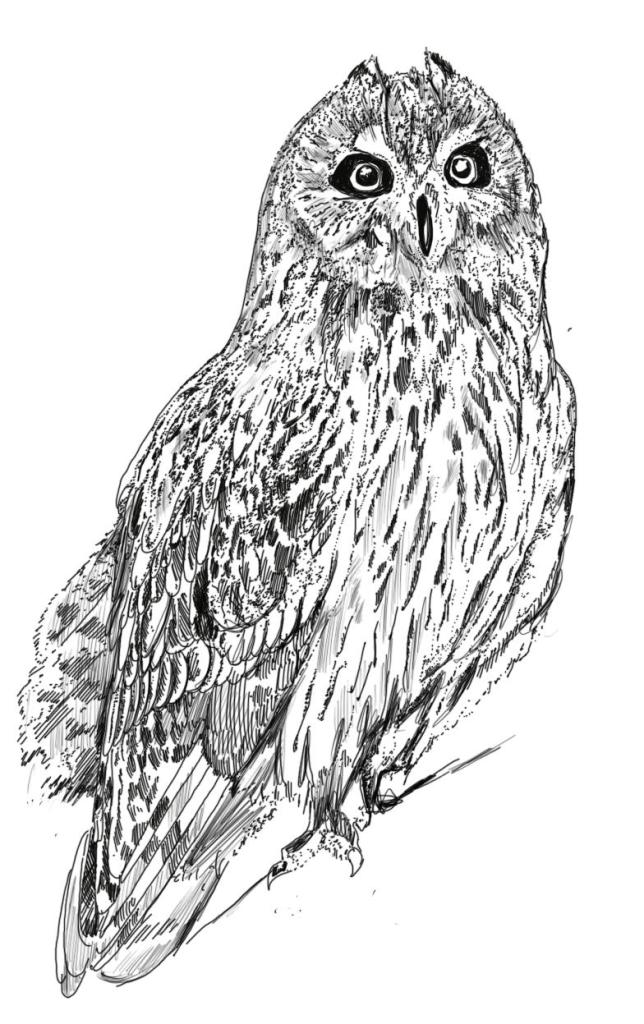
Practical example: Hymna dhe’n Oula Gallos
Here is a poem written at the Espronceda Institute in Barcelona in May 2024.
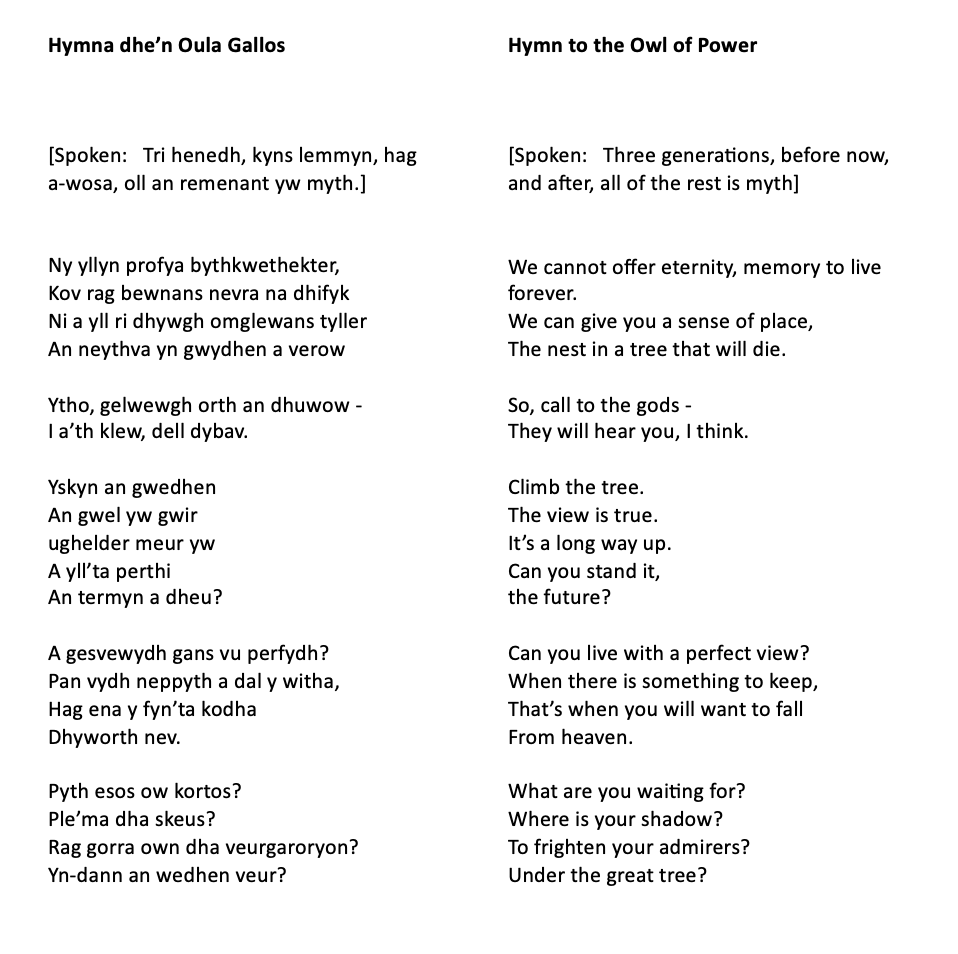
Let’s turn the poem into a sung poem.
- Read it out loud with feeling. Record it. Here it isː
- You can put it through voice tuning software at this point, if you like. As well as showing the notes of the speech in the waveform, the software will let you tweak soundbursts, so you can move things to the nearest semitone and cut out sliding sounds.
- Listen to it in small bursts and re-record it, ‘singing’ the sound of the speech. Singing here means making the pitch levels more discrete and exaggerating the length of syllables to sound more note-like. It may sound like stylised speech, but this is fine. It’s a little as if someone is singing speech in the narrative segments between arias in an opera. Here it is, ‘sung’ very loosely and tunelessly. The idea is not to sound great, but to let yourself feel how the pitch and rhythm flow from the language.
Here it is again, this time ‘sung’:
Expect it to sound weird and out of tune. You are following a potential, not nailing down an absolute.
- From this, you can make it sound less uneven, which is helpful if you want to create a musical accompaniment. One way to do this is to score what you’ve sung. As you go, unless you’re very keen on complex rhythms etc, you will probably automatically adjust things to make it more straightforward. The stylisation will make it easier to remember than a very complex or arbitrary sound.
- When scoring, it is helpful to use the time signature to reflect the stress emphasis. E.g.
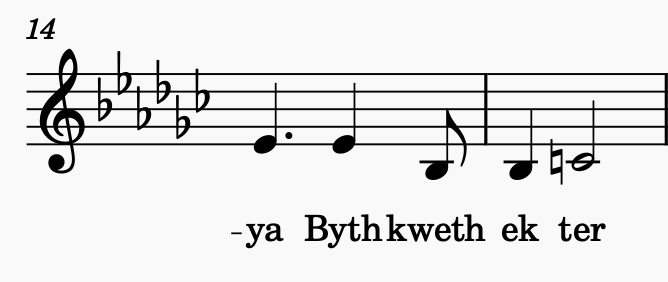
In the word bythkwethekter (eternity), the stress is on the third syllable, ‘ek’, so it is at the beginning of the bar. It isn’t the longest note, however, and that’s fine, as Cornish is not stress-timed. Raising the pitch would also work.
This is not a scientific process, but a way of accessing an artistic approach to the material. One consequence is that as the ‘tune’ develops, it may well depart increasingly from the actual pitch variation of the speech. For example, in the Sappho extract at the top of this page, you can hear the spoken line and the sung line. They diverge as they go on, once a ‘feel’ for the poem settled, it drove the line.
- Re record the sung poem again. This time it is less experimental and more a formalisation of the arrangement so far created.
- Accompaniment. The anticipated performance style will probably determine how you choose to accompany it.
If you are singing a long poem live with your own accompaniment, you may want to use a simple live accompaniment; strings or a hand drum. A looper would also be interesting, and would allow other instruments, ones that can’t be played while singing, e.g. an aulos, if you want something nice to go with a lyre, or any other woodwind.
If it is being recorded, for instance, as part of a film, you can use multiple instruments, Apple loops etc.
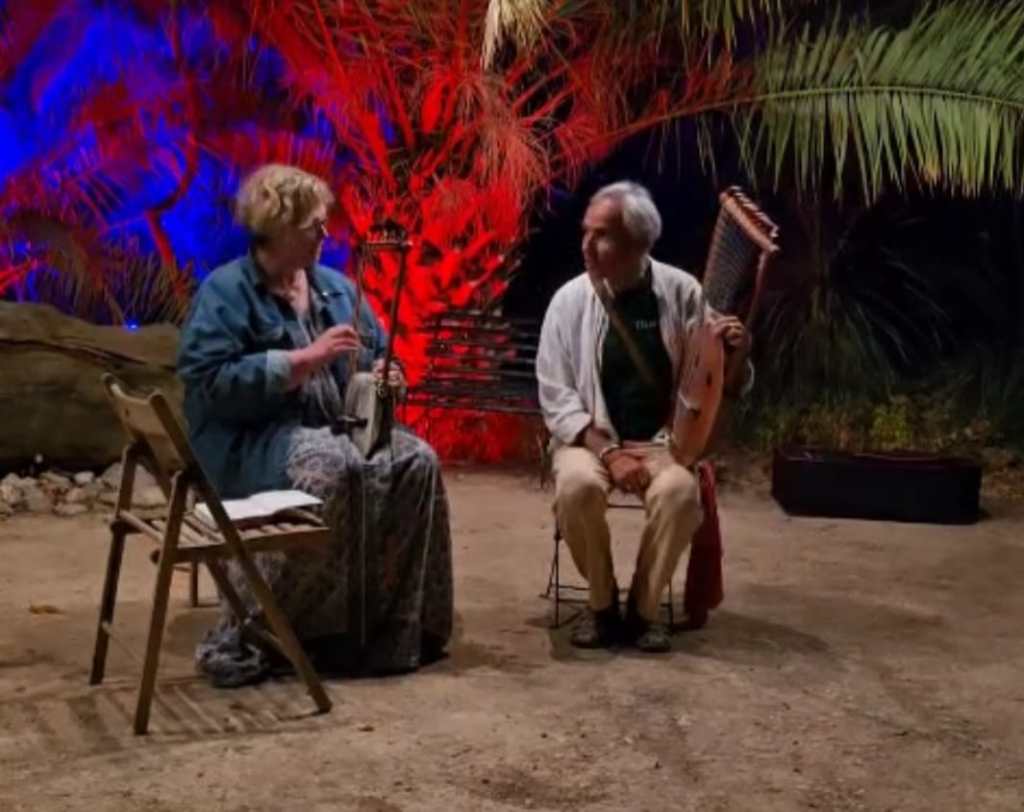
A lyre lesson with Thanasis Kleopas in Aegina, May 2025ː
 Lyric Cornish