TEXTUAL ANALYSIS
- Looking at phonemes
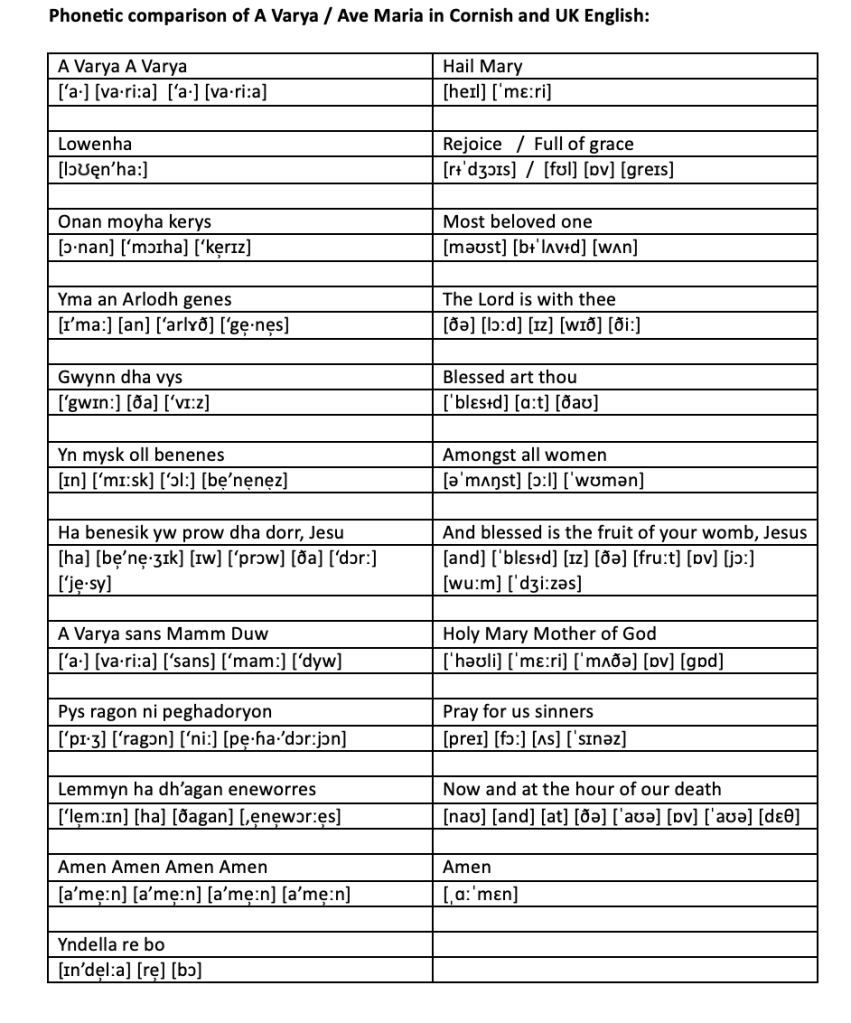
Method: each of three poems/songs in Cornish was transliterated into the International Phonetic Alphabet (IPA). The English translations of the three were also transliterated into IPA. This way, the Cornish and English texts can be compared, because the written letters (graphemes) of the IPA texts represent the same sounds (phonemes). The prevalence of different sounds can then be compared for the two different language versions of the same song/poem.
The first text is the Cornish version of Ave Maria/Hail Mary; my translation. A literal English translation is used for the IPA comparison. e.g. the Hail Mary said in church starts like this:
Hail Mary
Full of grace
The Lord is with thee….
The Cornish version – the isolated tenor part can be heard below – is:
A Varya
Lowenha
Onan moyha kerys…
Which translates as:
Mary! (but I’ve kept the Hail as it is implied)
Rejoice
Most beloved one…
*The translation was made several years ago, and has been recorded since. It wasn’t created for the purposes of this investigation.
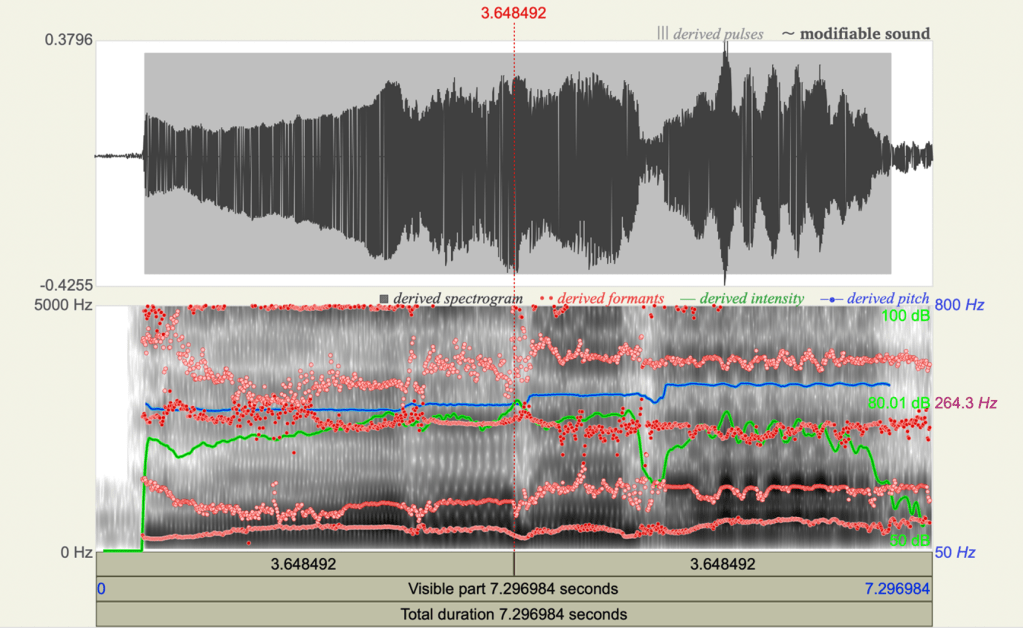
I used the ‘rejoice’ (lowenha) line in my original* translation to Cornish after reading about old versions of the religious song, which included this. The ‘lowenha’ has a diphthong and two vowels, which are all drawn out, as the word takes up an entire line’s worth of time. The vowel/diphthong sounds made – /ɔʊ/ /e̹/ /a/ – involve letting the air flow through the vocal tract in three tongue/jaw/lip positions. For the diphthong, the mouth is very rounded, with the tongue in a mid position. The e vowel is also mid, but less rounded, and it runs through to the a sound, which has the tongue in a lowered position. The overall effect is a fluid modulated vowel over a whole line, running gradually wider. The vowels make much less of a difference, and, although the h is a glottal sound, it is unvoiced. ‘Lowenha’, as sung:
The three long vowel/diphthong sounds make for much smoother singing than the English word, ‘rejoice’: [rᵻˈdʒɔɪs] in which the emphasis is on the /dʒ/ and the /ɔɪ/ i.e. the ‘joy’ part of the word. It feels less fluid
in the mouth. /ɪ/ is not a particularly long I sound, and the /ɨ/ is barely there.
For the /ɔi/ diphthong, the ɔ sound is a mid/back/rounded placement, while the ɪ is
High/front/unrounded. As something close to a single sound, they run into each other quickly and there is not a clear flow of air through on a single vowel. Similarly, the /dʒ/, which sounds like the J in ‘joy’, is a mashup of consonants. It would be difficult to make ‘rejoice’ sound as smooth as ‘lowenha’.
So, for analysis, I started by counting the number of words in each song/poem, for both languages. Then the number of diphthongs, single vowels and consonants. I did not include the letters/words in the titles.
The three texts areː
– A Varya / Hail Mary.
– A poem by Katrina Naomiː dhe’n dyffrans yntra kan ha bardhonek. In English; on the difference between a song & a poem. Translated by Katrina Naomi.
The full text is shown below on this page, within the acoustic analysis section.
– A poem by Fiona O’Cleirighː Hymna dhe’n Oula Gallos. In English; Hymn to the Owl of Power. Translated by Fiona O’Cleirigh, and edited by Esme Tackley.
The full text is shown under the ‘Practical Experimentation’ tab.
Incidence of phonemes:
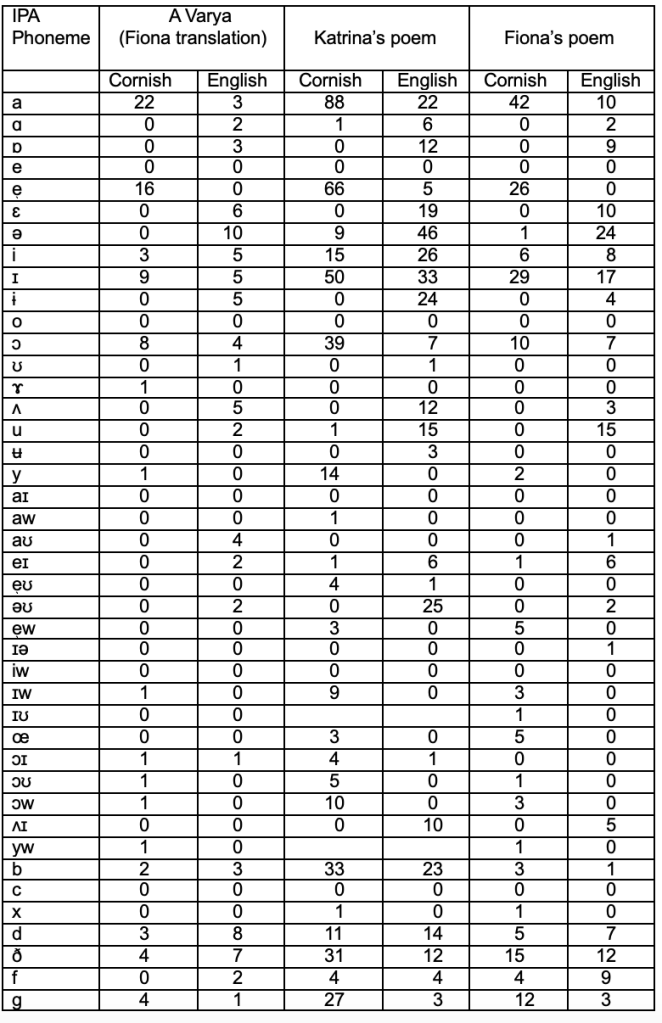
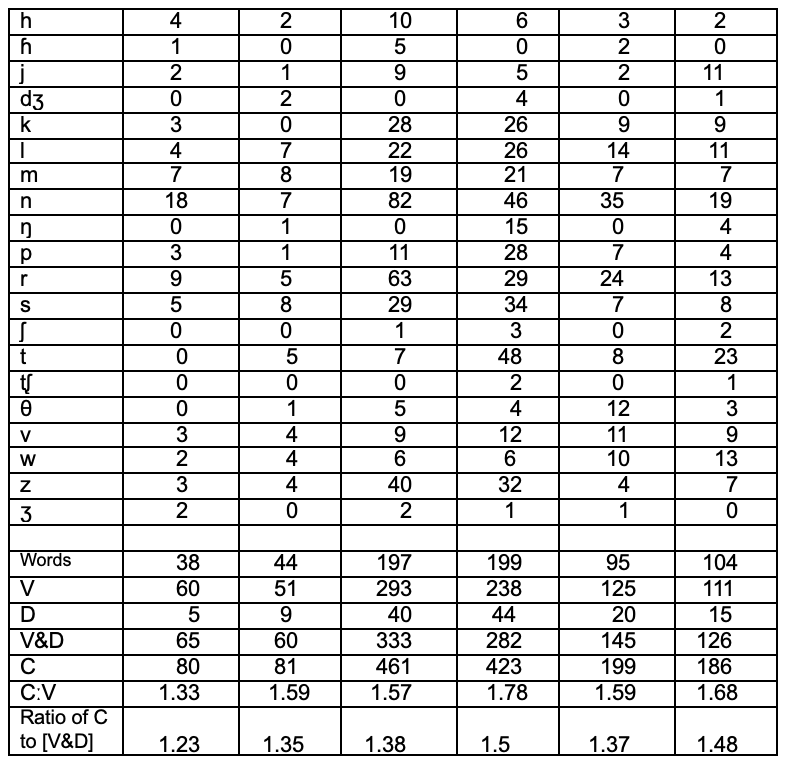
In all cases, the ratio of consonants to vowels/diphthongs is higher in the English version than the Cornish version. For the two longer poems, the ratios are very close.
The ratio of consonants to vowels/diphthongs is 1.38 in Katrina’s Cornish poem, and 1.37 in Fiona’s. For Katrina’s English poem, the ratio rises to 1.5, and for Fiona’s English poem it is 1.48. A Varya also shows a rise for English; 1.23 for Cornish and 1.35 for English. In each case, there is an increase of between 0.11 and 0.12 in the ratio of C to [V+D] for the English version.
This is a very tiny sample (which nevertheless took days to do), but it feels like a nod towards significance, especially as the two translations were by two different people. The similarity of ratios in the two languages is more likely to be a feature of the languages themselves than a quirk of a single translator.
Vowel distribution:
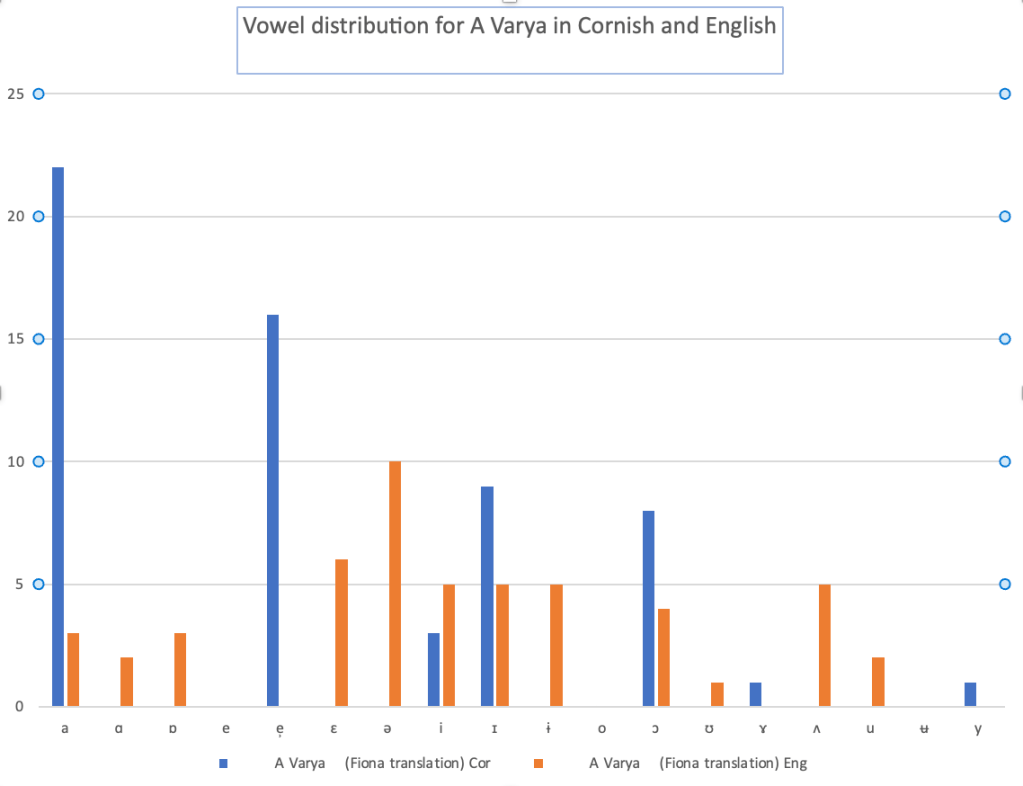
What we can see immediately is that Cornish (in blue) has its vowel sounds concentrated over a smaller range; in order of prevalence, they are /a/ /e̹/ /i/ /ɔ/ /i/ /y/ /ɤ/.
English (orange) vowels are more widely spread across a range. The three A letters /a/ /ɑ/ /ɒ/ are almost equally prevalent. We hear that the commonest written letter in the English language is E and, yes, here the most prevalent vowel is the schwa, /ə/.
In terms of where the sounds are producedː
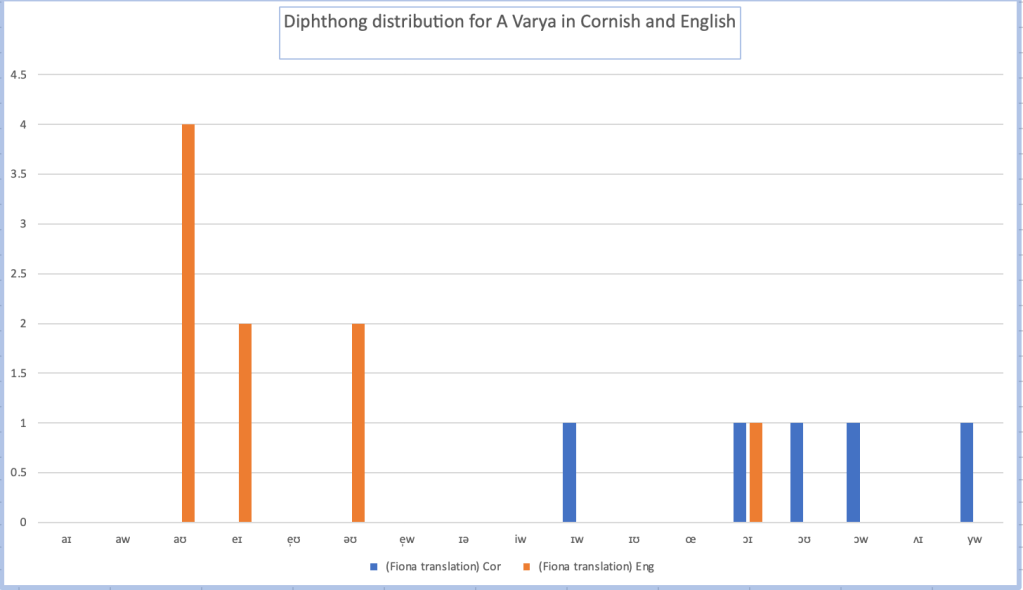
For diphthongsː
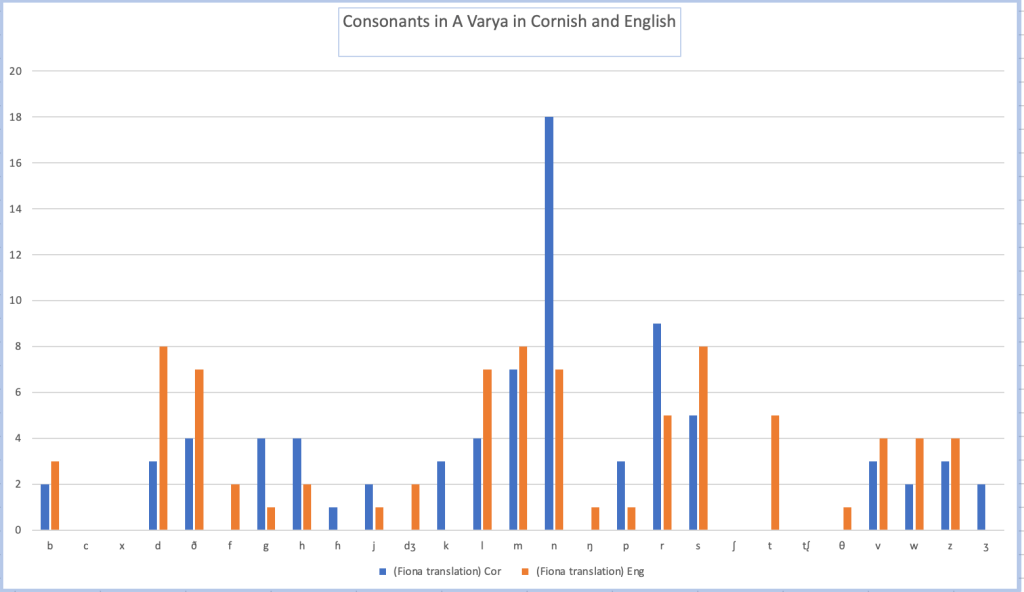
The most dramatic consonantal difference is the prevalence of /n/ in Cornish; more than double the instances of any phoneme in English. This nasal sound may well show up in the production of nasal formants in the Cornish language sound samples. The most common phonemes in the English text areː /d/ /m/ /s/. Sibilance can be problematic when singing. Operatic singing in Italian tends to replace some of the less well-placed /n/ sounds with either a regular bilabial /m/ or /ɱ/, a labio-dental alternative to /m/. (Try saying ‘m’ with your tongue just behind your upper teeth. It loses the jamminess of a proper /m/ but it also doesn’t have so many of the nasal qualities of /n.)
There is a very helpful source for arias transcribed into IPA at www.elisaramon.com
Elisa gives an example of the assimilation of /n/ː
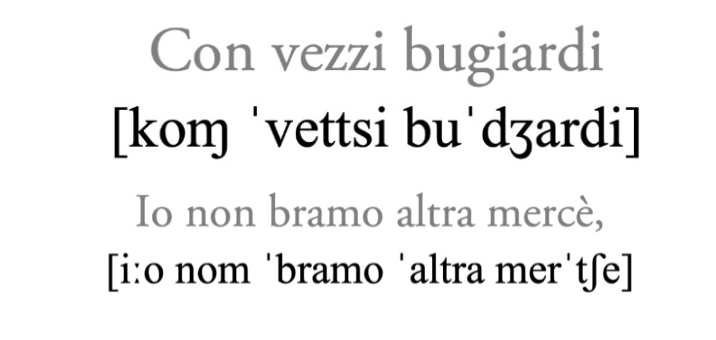
Counting the consonants, vowels and diphthongs in Italian and comparing to an accepted English translation for the first nine lines of Bellini’s Casta Diva aria is more dramatic.
[‘ka.sta] [‘diːva] [ke] [in.ar.’djɛn.ti]
[‘kwe.ste] [‘sa.kre] [an.’tiː.ke] [‘pjan.te]
[a] [nnoːi] [‘vɔl.dʒi] [il] [bɛl] [sɛm.’bjan.te]
[‘sɛn.tsa] [‘nuː.be] [e] [‘sɛn.tsa] [veːl]
[‘tɛm.pra] [o] [‘ddiː.va]
[‘tɛm.pra] [tu] [de] [‘kɔː.ri] [ar.’dɛn.ti]
[‘tɛm.pra] [aŋ.’koː.ra] [lo] [‘dzɛː.lo] [aːu.daː.tʃe]
[‘spər.dʒi] [ub] [‘ter.ra] [‘kwel.la] [‘paː.tʃe]
[ke] [reɲ.’ɲaːr] [tu] [faːi] [neːl] [tʃɛːl]
And in Englishː
[‘ka·sta] [‘diːva]
[pjʊə] [ˈɡɒdɛs] [huːz] [ˈsɪlvə] [ˈkʌvəz]
[ðiːz] [ˈseɪkrᵻd] [ˈeɪnʃnt] [plɑːntz]
[wiː] [təːn] [tuː] [jɔː] [ˈlʌvli] [feɪs]
[,ʌnˈklaʊdᵻd] [and] [wɪˈðaʊt] [veɪl]
[ˈtɛmpə] [əʊ] [ˈɡɒdᵻs]
[ðə] [ˈhɑːdn̩ɪŋ] [ɒv] [juː] [ˈɑːdnt] [ˈspɪrɪtz]
[ˈtɛmpə] [juː] [bəʊld] [ziːl]
[ˈskatə] [piːs] [əˈkrɒs] [ðə] [əːθ]
[ðaʊ] [meɪk] [reɪn] [ɪn] [ðə] [skʌɪ]
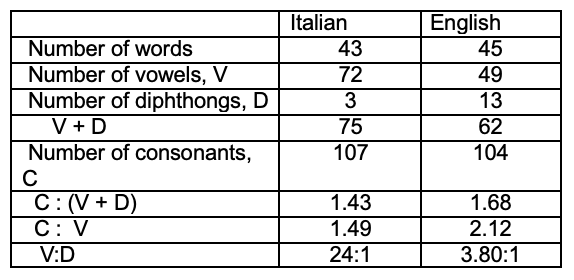
The ratio of consonants to vowels/diphthongs is dramatically lower for Italian than for English. The proportion of vowels compared to diphthongs is much greater for Italian; 24 times as many vowels as diphthongs, compared to 3.80 times as many in English.
Although clear vowels lend a purer sound, which is ideal for opera*, diphthongs can give colour to a song, for example emphasis in a chorusː
In the English shanty, What shall we do with the drunken sailor?, [ˈəːli] [ɪn] [ðə] [ˈmɔːnɪŋ] is actually sung with an introduced diphthong, [ˈəːlʌɪ] [ɪn] [ðə] [ˈmɔːnɪŋ]. It is more idiosyncratic and encourages a bit of swing.
* Note: German is also an operatic language – with lots of diphthongs – and that works well.
Looking at the other two poemsː
The vowel spread is the same on both Katrina’s and Fiona’s poems. For Katrina’s:
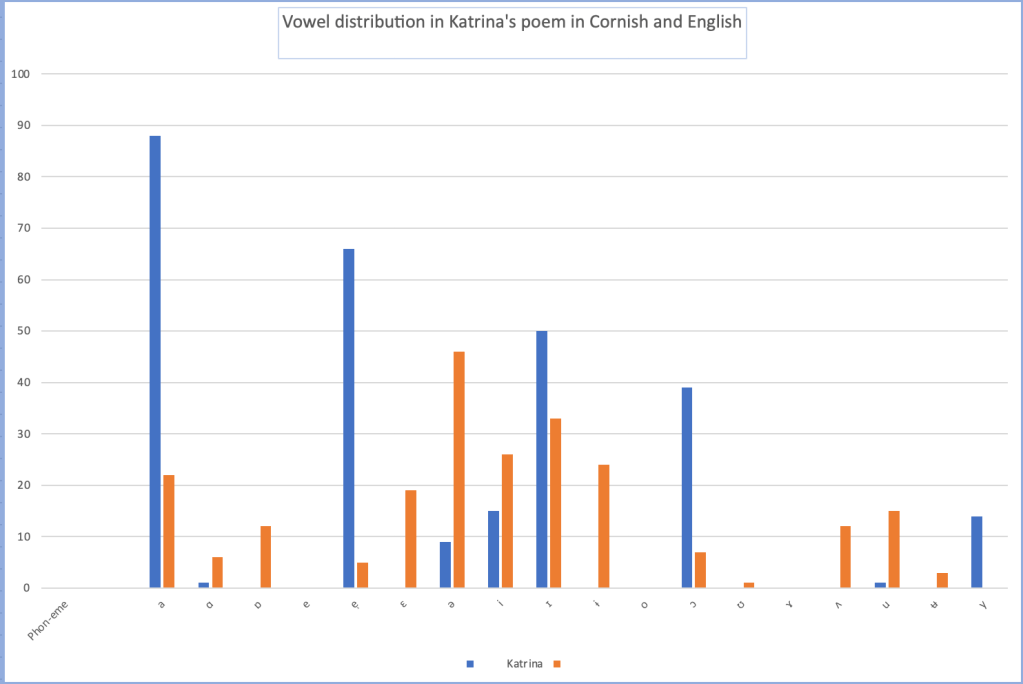
The blue bars represent the Cornish phonemes; the orange represent the English.
For Fiona’s poemː
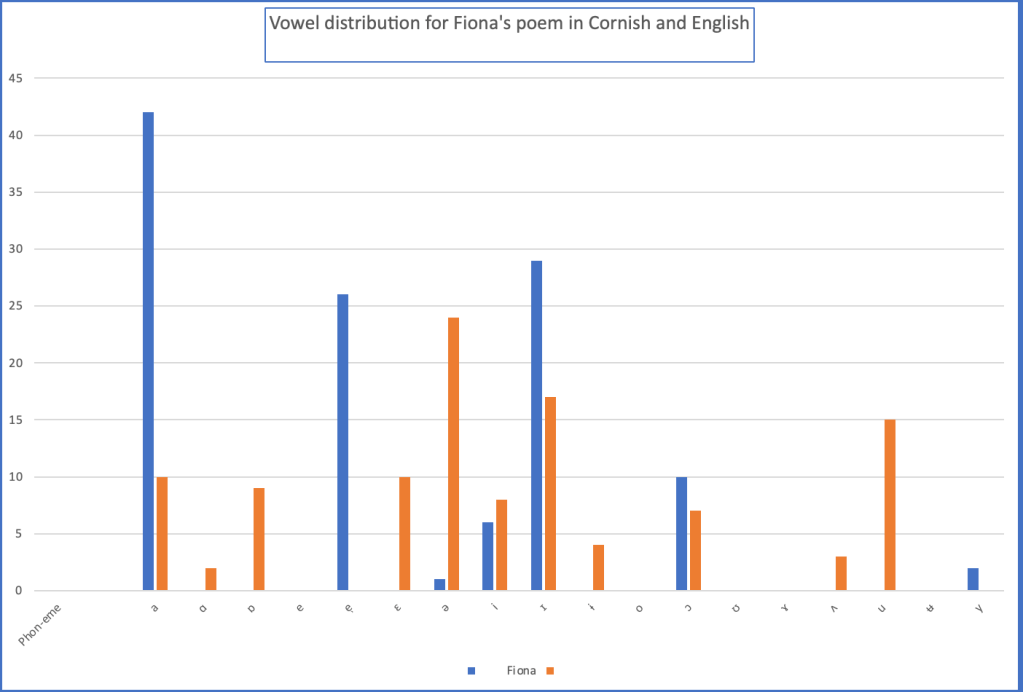
Fiona’s poem has a higher count for /ɪ/ but otherwise a similar pattern
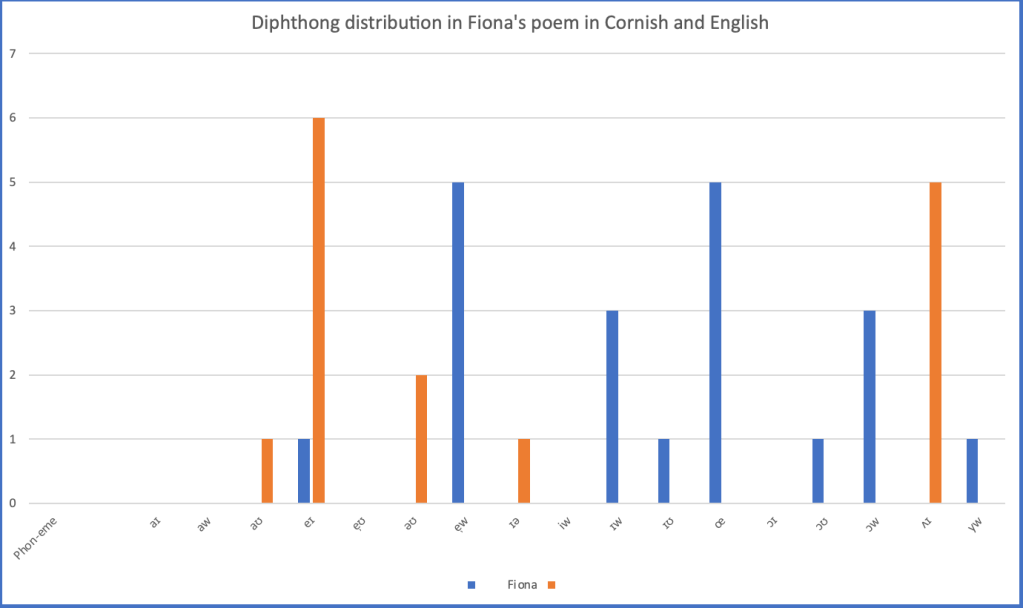
Moving on to diphthongs, Katrina’s poem:
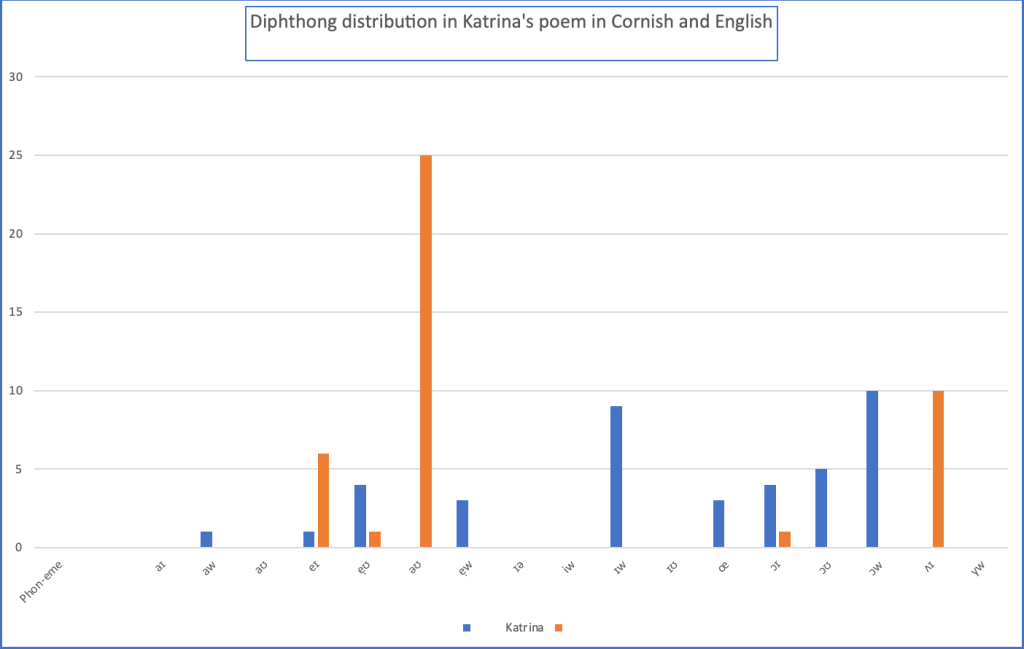
Fiona’s poem:
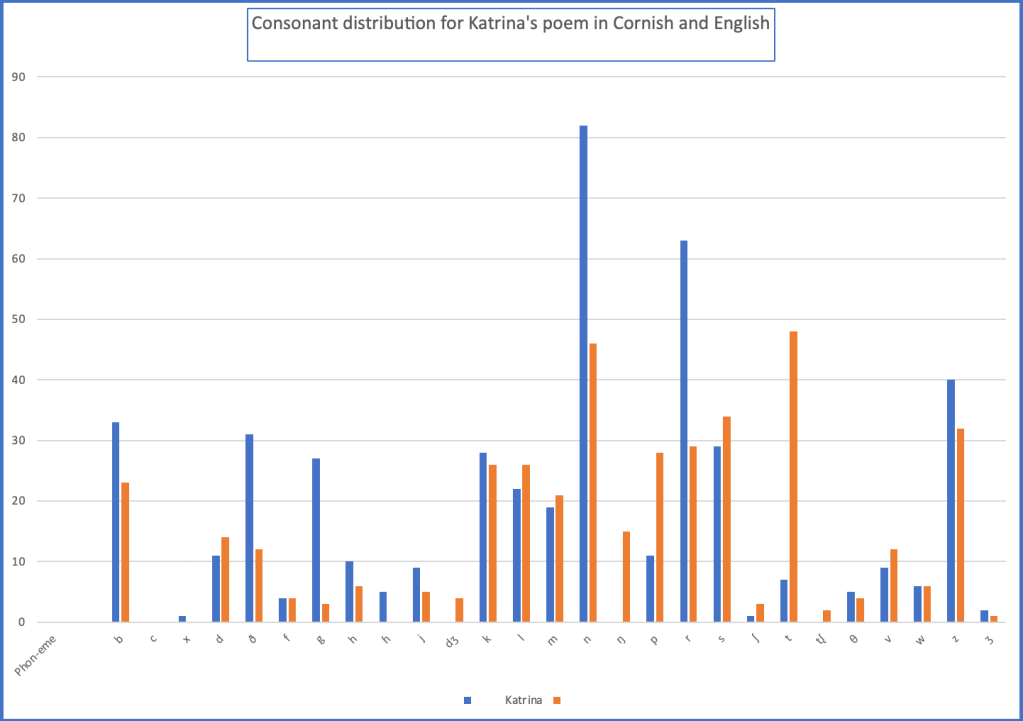
And for consonants, Katrina’s poem:
And for Fiona’s:
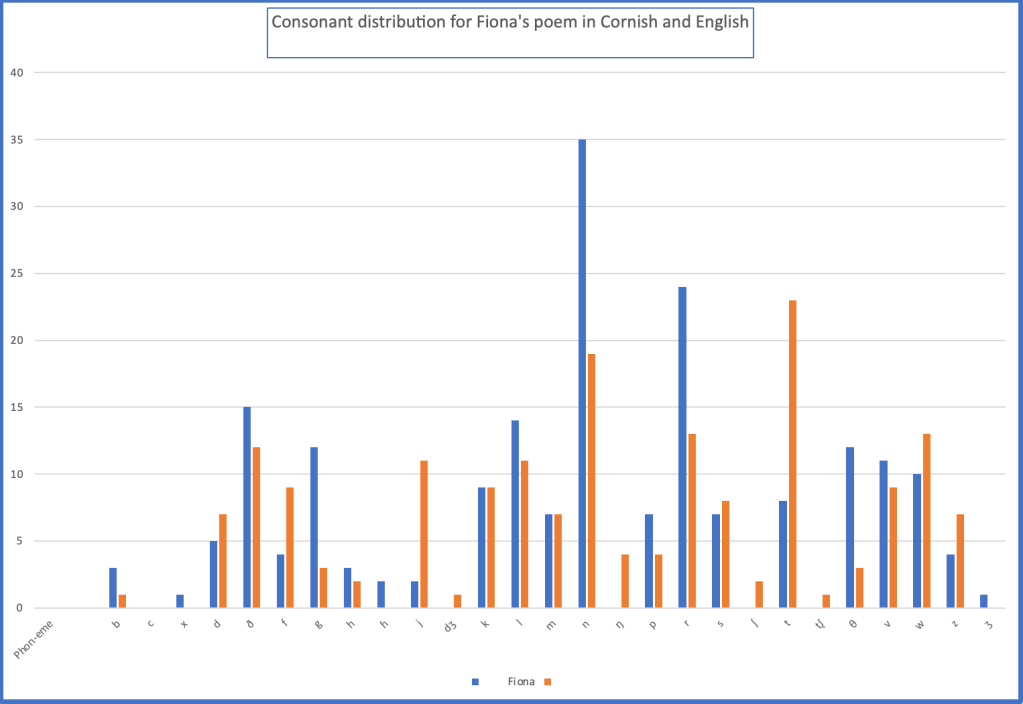
Both of the consonantal charts show the prevalence of /n/ followed by /r/ in the Cornish texts.
Both show a much greater use of /t/ in the English texts over their Cornish counterparts.
Otherwise, the spread of consonantal use is not wildly different between the two languages in either chart.
Acoustic analysis
The investigative prompts are given below.
The wav files needed to be broken up into samples for analysis as Praat is best for short phrases.
How were these chosen:
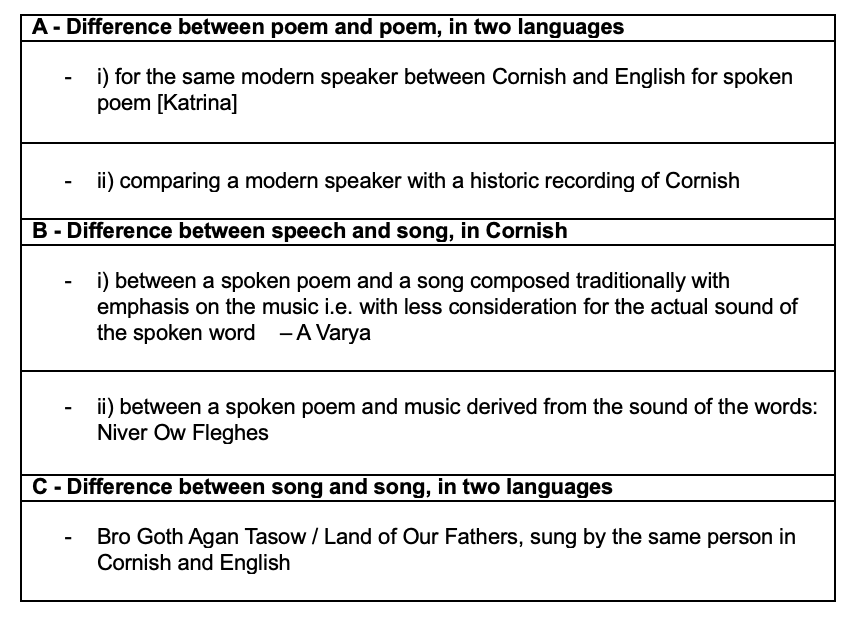
A – Difference between spoken languages
The following poem was written and read, in Cornish and English, by the poet Katrina Naomi:
dhe’n dyffrans yntra kan ha bardhonek
[ðən] [‘dɪfrans] [‘ɪntra] [‘kaːn] [ha] [bar’ðɔ·ne̹k]
goslowgh
[gɔ·z’lɔʊɦ]
molgh dhu a yll bos an desten a vardhonek & kan
[mɔlɦ’ðyː] [a] [ɪl][‘bɔːz] [an] [‘de̹·ste̹n] [a] [var’ðɔ·ne̹k] [ha] [‘kaːn]
kan yw gwirhaval moy bos senys
[‘kaːn] [ɪw] [gwɪr’ha·val] [‘mɔɪ] [‘bɔːz] [‘se̹nɪz]
gwirhaval moy unya an dus marnas yw an Nos Burns
[gwɪr’ha·val] [‘mɔɪ] [‘y·nja] [an] [‘dyːz] [‘marnaz] [ɪw] [an] [‘nɔːz] [‘Byrnz]
anusadow yw performya bardhonogow dhe dus erel
[,anys’a·dɔw] [ɪw] [pe̹r’fɔrmja] [barðɔ·’nɔgɔw] [ðə] [‘dyːz] [‘e̹·re̹l]
nyns yw bagas ilow dhe’n vowes po maw yn bardhonieth nyns yw berdh yn skoodhyans
rag bardh
[nɪnz] [ɪw] [‘ba·gaz] [‘i·lɔw] [ðən] [‘vɔʊe̹s] [pɔ] [‘maw] [ɪn] [,barðɔn’nɪ·e̹θ] [nɪnz] [ɪw] [‘be̹rð] [ɪn] [[sko·ðjans] [rag] [‘barð]
kanoryon yw usys dhe omwiska gwell tybyn Shirley Bassey
[ka’nɔ·rjɔn] [ɪw] [‘y·zɪz] [ðə] [əm’wi·ska] [‘gwe̹l] [‘tɪ·bɪn] [‘ʃe̹rliː] [‘basi·]
kaner sewen dendil kemmys moy ages bardh meurgerys
[‘ka·ne̹r] [se̹·we̹n] [‘de̹ndɪl] [‘ke̹mːɪs] [‘mɔɪ] [ag’e̹ːz] [‘barð] [mœr’ge̹·rɪz]
bardhonek blas a sevi an sugen korryns rudh dre gan
[bar’ðɔ·ne̹k] [‘blasːz] [a] [‘se̹·vi] [an] [‘sy·ge̹n] [‘kɔrːɪnz] [‘ryːð] [dre̹] [‘gaːn]
goslowgh
[gɔ·z’lɔʊɦ]
kan a yll drehedhes an notennow ilow ughel
[‘kaːn] [a] [ɪl] [dre̹’he̹·ðe̹z] [an] []nɔ·te̹nɔw] [‘i·lɔw] [‘y·ɦe̹l]
nyns yw bardhonogow heudh pub prys
[nɪnz] [ɪw] [barðɔ·’nɔgɔw] [‘hœːð] [pəp’prɪːz]
kan yw benow
[‘kaːn] [ɪw] [‘be̹·nɔw]
bardhonek yw gorow yn yeth ma moyha dewek
[bar’ðɔ·ne̹k] [ɪw] [‘gɔ·rɔw] [ɪn] [‘je̹ːθ] [ma] [‘mɔɪha] [‘de̹ʊe̹k]
an dhew re bons hwilas tenna pries a reydh neb
[an] [‘ðe̹w] [re̹] [bɔnz] [‘hwi·laz] [‘te̹nːa] [‘pri·e̹z] [a] [‘re̹ɪð] [‘ne̹ːb]
bardhonek a yll dos ha bos kan
[bar’ðɔ·ne̹k] [a] [ɪl] [‘dɔːz] [ha] [‘bɔːz] [‘kaːn]
berdh ny pysi nebonan aral a skrifa ragdha
[‘be̹rð] [nɪ] [‘pɪ·zi] [ne̹b’ɔ·nan] [‘a·ral] [a] [‘skri·fa] [‘ragða]
esya yw skrifa bardhonieth yn Kernewek
[‘e̹·zja] [ɪw] [‘skri·fa] [,barðɔn’nɪ·e̹θ] [ɪn] [ke̹r’ne̹ʊe̹k]
y’gan beus verb prydydhi skrifa bardhonieth
[ɪgan] [‘bœ·s] [vəːb] [prɪ’dɪ·ðɪ] [‘skri·fa] [,barðɔn’nɪ·e̹θ]
ny yllyn y wul homma yn Sowsnek
[nɪ] [‘ɪlːɪn] [ɪ] [‘wyːl] [ɪn] [‘sɔʊzne̹k]
nebes bardhonogow y’s teves chorus
[‘ne̹·be̹z] [barðɔ·’nɔgɔw] [ɪs] [‘te̹·ve̹z] [ˈkɔːrəs]
bardhonieth ny brenner y’s tevia toppys dew-ugens
[,barðɔn’nɪ·e̹θ] [nɪ] [bre̹nːe̹r] [ɪs] [‘te̹·via] [‘tɔpɪs] [,de̹ʊ’y·ge̹ns]
rapper kesoon an dhew artys
[ˈrapə] [ke̹suːn] [an] ]’ðe̹w] [‘artɪz]
yn Somalia yma revrons rag berdh
[ɪn] [səˈmɑːlia] [ɪ’maː] [‘re̹vrɔns] [rag] [‘be̹rð]
omma pubonan a gar kaner
[‘ɔmːa] [pyb’ɔ·nan] [a] [‘gaːr] [‘ka·ne̹r]
goslowgh
[gɔ·z’lɔʊɦ]
ena ny re bo molgh bardhonek
[‘e̹·na] [nɪ] [re] [bɔː] [‘mɔlx] [bar’ðɔ·ne̹k]
mes gesyn dhe grysi kasegi koos & kramyeriges
[‘me̹ːz] [ge̹·zɪn] [ðɘ] [‘grɪ·ʒi] [ka·,ze̹gi’koːz] [ha] [,kra·m’je̹rɪge̹z]
resyas-kravas aga geryow yn rusken
[,re̹·ʒjaz’kra·vaz] [,aga] [‘ge̹·rjɔw] [ɪn] [‘ryːske̹n]
In English:
on the difference between a song & a poem
[ɒn] [ðə] [ˈdɪf(ə)r(ə)n(t)s] [bᵻˈtwiːn] [ə] [sɒŋ] [and] [ə] [ˈpəʊᵻm]
listen
[ˈlɪsn]
a blackbird can be the subject of a poem & a song
[ə] [ˈblakbəːd] [kan] [biː] [ðə] [ˈsʌbdʒᵻkt] [ɒv] [ə] [ˈpəʊᵻm] [and] [ə] [sɒŋ]
a song is more likely to be played
[ə] [sɒŋ] [ɪz] [mɔː] [ˈlʌɪkli] [tuː] [biː] [pleɪd]
more likely to unite people unless it’s Burns Night
[mɔː] [ˈlʌɪkli] [tuː] [juːˈnʌɪt] [ˈpiːpl] [(ə)nˈlɛs] [ɪtz] [bəːnz] [nʌɪt]
it’s unusual to perform other people’s poems
[ɪtz] [ʌnˈjuːʒ(ᵿ)l] [tuː] [pəˈfɔːm] [ˈʌðə] [piːplz] [ˈpəʊᵻmz]
no girl or boy bands in poetry a poet doesn’t have backing poets
[nəʊ] [ɡəːl] [ɔː] [bɔɪ] [bandz] [ɪn] [ˈpəʊᵻtri] [ə] [ˈpəʊᵻt] [ˈdʌz.ənt] [hav] [ˈbakɪŋ] [ˈpəʊᵻtz]
singers tend to be better dressed think Shirley Bassey
[ˈsɪŋəz] [tɛnd] [tuː] [biː] [ˈbɛtə] [drɛst] [θɪŋk] [‘ʃe̹rliː] [‘basi·]
a successful singer earns so much more than an admired poet
[ə] [səkˈsɛsf(ᵿ)l] [ˈsɪŋə] [əːnz] [səʊ] [mʌtʃ] [mɔː] [ðan] [an] [ədˈmʌɪəd] [ˈpəʊᵻt]
a poem tastes of strawberries the juice of redcurrants brings a song
[ə] [ˈpəʊᵻm] [teɪstz] [ɒv] [ˈstrɔːb(ə)riz] [ðə] [dʒuːs] [ɒv] [ˌrɛdˈkʌrəntz] [brɪŋz] [ə] [sɒŋ]
listen
[ˈlɪsn]
a song can reach the high notes
[ə] [sɒŋ] [kan] [riːtʃ] [ðə] [hʌɪ] [nəʊtz]
poems aren’t always uplifting
[ˈpəʊᵻmz] [ɑːnt] [ˈɔːlweɪz] [ˌʌpˈlɪftɪŋ]
song kan is feminine
[sɒŋ] [kan] [ɪz] [ˈfɛmᵻnᵻn]
poem bardhonek is masculine in this most binary of languages
[ˈpəʊᵻm] [bar’ðɔ·ne̹k] [ɪz] [ˈmaskjᵿlɪn] [ɪn] [ðɪs] [məʊst] [ˈbʌɪnəri] [ɒv] [ˈlaŋɡwɪdʒɛz]
both may seek to attract a mate of any gender
[bəʊθ] [meɪ] [siːk] [tuː] [əˈtrakt] [ə] [meɪt] [ɒv] [ˈɛni] [ˈdʒɛndə]
a poem can become a song
[ə] [ˈpəʊᵻm] [kan] [bᵻˈkʌm] [ə] [[sɒŋ]
poets don’t ask anyone else to write for them
[ˈpəʊᵻtz] [dəʊnt] [ɑːsk] [ˈɛniwʌn] [ɛls] [tuː] [rʌɪt] [fɔː] [ðɛm]
it’s easier to write poetry in Kernewek
[ɪtz] [ˈiːziə·] [tu`ː] [rʌɪt] [ˈpəʊᵻtri] [ɪn] [ke̹r’ne̹ʊe̹k]
we’ve a verb prydydhi to write poetry
[wiːv] [ə] [vəːb] [prɪ’dɪ·ðɪ] [tuː] [rʌɪt] [ˈpəʊᵻtri]
you can’t do this in English
[juː] [kɑːnt] [duː] [ðɪs] [ɪn] [ˈɪŋ(ɡ)lɪʃ]
few poems have a chorus
[fjuː] [ˈpəʊᵻmz] [hav] [ə] [ˈkɔːrəs]
poetry has never had a top 40
[ˈpəʊᵻtri] [haz] [ˈnɛvə] [had] [ə] [tɒp] [ˈfɔːti]
a rapper spans both arts
[ə] [ˈrapə] [spanz] [bəʊθ] [ɑːtz]
in Somalia poets are revered
[ɪn] [səˈmɑːliə] [ˈpəʊᵻtz] [ɑː] [rᵻˈvɪəd]
here everyone loves a singer
[hɪə] [ˈɛvrᵻwʌn] [lʌvz] [ə] [ˈsɪŋə]
listen
[ˈlɪsn]
there may be no poemthrush
[ðɛː] [meɪ] [biː] [nəʊ] [ˈpəʊᵻm] [θrʌʃ]
but let us believe woodpeckers & treecreepers
[bʌt] [lɛt] [ʌs] [bᵻˈliːv] [ˈwʊdˌpɛkəz] [and] [ˈtriːˌkriːpəz]
rhythm-scratch their words into bark
[ˈrɪð(ə)m] [skratʃ] [ðɛː] [wəːdz] [ˈɪntuː] [bɑːk]
PRAAT ANALYSIS GOES HERE
B Difference between speech and song, in Cornish
By chance, both of these compositions relate to female divine beings. The first, Mary, the mother of Jesus, and the second, Inanna, Queen of Heaven and Earth.
i. Traditional tune composition: A Varya
‘Traditional’ here refers not to the genre of classical music but to the traditional approach of setting words to music. i.e. it is not meant as an example of a sung poem
There are long rests because this is the recorded tenor part, and so missing the piano, strings, and alto parts. It is sung and spoken here by the composer, Ben Sutcliffe. The sung line was recorded in March 2023 in St Endellion church in north Cornwall, and the spoken line was recorded in January 2026 in St Just-in-Penwith church.
Here is the first line;
A Varya [‘a·] [va·ri:a]
Hail Mary
A Varya – spoken (Cornish):
A Varya – sung (Cornish):
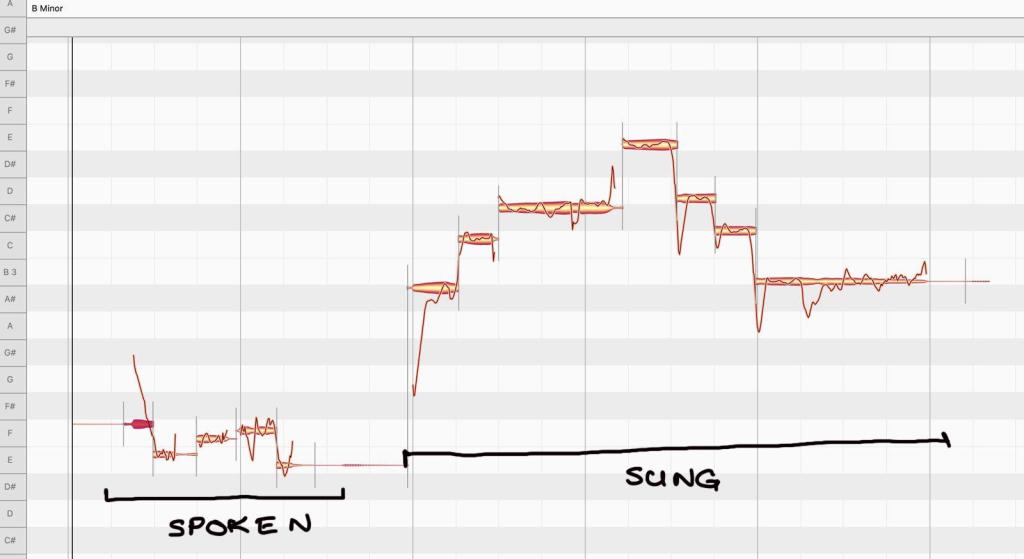
The first few notes – the sequence nearest the left – are the phrase spoken and the rest is the phrase sung.
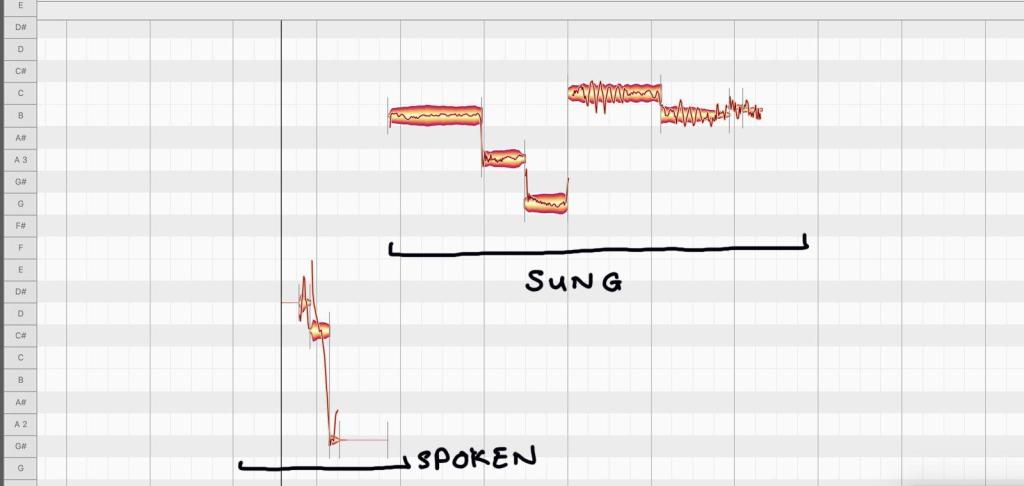
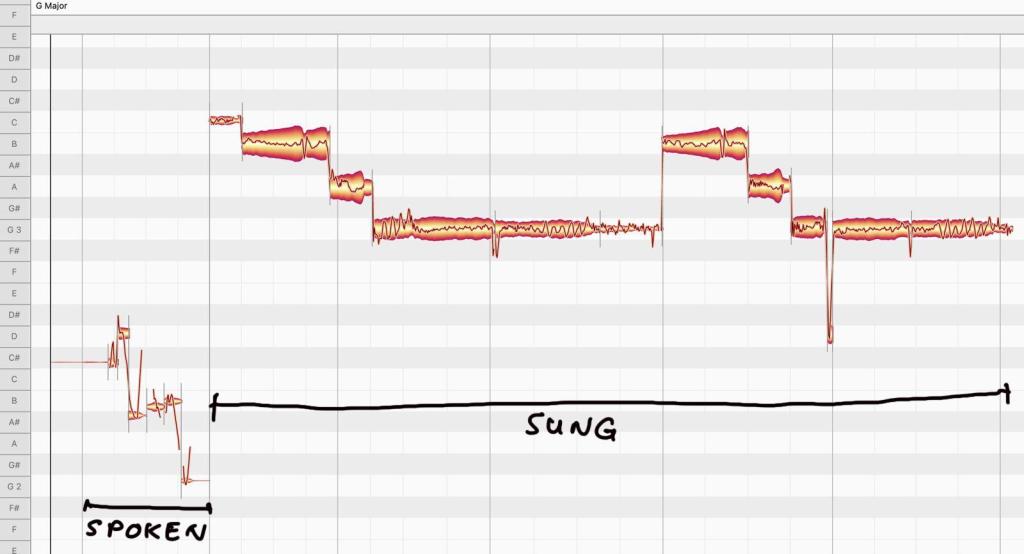
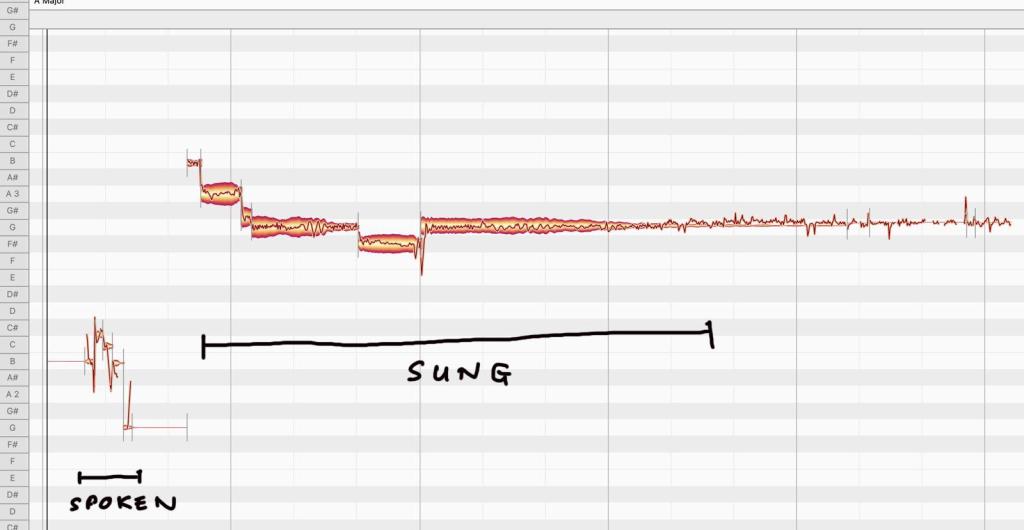
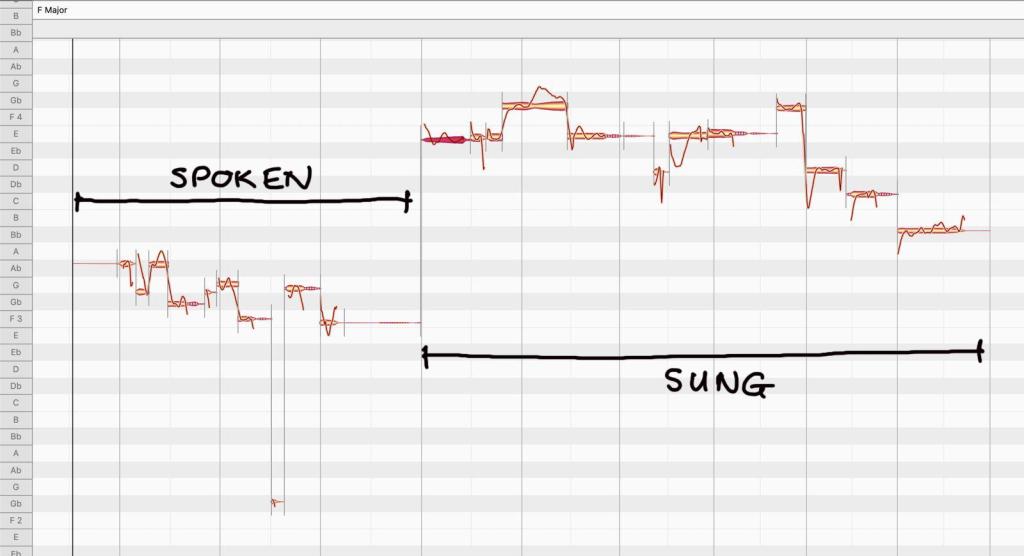
The first observation is that the starting note for speech is D (almost D#) and the starting note for singing is B, a major sixth up.
The second is that the speaker speaks here in discrete notes in values of whole semitones, which may or may not be unusual.
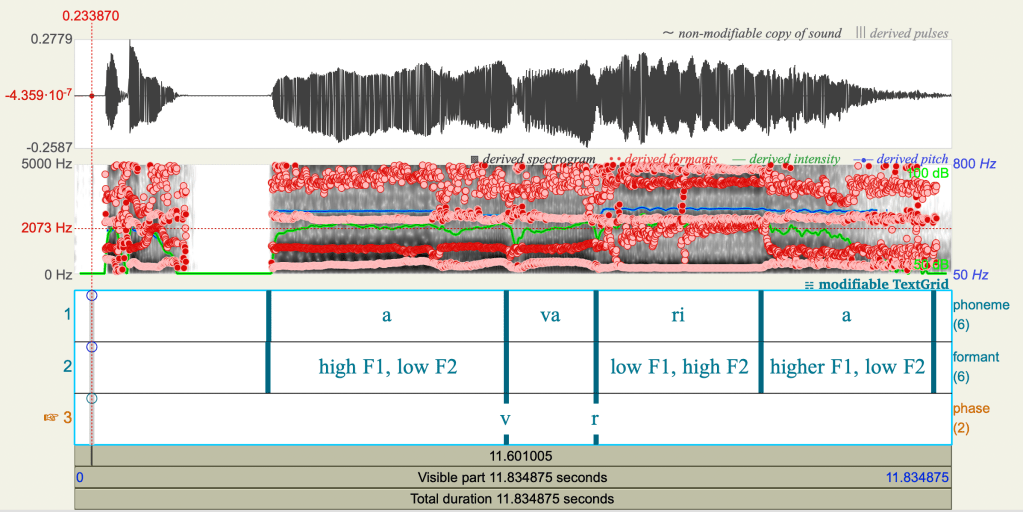
The two iterations as a spectrogram, showing formants:
Superimposing the pitch contours, we can get a clearer idea as to the relative pitch progression of the two ways of delivering the lineː
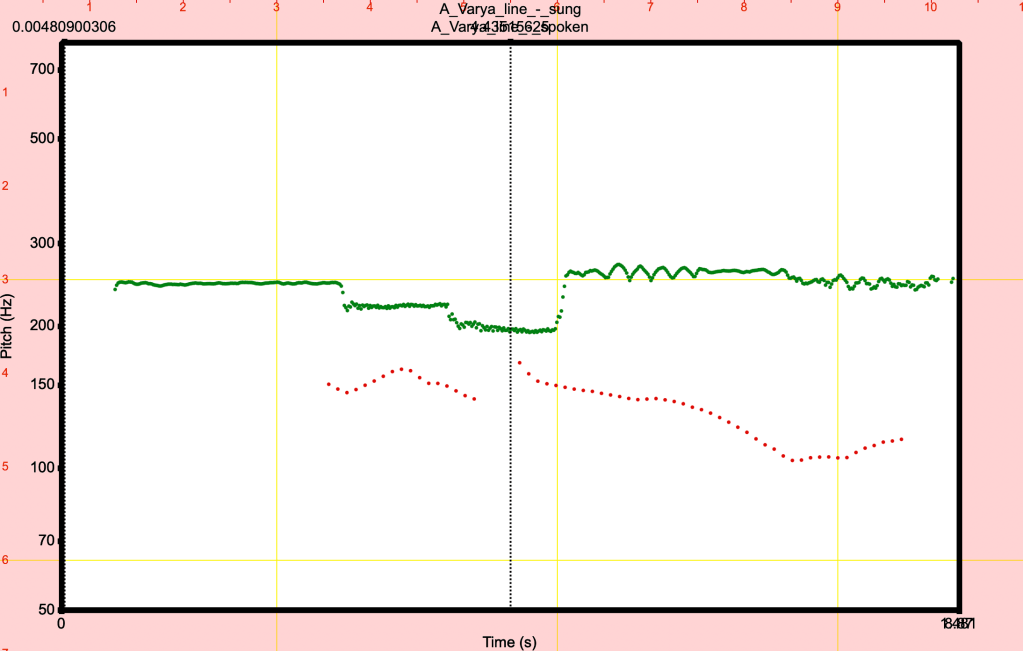
The time axis is calibrated differently for the two utterances of ‘A Varya’; this makes it easier to compare them by way of their relative duration.
The intensity contourː
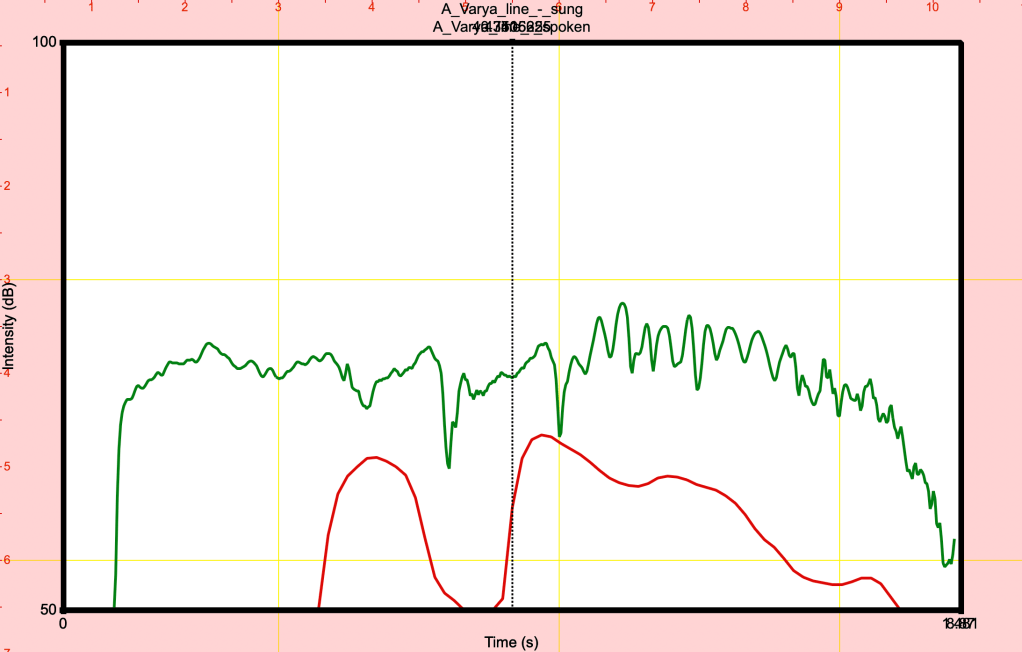
The shape of the curves will have to be more significant than the relative magnitudes; the recordings were made with the same speaker but on different equipment.
The trough in the middle of the red curve represents the separation between the two spoken words ‘A’ and ‘Varya’. When sung, they were run together smoothly. Without that trough, the curves are more similar; both show a steady and marked decrease in intensity over the second word. ‘A Varya’ is either an evocation or a direct address, depending on how you see these things, but either way it is a calling out to the Virgin Mary, and stands alone within the prayer.
Second lineː
Lowenha [lɔʊęn’ha:]
Rejoice
The spoken lineː
The sung lineː
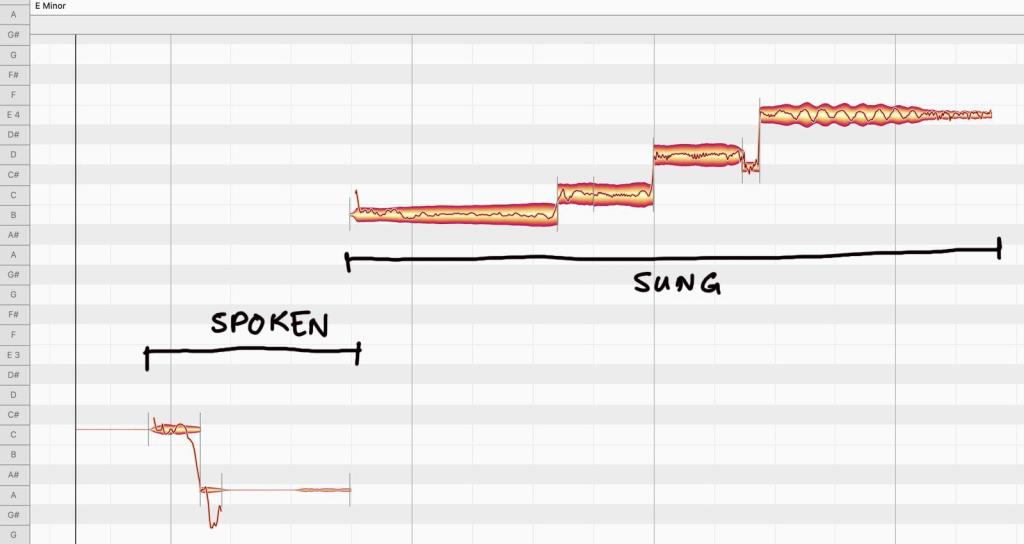
The first spoken line is rather cramped (starting on C), with the sung line starting on B, almost an octave higher (5.5 tones).
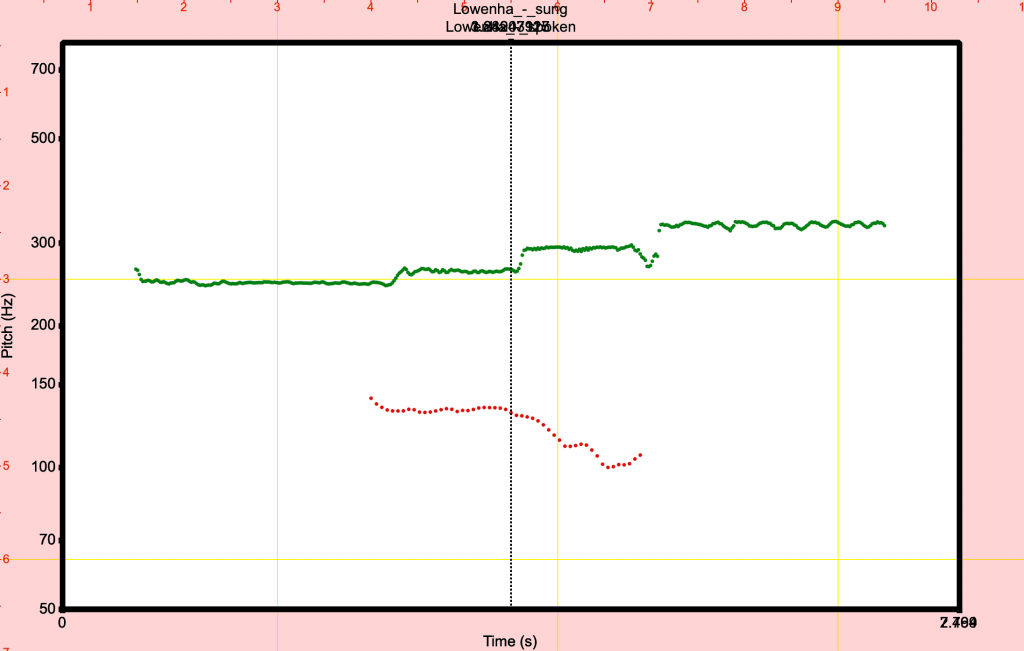
The pitch builds in steady stages in the sung line; it falls off in the spoken one.
And the intensity contourː
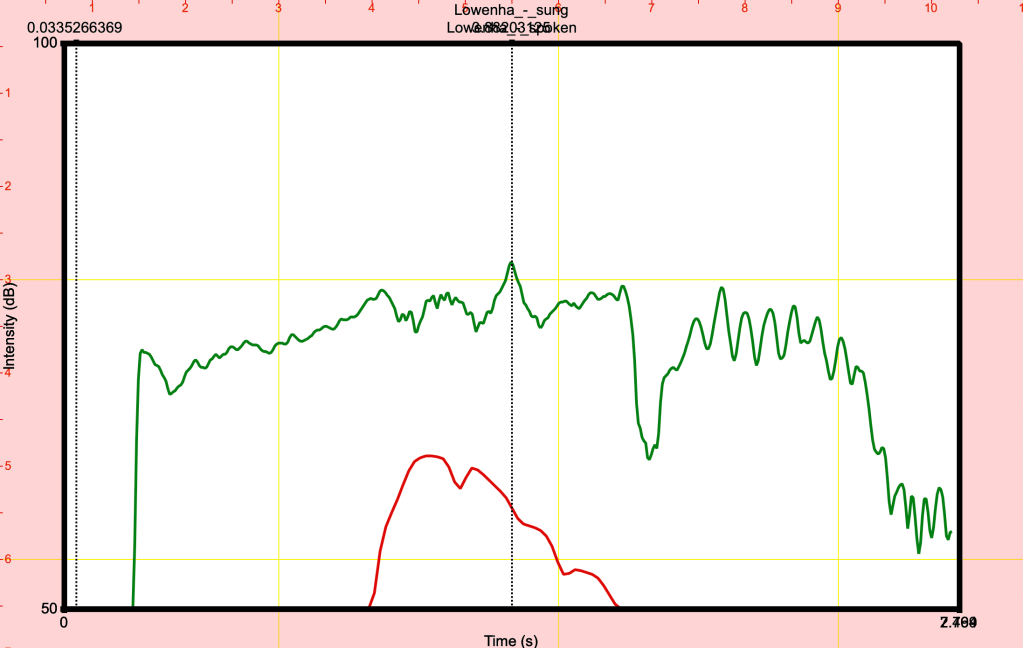
As for the first line, this is not too dissimilar for intensity. This is greater for the sung line again, but the profile matches.
Next lineː
Onan moyha kerys [ɔ·nan] [‘mɔɪha] [‘ke̹rɪz]
Most beloved one
The spoken lineː
The sung lineː
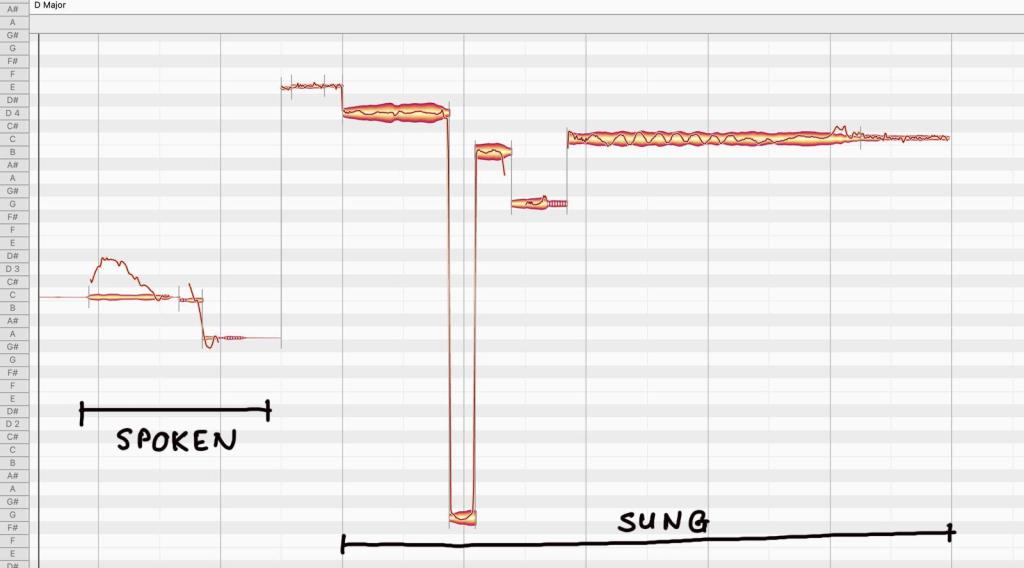
The pitch contoursː
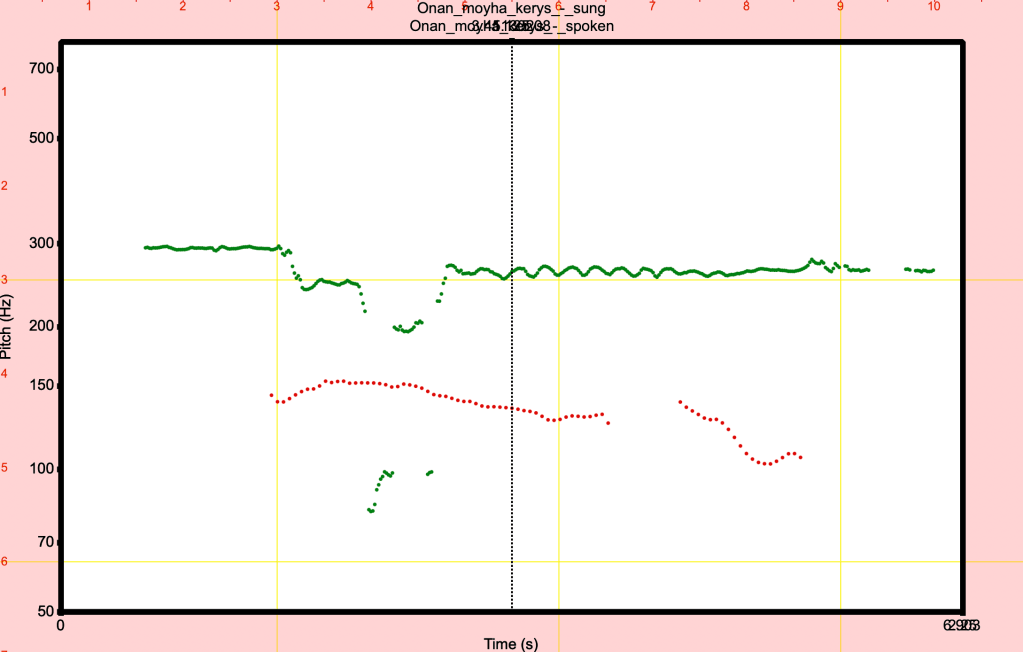
While both sung and spoken pitch are lowering slightly over the phrase, the spoken line drops off more at the end. The sung line has more note variation built into the first third of the phrase.
The intensity contourː
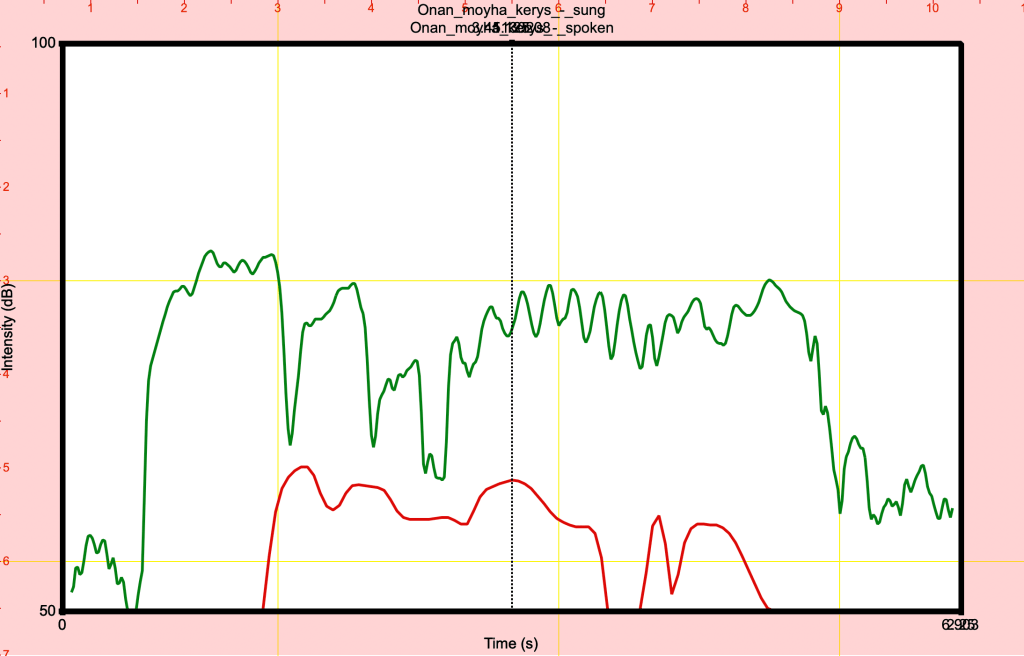
The pattern of intensity swelling and reduction is again matching the words for spoken and sung lines.
Next lineː
Yma an Arlodh genes [ɪ’maː] [an] [‘arlɤð] [‘ge̹·ne̹s]
The Lord is with thee
The spoken lineː
The sung lineː
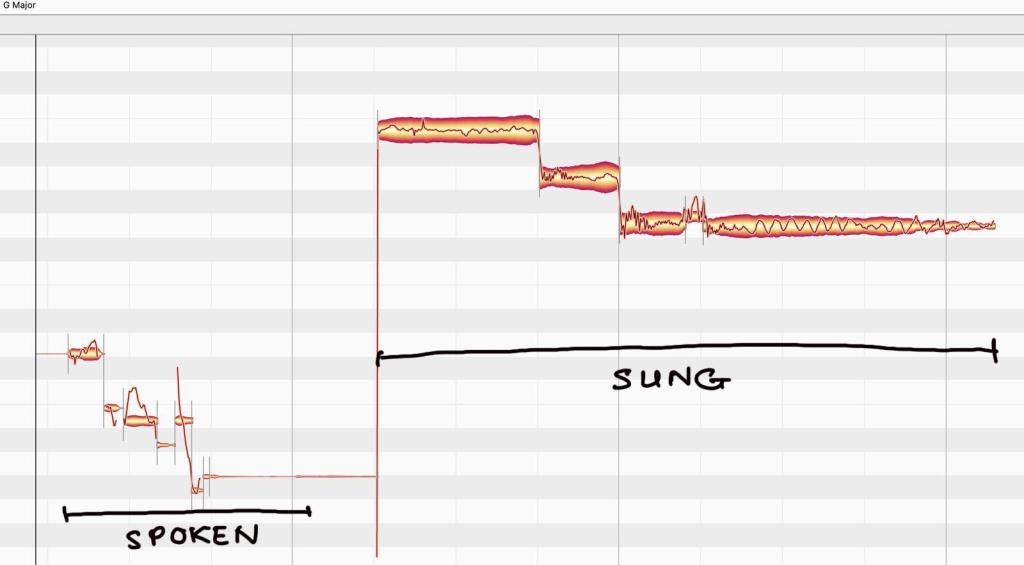
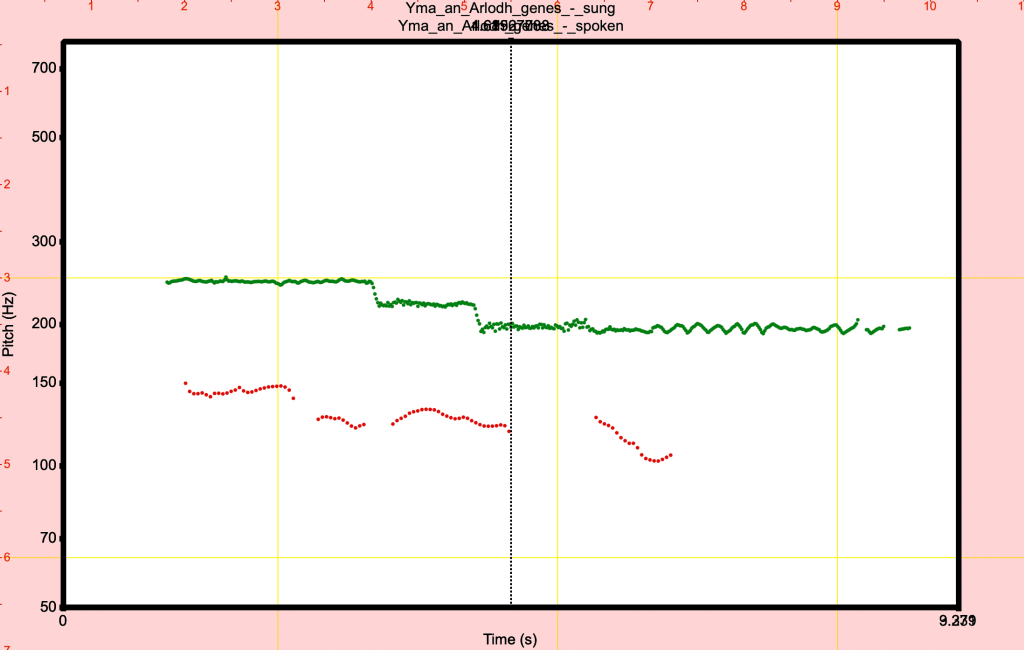
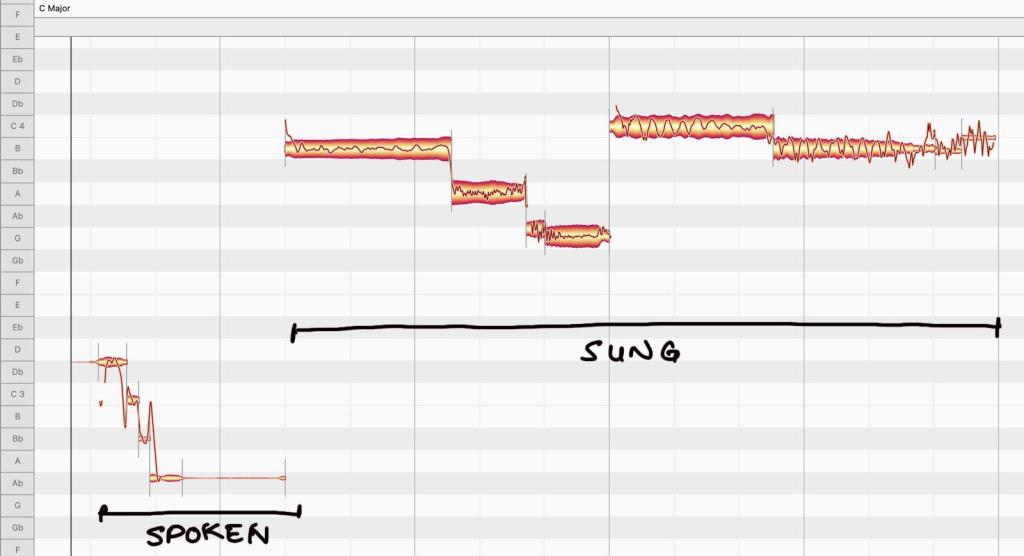
There is a stepped pitch reduction across the line for both spoken and sung. This line concludes the first section of the song, which is the formal address to Mary.
There is an alto part to this song, which obviously does not follow the same melodic line as the tenor part. Isolating a line from a harmony may not make for a clear comparison with other styles of singing, but it represents the far point of song as stylised art; each part has to be recognisable as language with meaning, but the pitch in particular will vary.
Here is the pitch contour for each lineː
And the intensity contourː
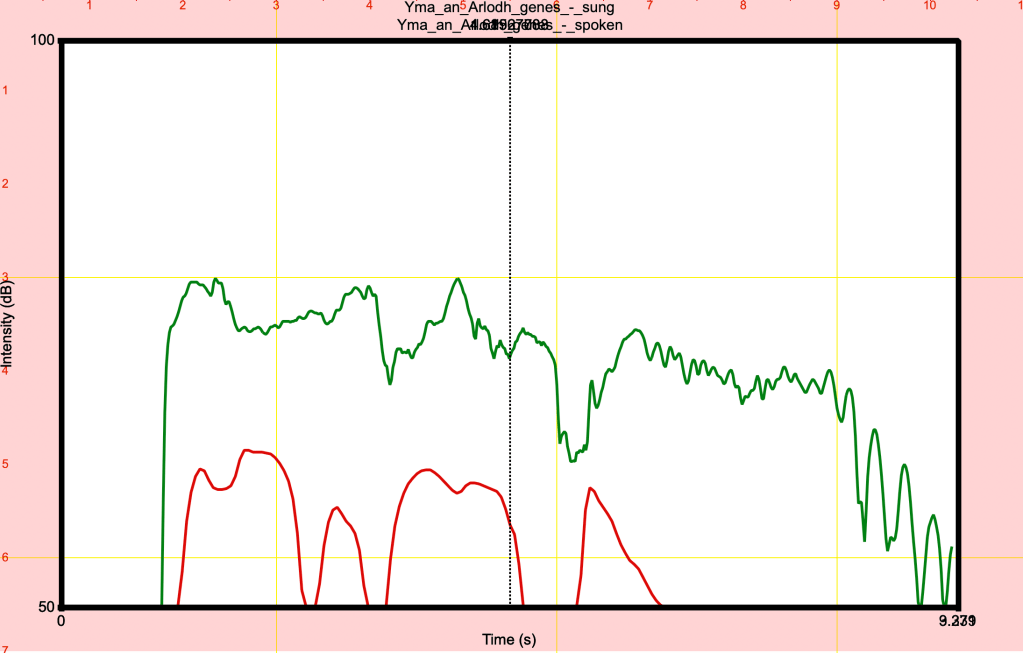
As with the other samples of the song so far, the intensity is greater for the sung line, and really looks like an exaggerated version of the spoken line, with added vibrato.
Next lineː
Gwynn dha vys [‘gwɪnː] [ða] [‘vɪːz]
Blessed art thou – it means ‘fair your world’ and is a Cornish idiom
Spoken lineː
Sung lineː
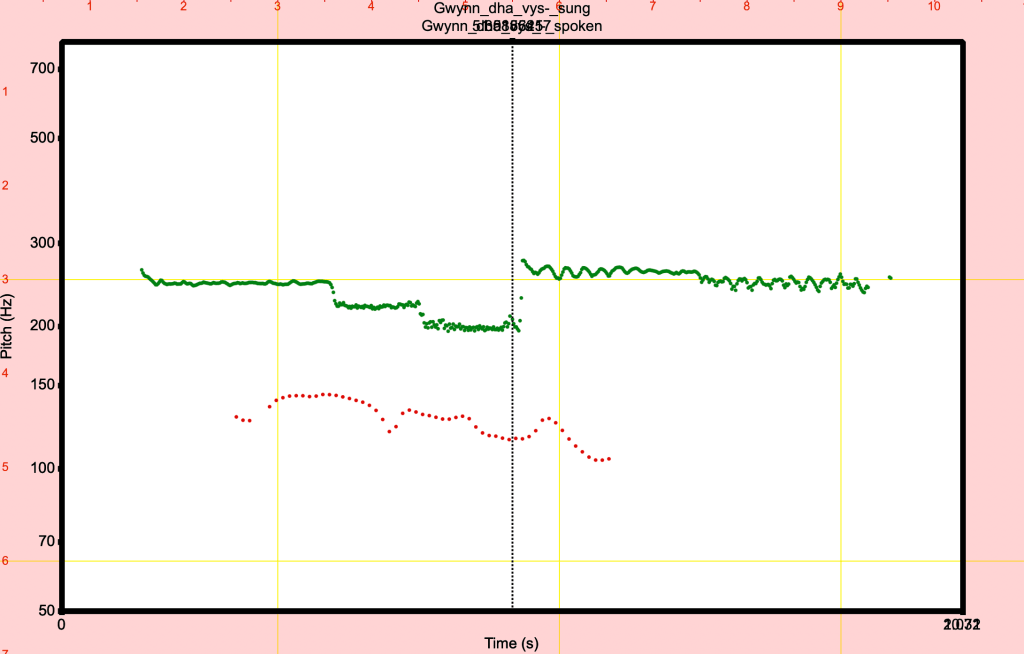
Here the pitch of the sung line follows the spoken line in a more defined way.
The intensity contoursː
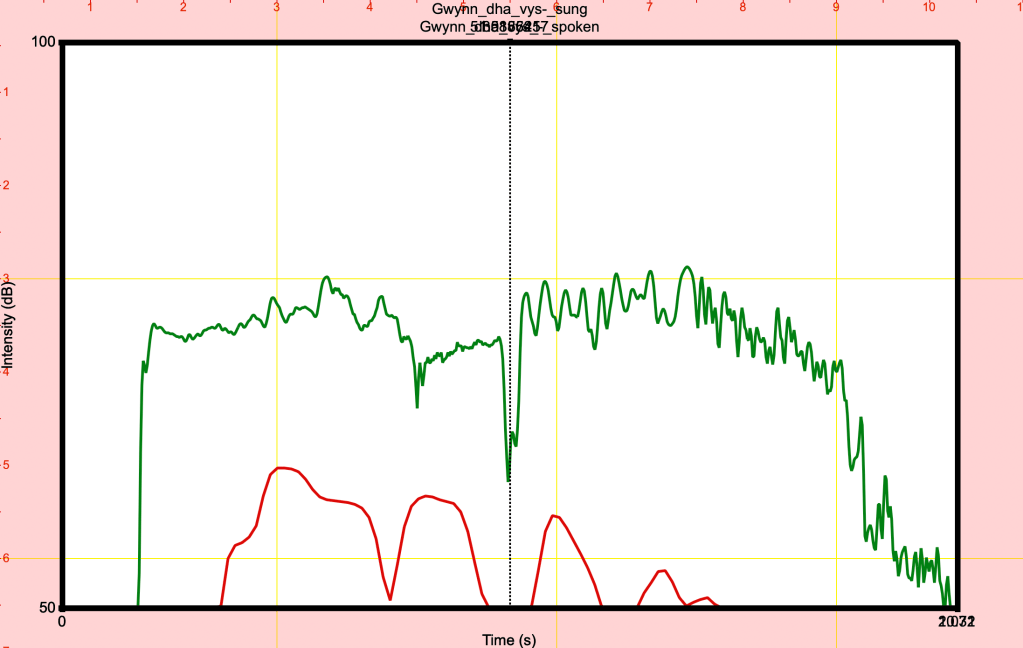
There is more emphasis on the final word ‘vys’, with vibrato on the drawn out /ɪ/. The word is not exaggerated in this way in the spoken line.
Next lineː
Yn mysk oll benenes [ɪn] [‘mɪːsk] [‘ɔlː] [be̹’ne̹ne̹z]
Amongst all women
The spoken lineː
The sung lineː
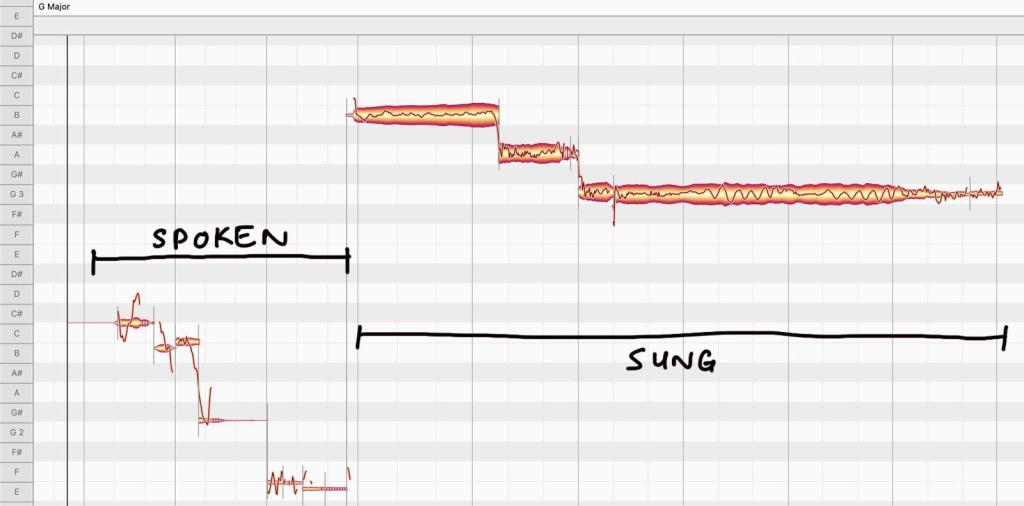
The pitch variation range is lower for the sung than the spoken line, by about half.
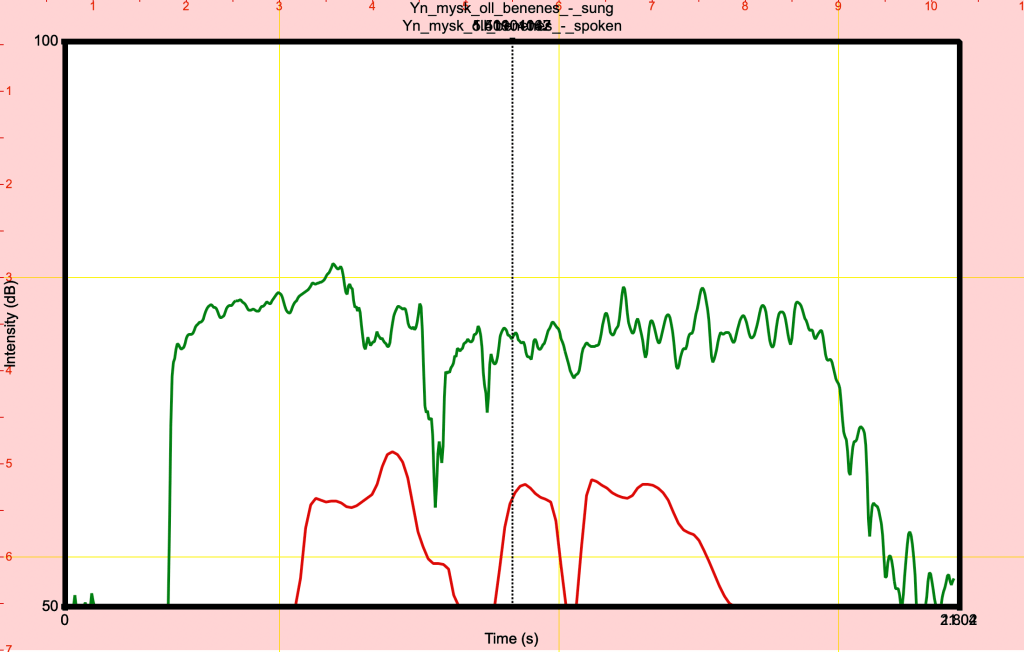
The intensity contours are similar, although again about double for the sung line.
Next lineː
Ha benesik yw prow dha dorr, Jesu [ha] [be̹’ne̹·ʒɪk] [ɪw] [‘prɔw] [ða] [‘dɔrː] [‘je̹·sy]
And blessed is the fruit of your womb, Jesus
The spoken lineː
The sung lineː
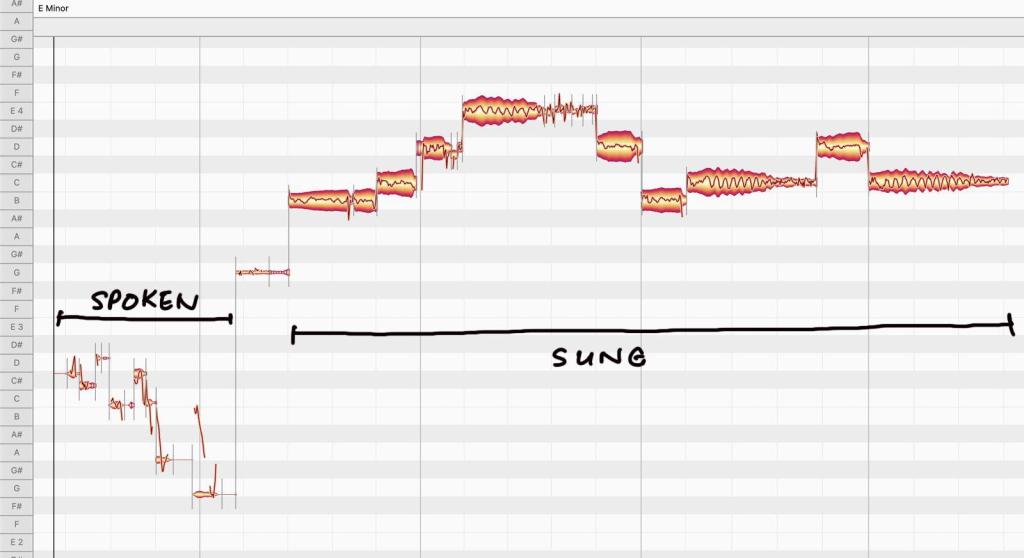
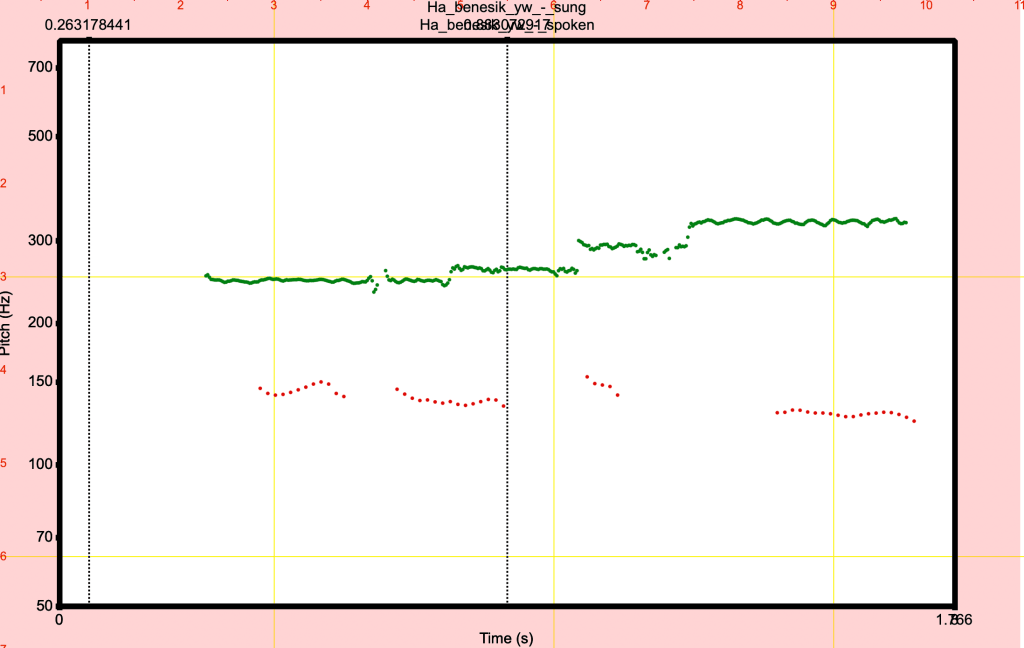
This is a swelling line in the song, but not spoken.
Pitch contour for Ha benesik ywː [Praat has a 15 second analysis window]
and for prow dha dorr, Jesuː
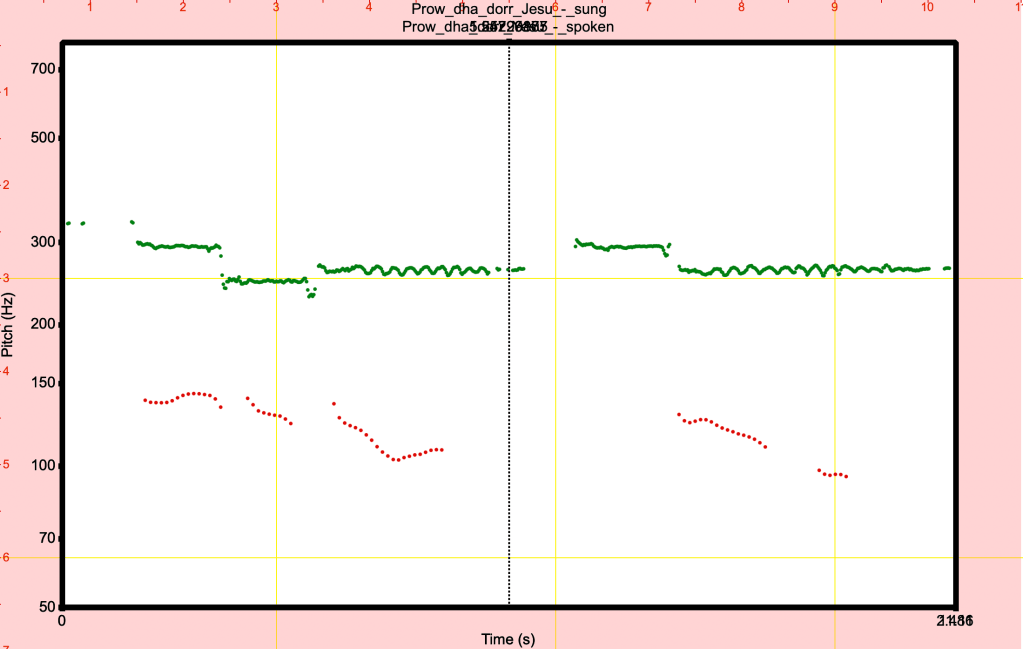
There is a steadiness to the progression of the pitch raises in the first part of the line, and less so in the second part.
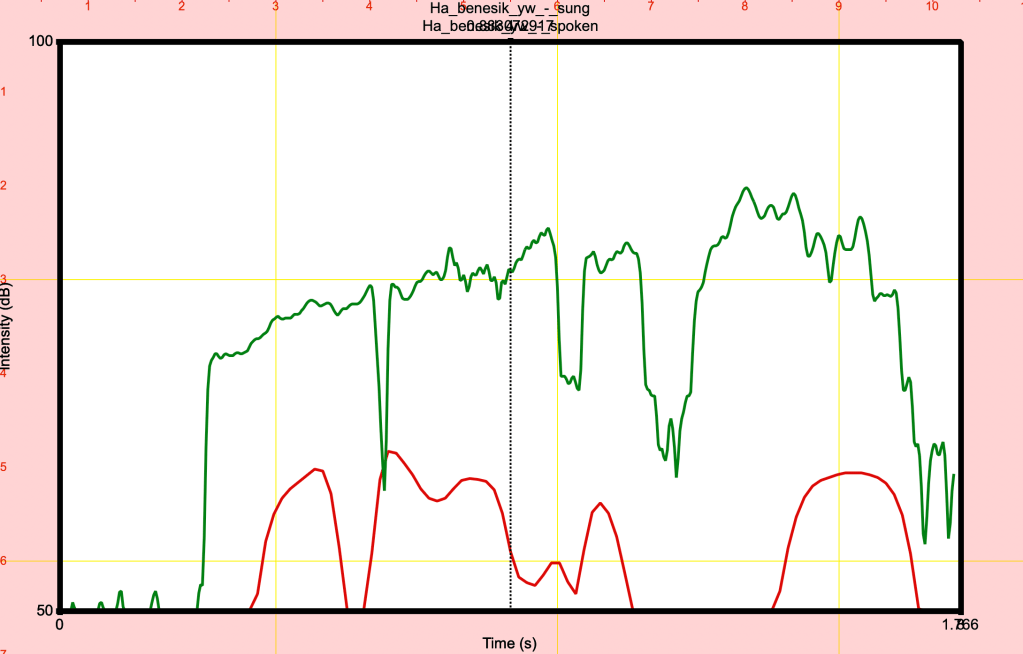
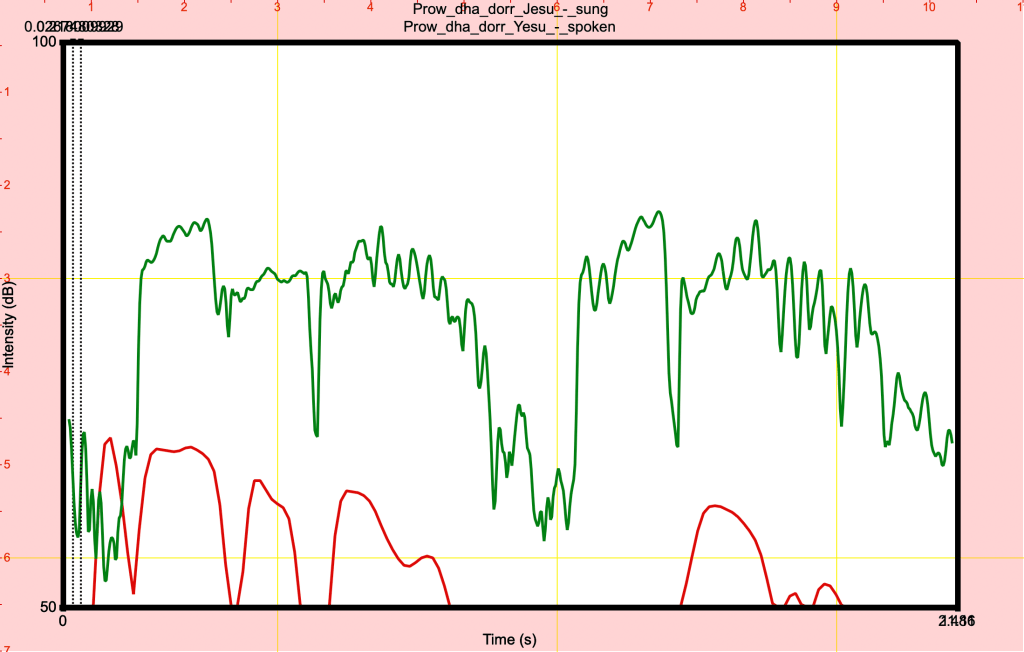
The building and lowering of sung amplitude is again following the spoken line, more or less. The words are less clearly enunciated in all these cases for the sung line; when spoken, there are more pauses between the words. That clarity is not being sought in the sung lines, where the words flow into each other more. This may be a feature of song. It may be what makes it easier to remember song than speech; as well as the rhythm that songs tend to rely upon, the joined-up words, to use an analogy of handwriting, makes the next word easier to remember as it is triggered by the ending of the last word. This is a guess.
The next lineː
| A Varya Sans Mamm Duw [‘a·] [va·ri:a] [‘sans] [‘mamː] [‘dyw] Holy Mary Mother of God |
The line is repeated twice in the singingː
The spoken lineː
The sung lineː
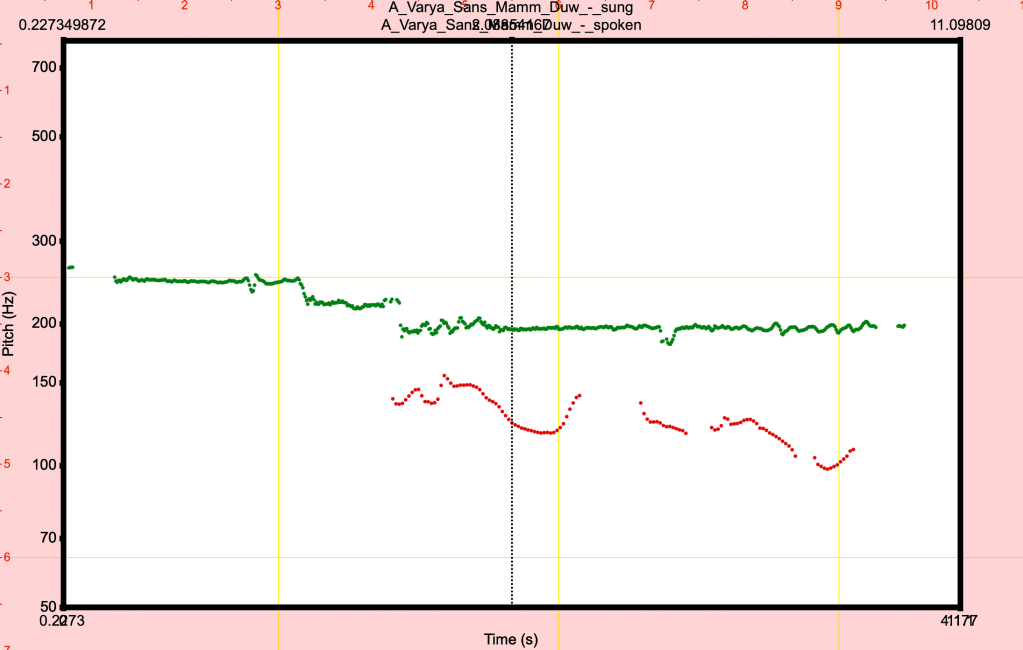
Looking at the pitch contour for the spoken line and the sung line (just the first instance of it)ː
And the second instance of the sung line (contrasted with the single spoken line againː
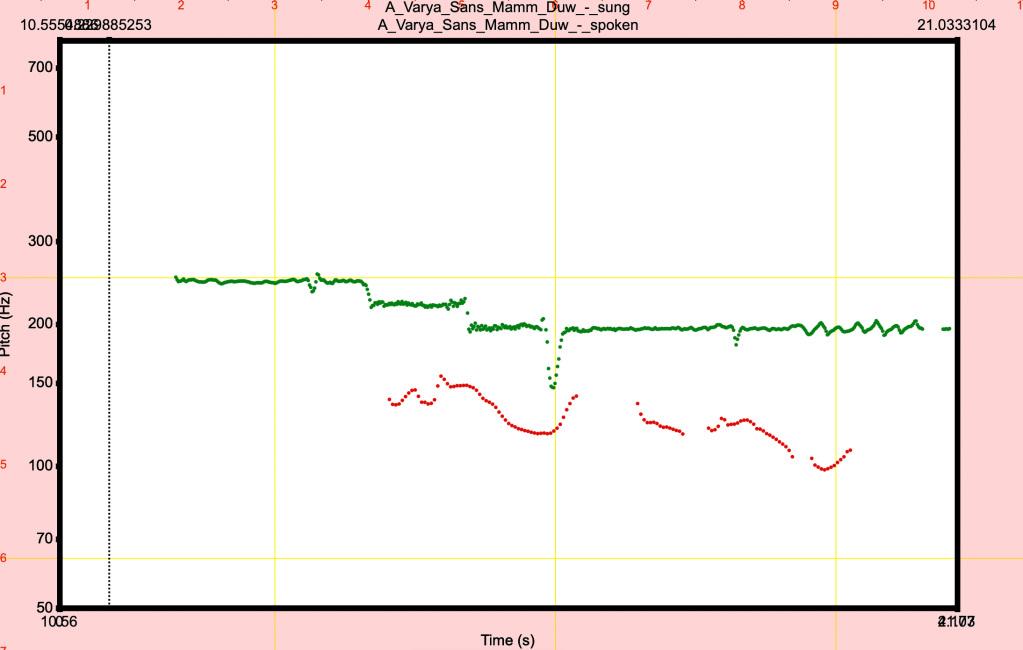
The sung pitch is not following the spoken line. This is not surprising; the alto has the tune at this point. It is possible that the conventions of SATB are a case of their own and not representative of ‘song’, but it would be hard to identity a generalised song style.
The intensity contoursː
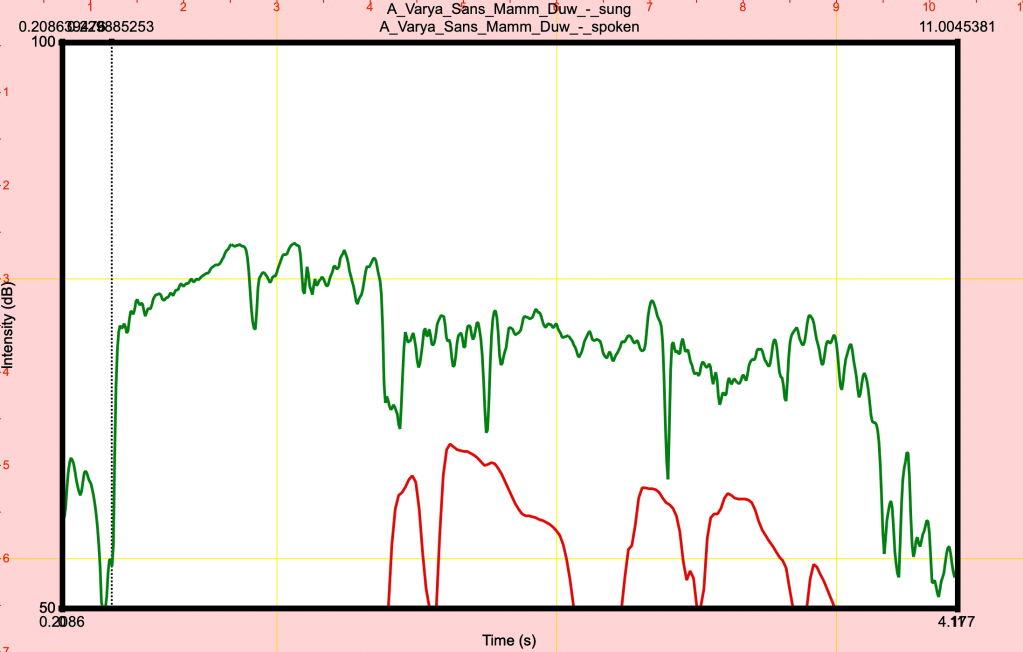
And, for the repeated sung lineː
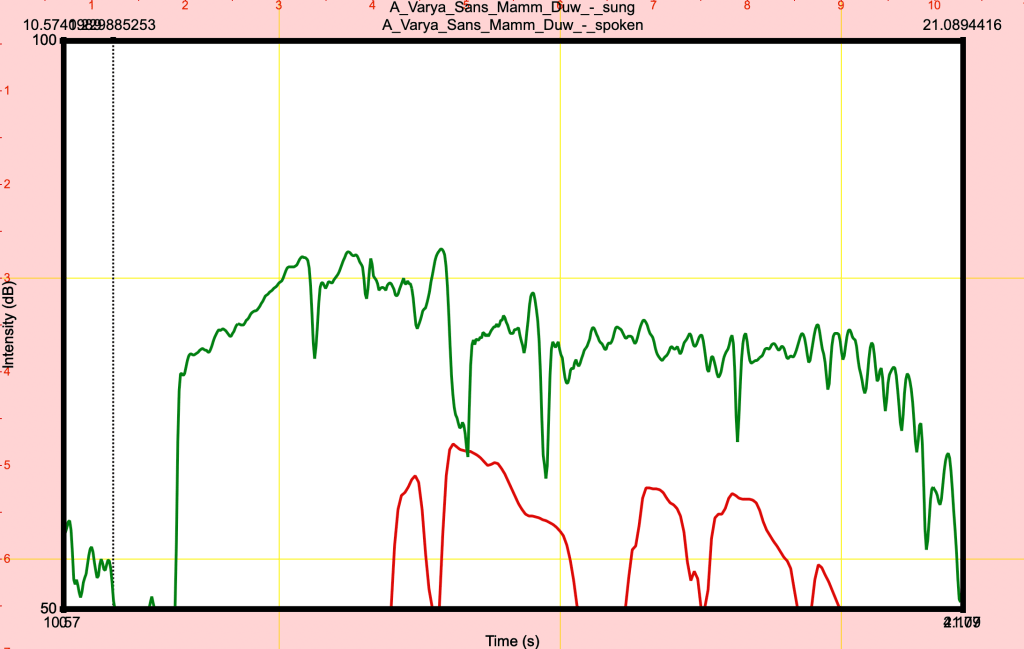
These are very similar.
Next lineː
Pys ragon ni peghadoryon [‘pɪ·ʒ] [‘ragɔn] [‘niː] [pe̹·ɦa·’dɔrːjɔn]
Pray for us sinners
The spoken lineː
The sung lineː
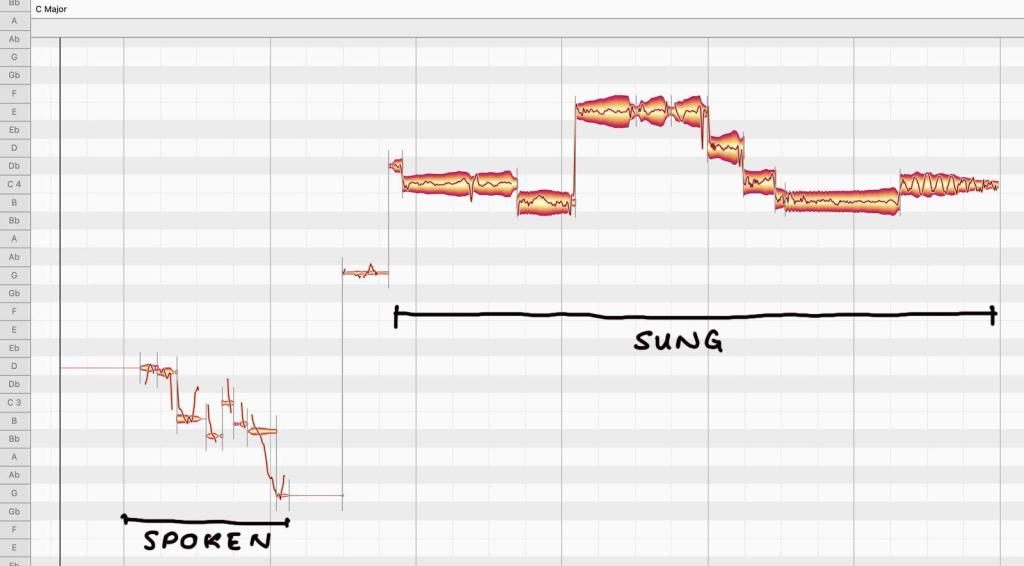
Again, there is actually a wider pitch range for spoken line.
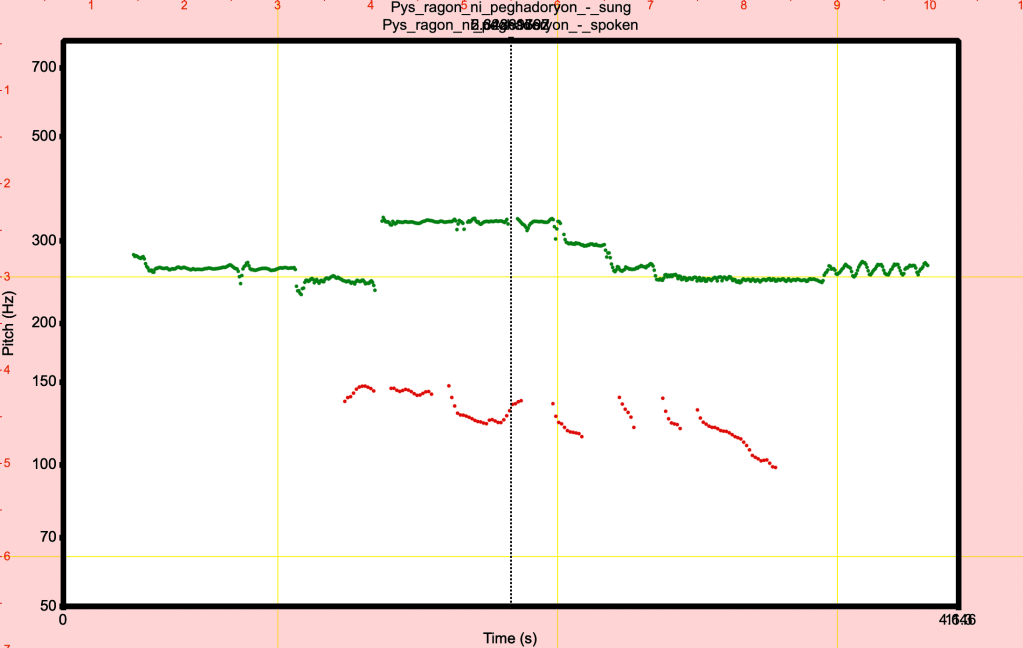
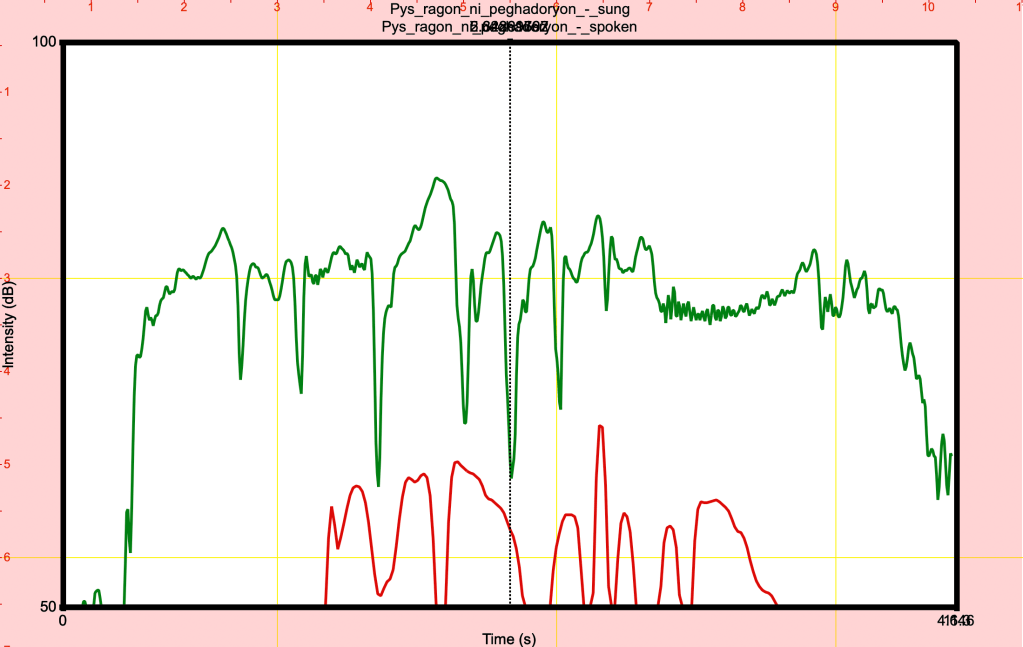
The sung words are both loud and clearly enunciated; this is the heartline of the songː pray for us sinners. It is a beseeching of the Virgin. Intensity (amplitude) is increased for this emotive line.
The pitch, however, has taken over the variation in tune from the alto for this line.
Next lineː
Lemmyn ha dh’agan eneworres [‘le̹mːɪn] [ha] [ðagan] [,e̹ne̹wɔrːe̹s]
Now and at the hour of our death
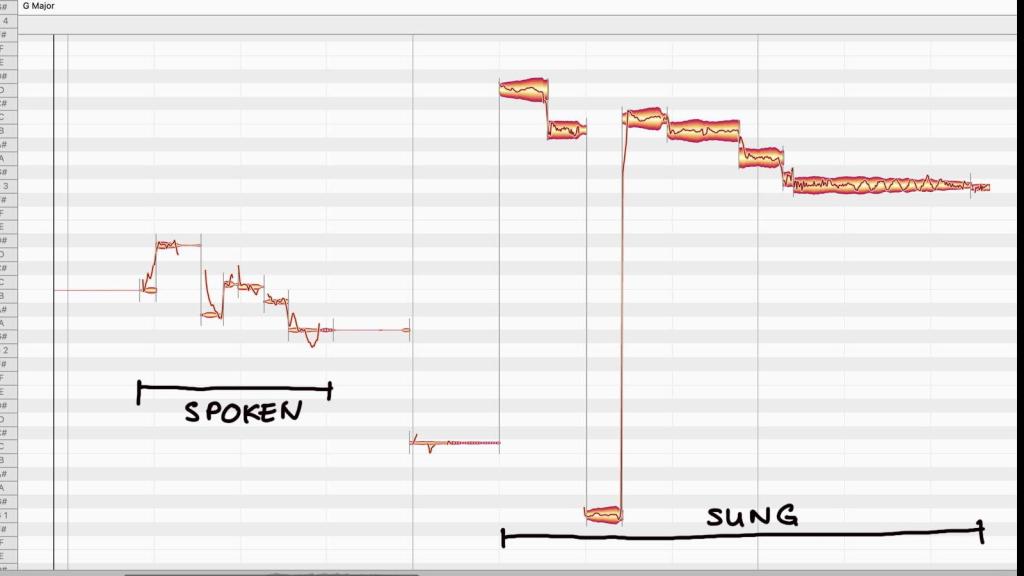
In both cases, the steep drop in pitch for the third burst of sound relates to the ha after lemmyn. The pitch contoursː
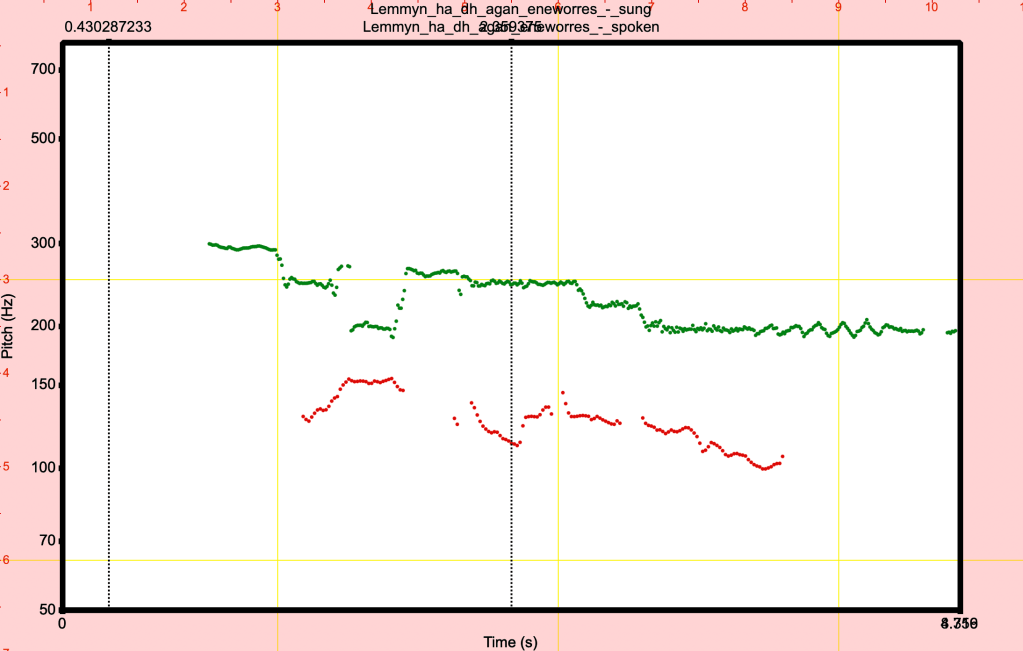
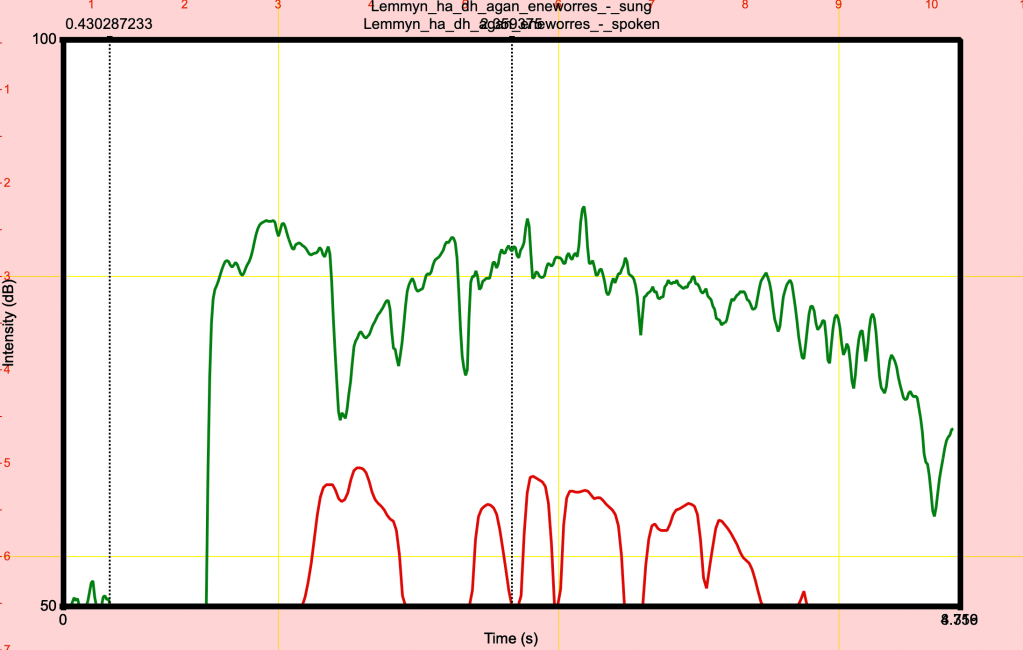
There is significant congruity between the spoken and sung lines, again with reduced intensity for speech and breaks between spoken words. The shape of the curve is pronounced, however.
At this point, I had a little chat with the composer. Firstly, I asked whether one line dominates in the composition, the tenor or alto lines. He repliedː
“No, I heard them both simultaneously in my head. There’s definitely parts where the intended melody leans one way or the other, though.”
I then pointed out the similarity in intensity patterning. He repliedː
“That’s actually completely fascinating. So when I have lyrics, I always look for the meaning in the words and the phrasing of how you would say it is really important as to how you emphasise that through turning it into a melody.”
This is close to the heart of the idea of a sung poem. The call to Mary in prayer is also very close to the notion of charm and chant, Northrop Frye’s root radicals of melos.
Next lineː
Amen [a’me̹ːn] [x 4]
Amen
The spoken lineː
The sung lineː
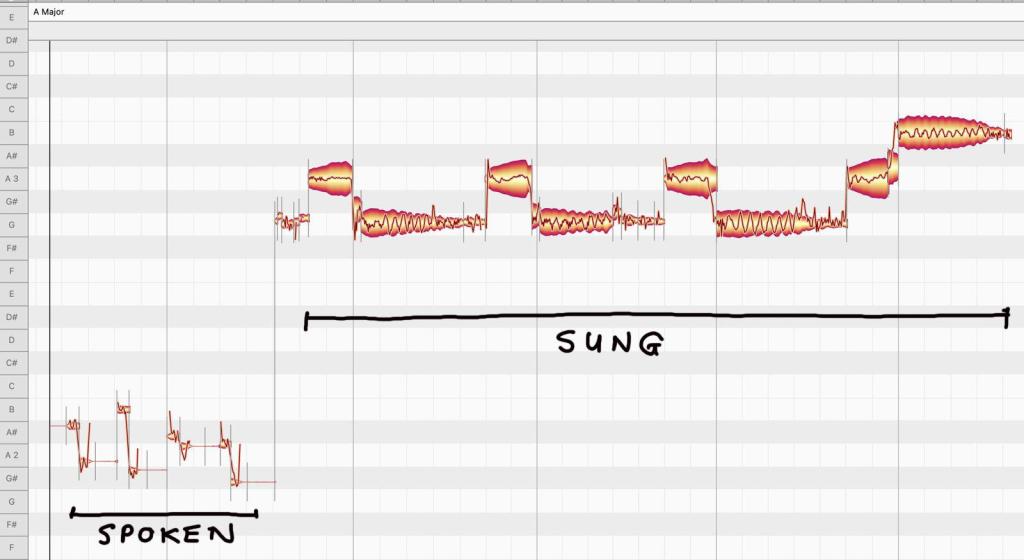
The spoken amen is simply repeated. The sung amens are the same for the first three; the final amen is raised in pitch, ending on a B – the next line begins with this note, so it brings continuity.
Only the last three of each will be used in the Praat analysis, as the first one is a duplicate, and Praat has a maximum sample length of 15 seconds.
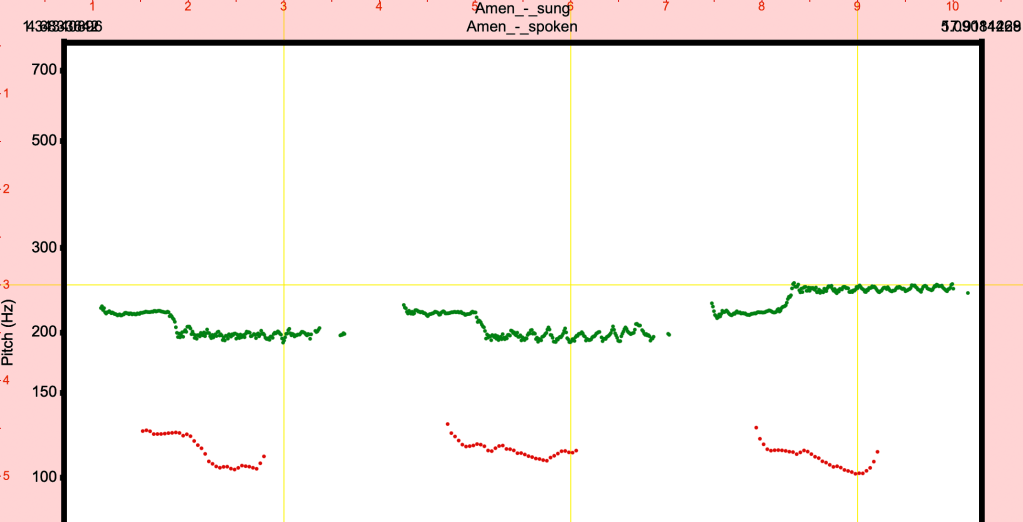
There is similar patterning again, with the exception of the inverted final amen.
The intensity contoursː
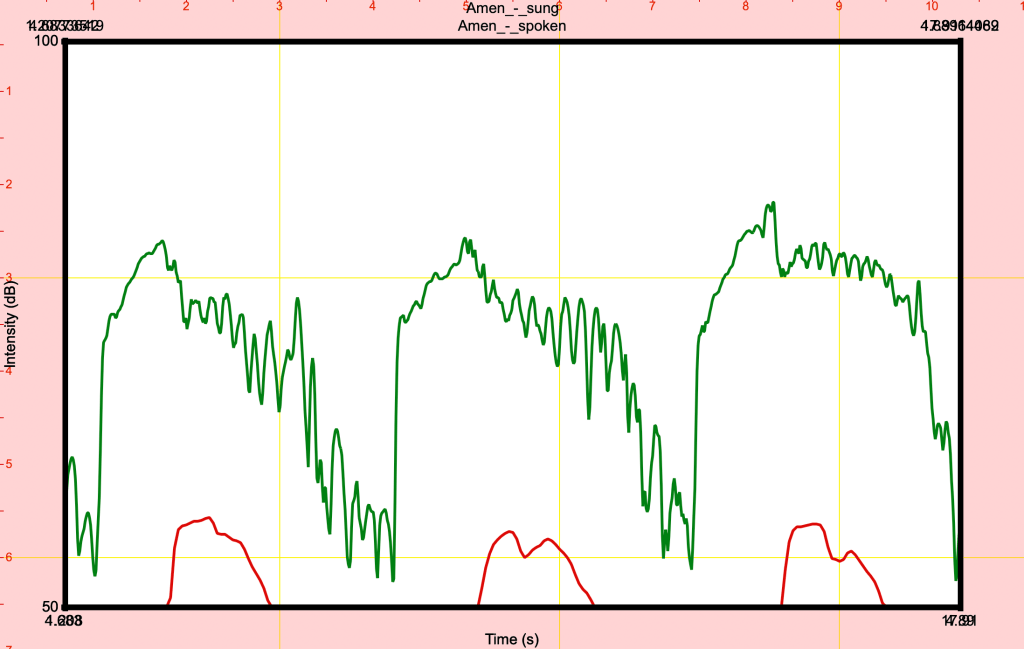
Despite the protracted duration of the sung amens, with vibrato, these have similar intensity profiles once more.
And now for the last lineː
Yndella re bo [ɪn’de̹lːa] [re̹] [bɔ]
Let it be so [the traditional Cornish expression that means the same as ‘amen’]
The spoken lineː
The sung lineː
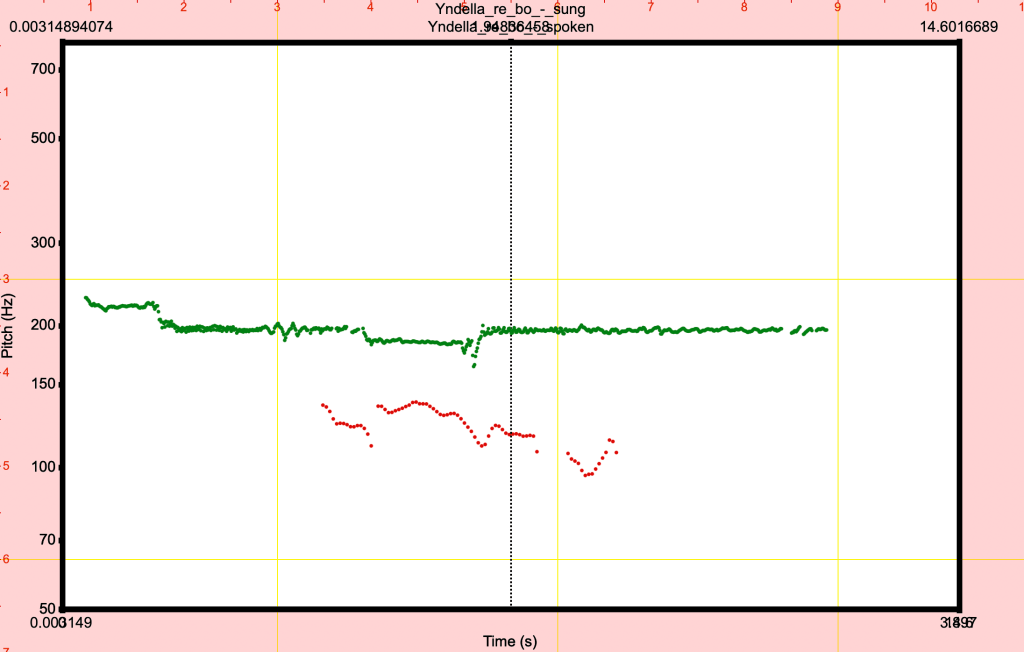
The song closes formally with a drawn out ‘yndella re bo’ i.e. an amen.
And, finally, the intensity contourː
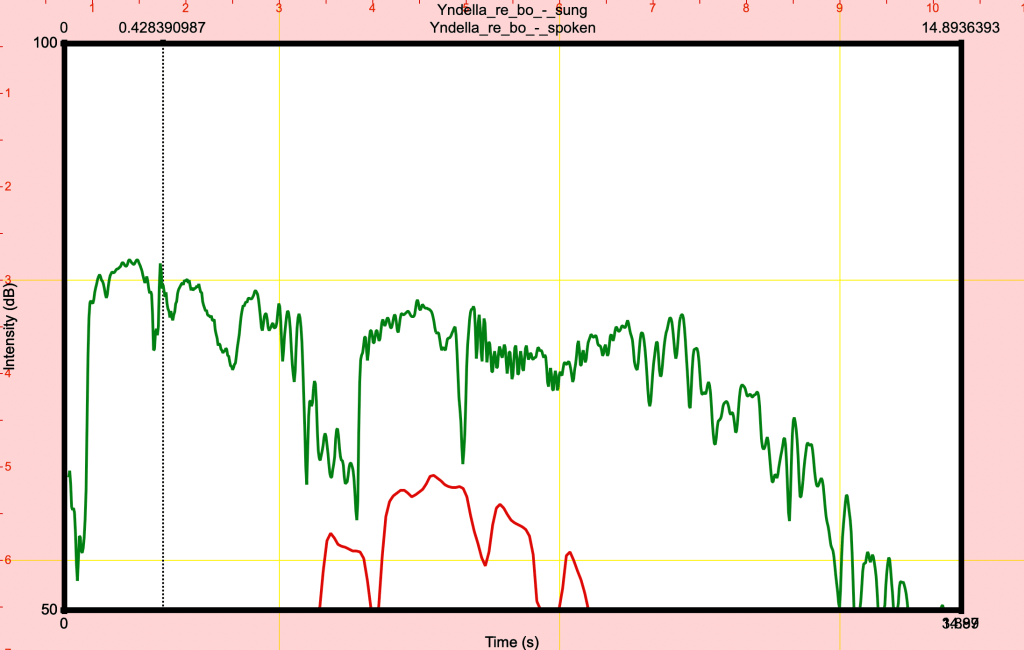
Another remarkable match.
Now we turn to another iteration of the divine feminine.
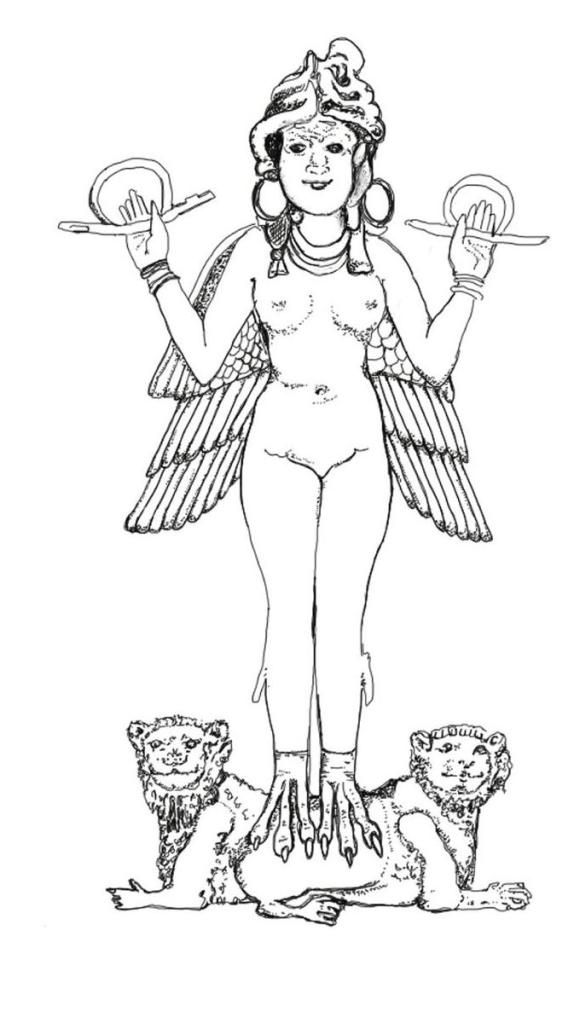
ii. Speech-derived tune: Niver Ow Fleghes [Inanna, Gate VI]
I wrote this in the summer of 2025. I recorded myself speaking it and then recorded it sung, line by line, after hearing the spoken line first. So it represents my interpretation of ‘singing’ my spoken line, having heard the spoken line. The decision to look at it through acoustic analysis software came some time later, so did not influence the way in which I chose to ‘sing’ the spoken words.
Both recordings used the same equipment and settings.
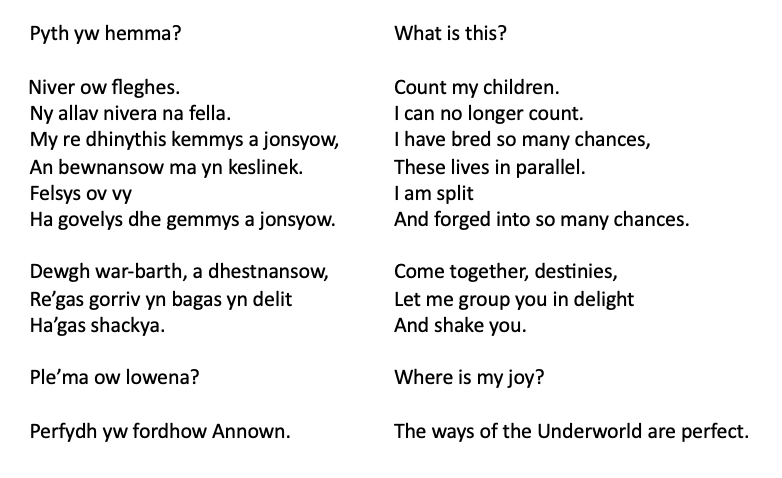
The first phrase: Pyth yw hemma? [‘pɪːθ] [ɪw] [‘he̟̝̘̹mːa]
The spoken lineː
The sung lineː
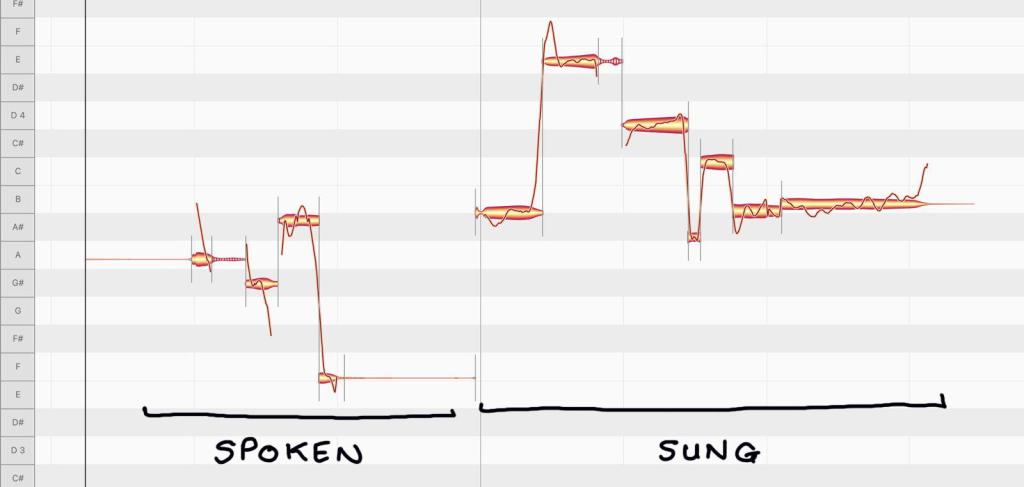
The first observation is that the spoken line starts on an A (A3, the one below middle C). The sung line starts on a B, a tone higher. This contrasts with the major sixth difference in the A Varya starting line, above. It seems natural that song derived from speech should be in the same sort of register; starting near the same note also feels natural.
Already it is clear that this is one person’s approach. The only way to compare this properly would be across a sample of people having a go at singing from speech. The only other person I have heard of who has written about this is Thomas Campion and he was writing in 1602. It doesn’t seem to have caught on.
There are going to be many variables at work here; they may be based on how individuals perceive sound, or a range of ways in which they do, or on what pitch they are working at, what mood they are in (e.g. when agitated, people sometimes bellow or become shrill – they can move to the extremes of their register), conventions of pace, conventions of conveying sadness, fashions. All of this is far outside the scope of this project, which is more intended as an empirical sandpit for curious people.
The second observation is that this person also starts speaking in discrete semitone intervals, which is a surprise. The A Varya speaker is a professionally trained singer; this second speaker (me) is not.
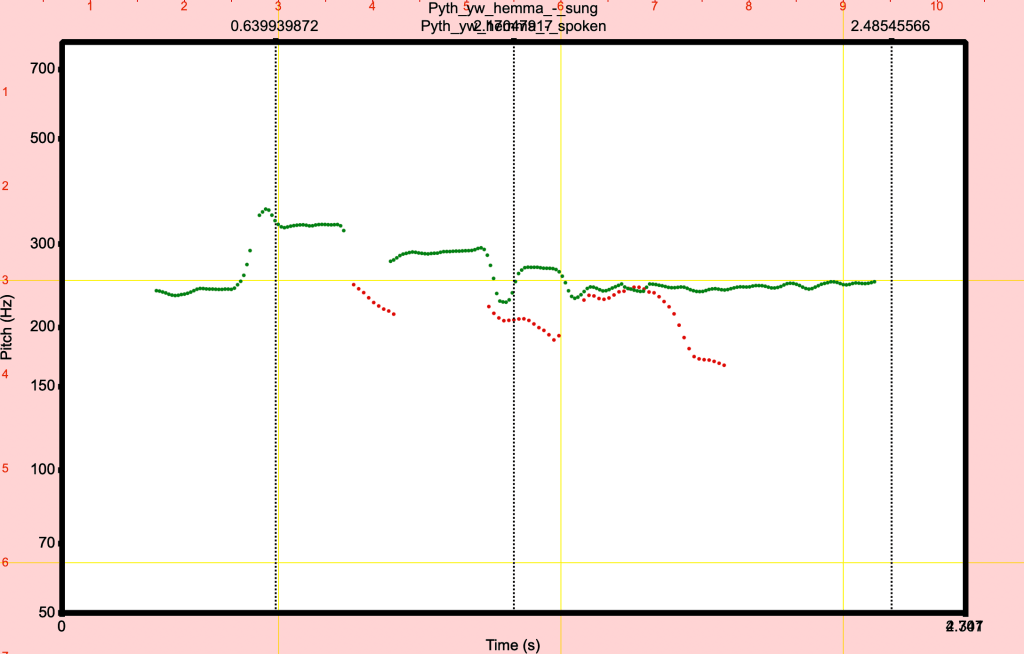
The pitch for the sung line is in green; the spoken line is in red. It is hard to line them up because the duration of word enunciation is longer for the sung line. This is a convention of song; one of the ways of exaggerating the sound is to change the length of a note or a word. A word may sit on one note or contain several. I am curious to see how my mind does it, at least; perhaps that is the most conclusive evidence I will be able to draw.
The pitch is very roughly showing the same sort of profile; falling in a series of steps, with a pivot on the first syllable of ‘hemma’ (this). This song poem is part of a longer narrative. It represents the point at which a weary goddess comes to the sixth gate to the Underworld. She has already given up her power, security, love and close to losing her entire identity. She is not feeling energised or happy. She has asked the same question ‘what is this?’ at the previous five gates and will ask it once more after this, at the seventh gate.
Here, for future comparison, is the intensity contouringː
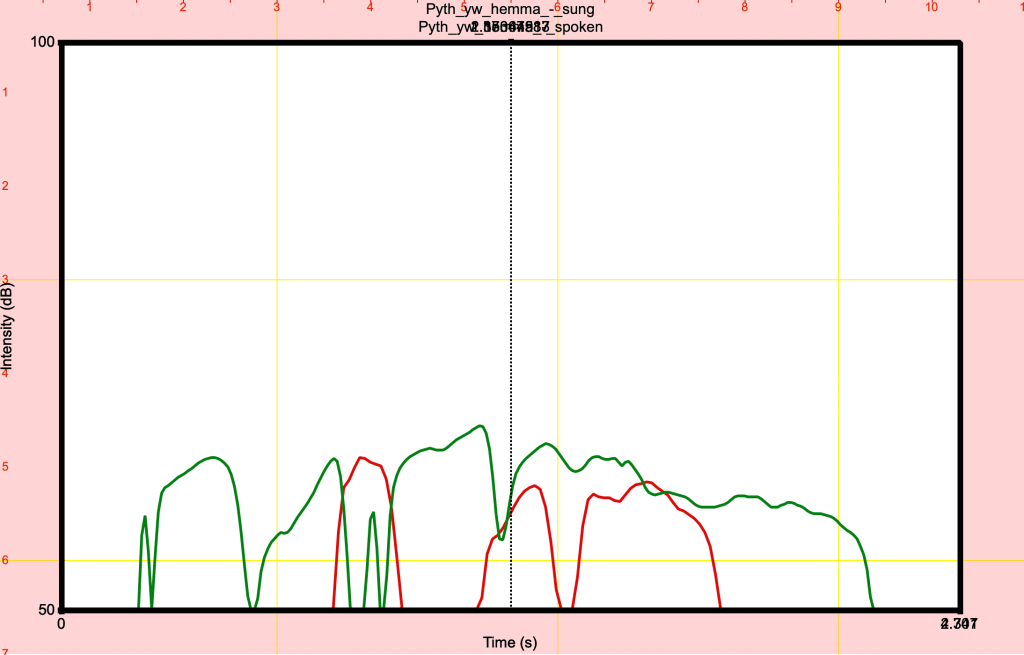
The spoken line (red) and the sung line (green) are hitting about the same levels; both decrease slightly in intensity over the course of the line. There is not the same degree of consistency of intensity curve as for the A Varya singer/speaker.
The next line is the first line specific to this songpoemː
Niver ow fleghes [‘niːver] [ɔw] [‘fle·xez]
The spoken lineː
The sung lineː
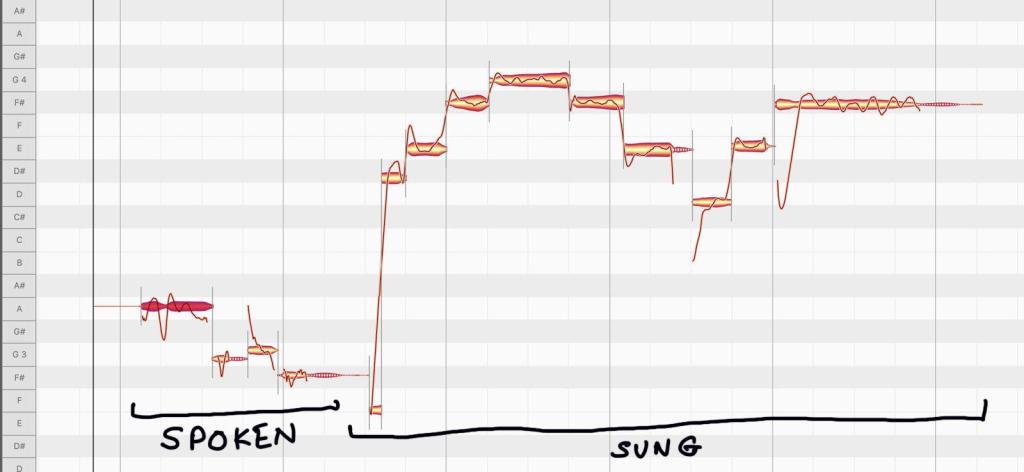
This is quite dramatically different. The spoken first note and sung first note have three full tones between them. While the spoken phrase falls in pitch, the sung one rises, falls and rises again. The phrase is a commandː count my childrenǃ The singing is reflecting the sentiment with greater intensity and a raised voice; there is a connection between the spoken and sung line, but it is addressing the image of the line more than the actual sound of the words.
Here are the superimposed pitch contoursː
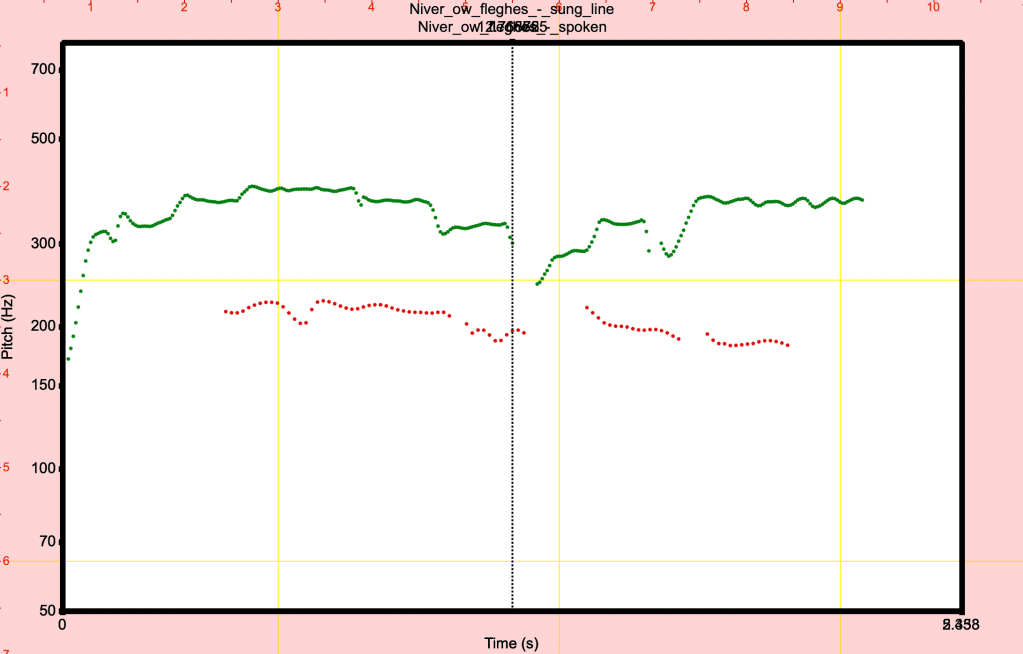
Here is the intensity contourː
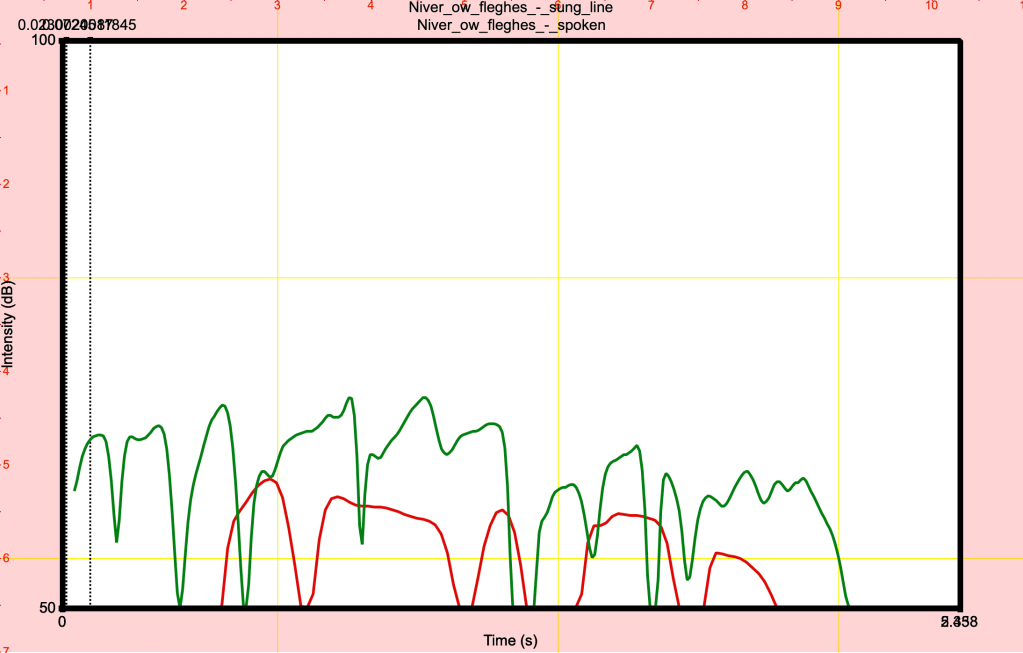
The spoken line (red) is consistently delivered at a lower intensity than the sung one. For both there is a gradually falling off over the course of the line. This is noticeably different to the delivery of the first line, where there was little difference in intensity. That line was a wearied question. This one is an anguished command; the intensity is greater, the emotion is more overt, in the sung than the spoken line.
An aside – it feels quite strange to be analysing one’s own voice for this sort of thing. After and despite a great deal of reading and thinking, I had not expected to see this, and yet the ‘answer’, whatever it may be, the great secret to how my voice modulates the interface between thought and sound, is happening inside me, always.
Right, next lineː
Ny allav nivera na fella [nɪ] [alːav] [ni’ve̹·ra] [na] [’fe̹lːa]
The spoken lineː
The sung lineː
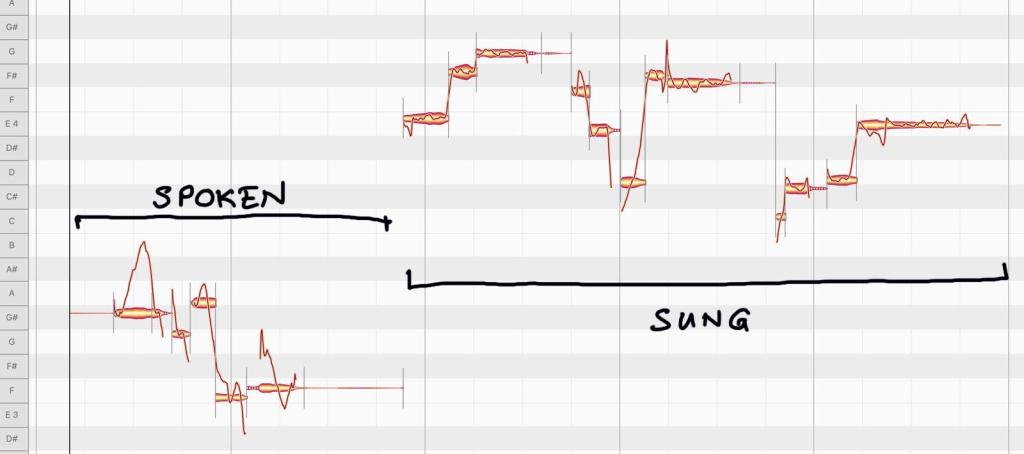
Incidentally, Melodyne is really struggling to find the key. This one is E minor, it thinks. The last line was G major. The one before was, allegedly, D major. What this smattering of semitones does suggest is that the rules of composition are not considered relevant by my melody-shaping faculties. I suspect that rules are being followed but they are not solely musical ones, concerning sounds that are meant to be pleasing or concordant. There is no ‘correct’ way to interpret the spoken line as song, but the choice may still not be as arbitrary as that would suggest.
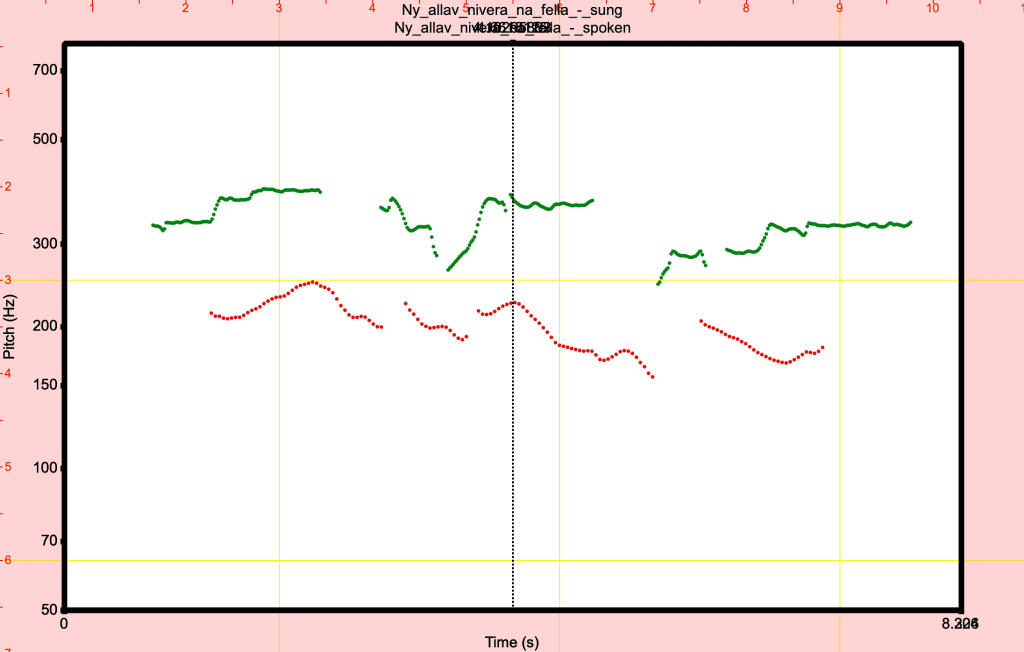
The interval between spoken starting note, G#, and sung starting note, E, is now up to four whole tones. The pitch contour, however, shows significant conformity of melodic variation over the line, with the exception of the end; the sung line trails more, at its final pitch. It is likely that this is because it is going to lead in to the next line – or not. There is a slight narrative break before the next section, a pause, and the note is hanging.
The intensity contourː
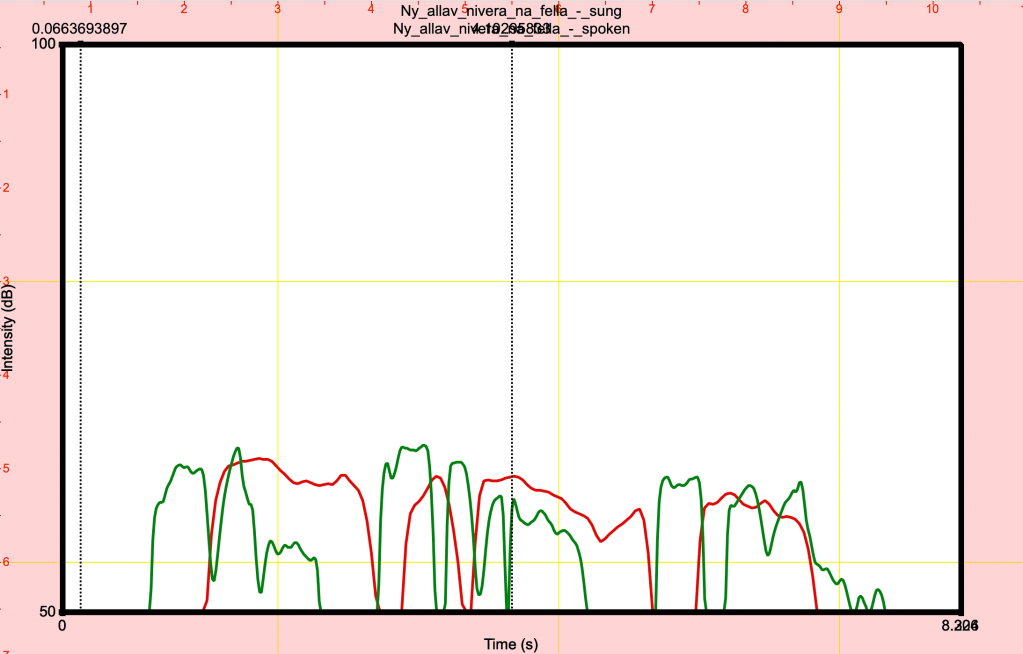
The spoken and sung lines conform well on intensity in this line. There is more resignation in this line, in terms of meaning, than in the one before; it is not command nor outrage.
The phrase:
My re dhinythis, kemmys a jonsyow [‘mɪː] [re̹] [ðɪ’nɪθis] [’ke̹miːz] [a] [‘dʒɔːnsjɔw]
I have bred so many chances
The spoken line:
The sung line:
The sung tune is ‘derived’ from the spoken one. The previous A Varya sung tune has no necessary relationship to the spoken A Varya line, other than requiring to fit the words to a musical phrase – there is at least some kind of rhythmic relationship, if only because of the relative time it takes to enunciate one word relative to another in the sentence. But the composer typically writes the pitch completely independently of the pitch of the spoken line.
When trying to derive a tune from a spoken line, there is still an arbitrary relationship, in that the singer/speaker has to decide where to depart from the original spoken line – if there is no departure at all, it remains a spoken line. In the pitch profile below, the phrasing of the sung line loosely follows that of the spoken line, but at a higher pitch. In the first phrase – my re dhinythis – there is a gradual and slight divergence in pitch. It is more exaggerated in the next line, with one key difference. The ‘a’ of Kemmyn a jonsyow has a pitch elevation; in the spoken phrase it is part of the descending pitch profile of the phrase. This ‘a’ is a particle and has no direct vocabulary translation; it isn’t a thing or an image of a verb. It felt like a natural departure when the line was created, a lift to the next relevant noun, jonsyow (a mutated form of chonsyow, chances or opportunities); it is not a pitch emphasis for meaning.
Pitch curveː green for sung, red for spoken
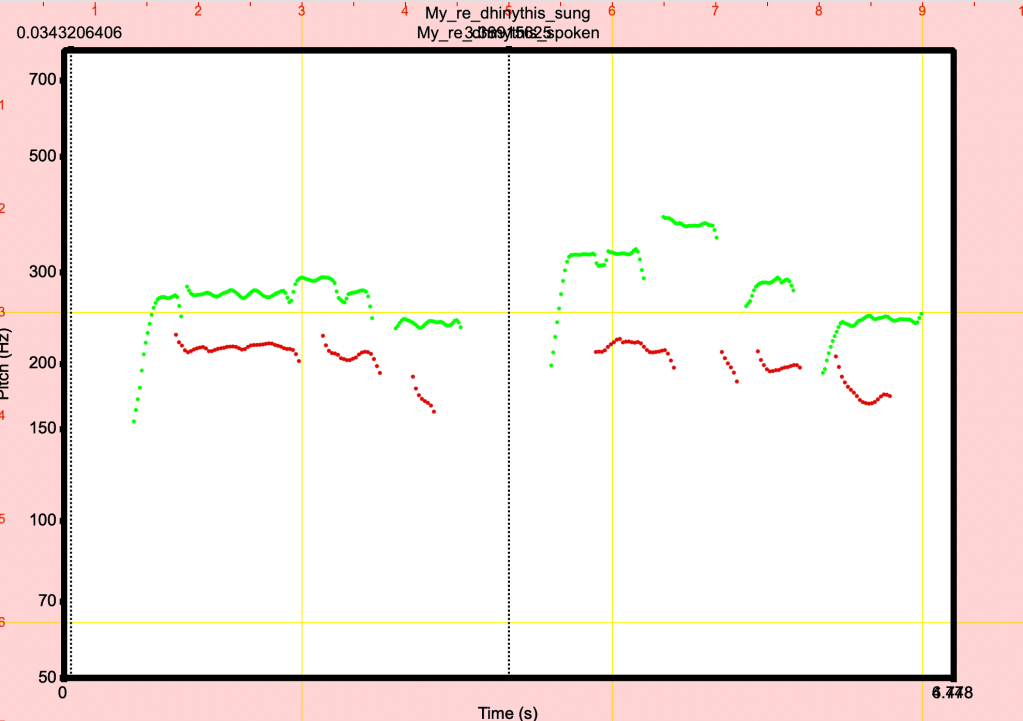
This is interesting, the sung line follows the spoken line quite nicely – until the end, where the dips in pitch of syllables are reversed, to become little lifts of pitch.
Intensity curveː
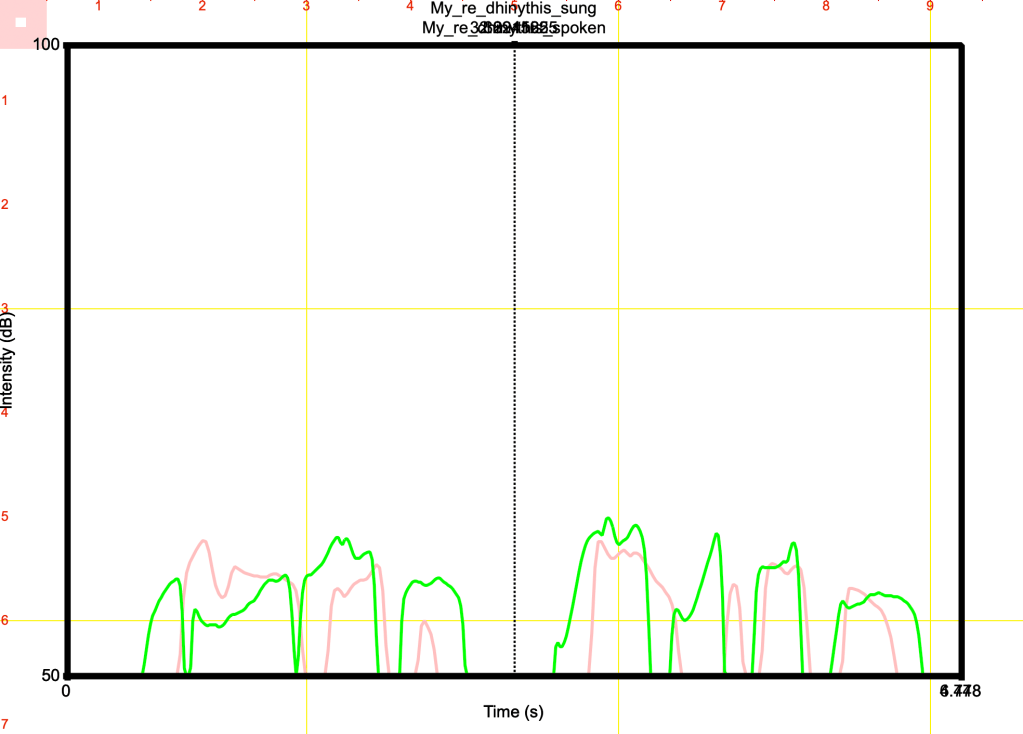
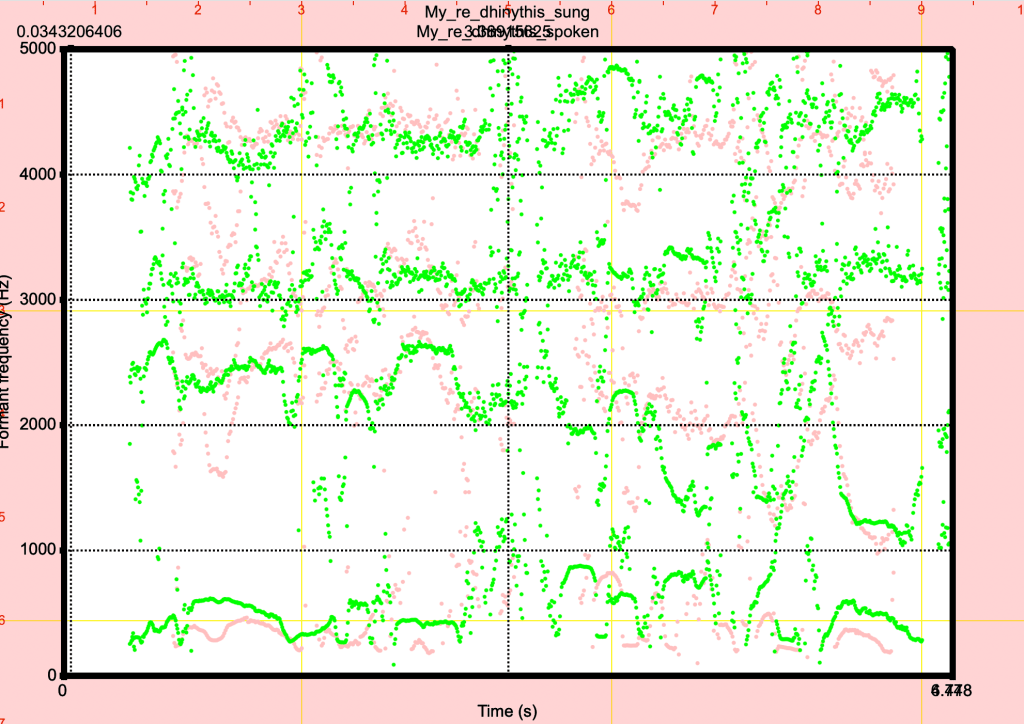
It is possible to plot the formants as well, like this, although I will not be using them for nowː
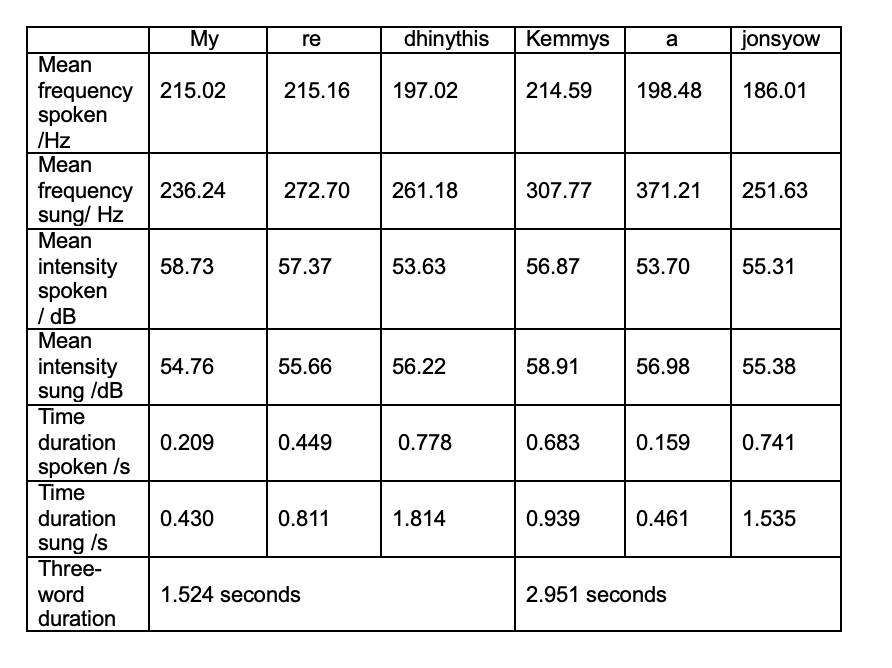
Praat, the acoustic analysis software, can also take measurements at points and over durationsː
Next lineː
An bewnansow ma yn keslinek /an/ /’bewnanz·ɔw/ /ma/ ɪn/ /ke̹z’li·ne̹k/
These lives in parallel
Spoken lineː
Sung line
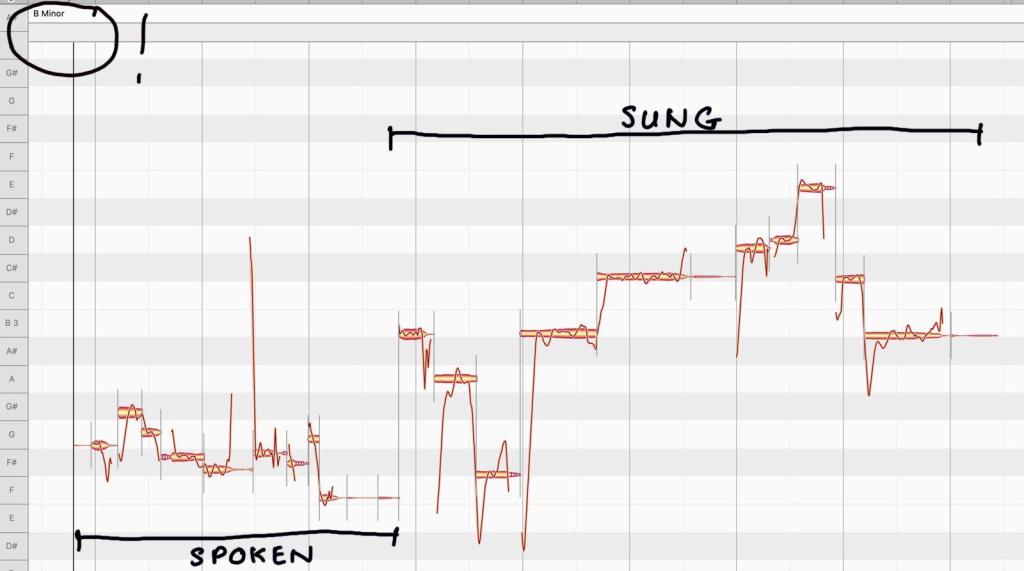
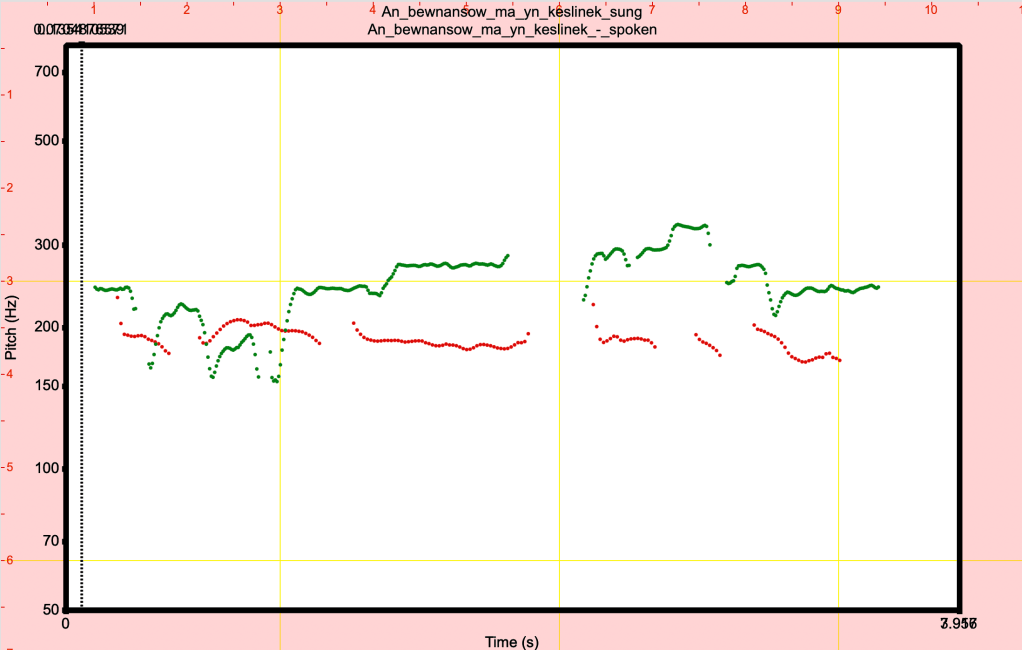
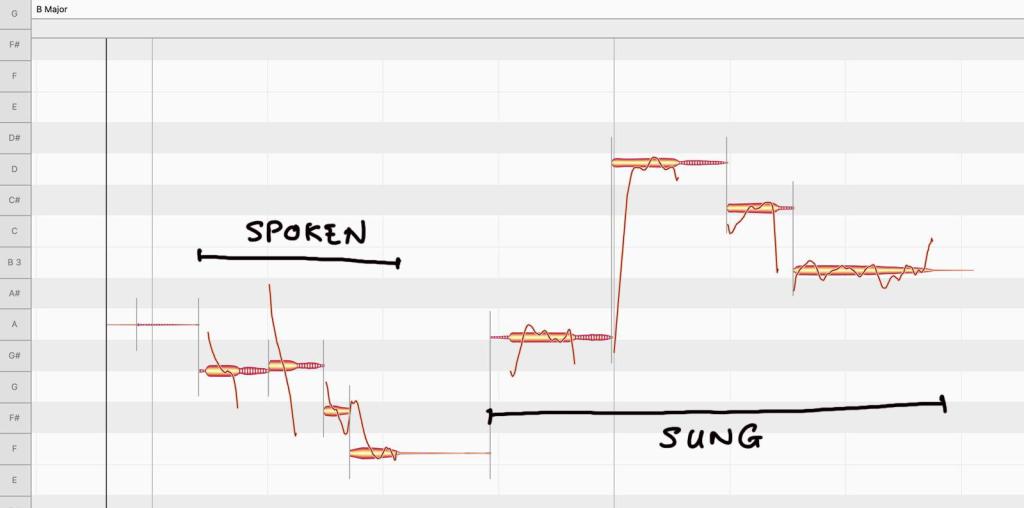
This first section of the poem comes to a close. The first sung note is now back to just two tones above the starting spoken note. This is the first time that the pitch of the sung melody line dips below the spoken pitch, albeit not by very much (just over a semitone, on the middle syllable ‘nans’ of bewnansow). The spoken line varies little in pitch, gradually lowering over its course. The sung line starts and ends on exactly the same noteː B3. Between those points it lowers in steps over the first three syllables, gradually rising until the last three syllables when it falls in similarly sized steps.
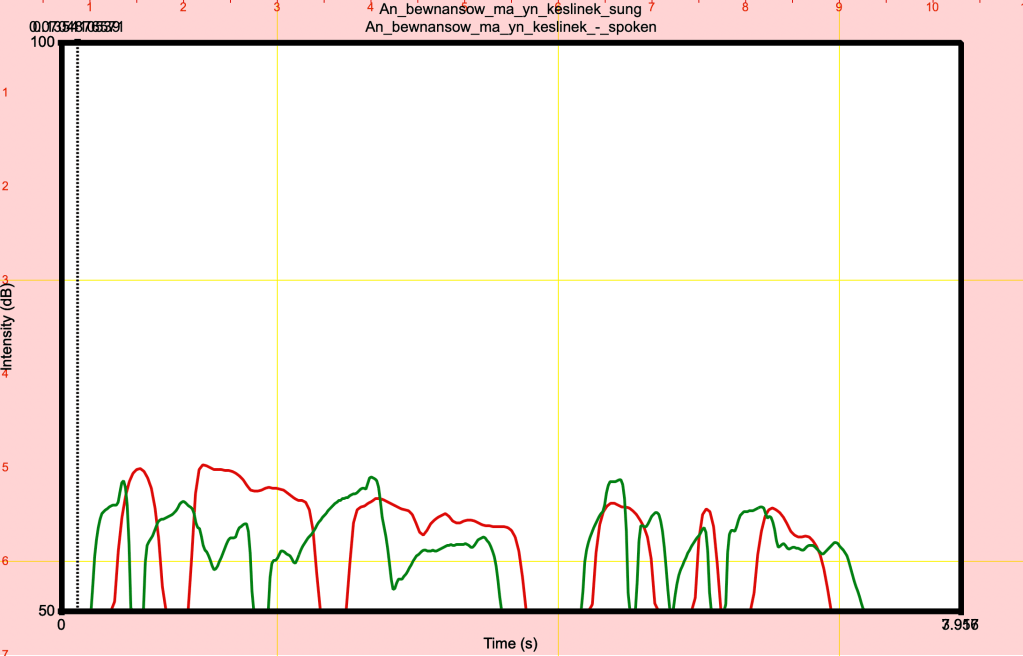
The intensity contour shows similar peaks reached by spoken and sung lines, but there is more variation within the sung line. It feels as if the singing of the line gives emotional colour through intensity, with volume varying more. It will be interesting to compare the singing of a song in two languages later; is this a feature of the song or of the singer, or of the difference between speech and song in that language i.e with that vowel distribution pattern. Does it reflect a personal lexis or just an interpretation of one poem in particular? Is it just what my subconscious considered artistically appropriate on that day at that hour, in that weather? This is not going to be an easy question to answer.
Next lineː
Felsys ov vy [’fe̹lʒɪz] [’ɔːv] [’vɪː]
I am split
Spoken lineː
Sung lineː
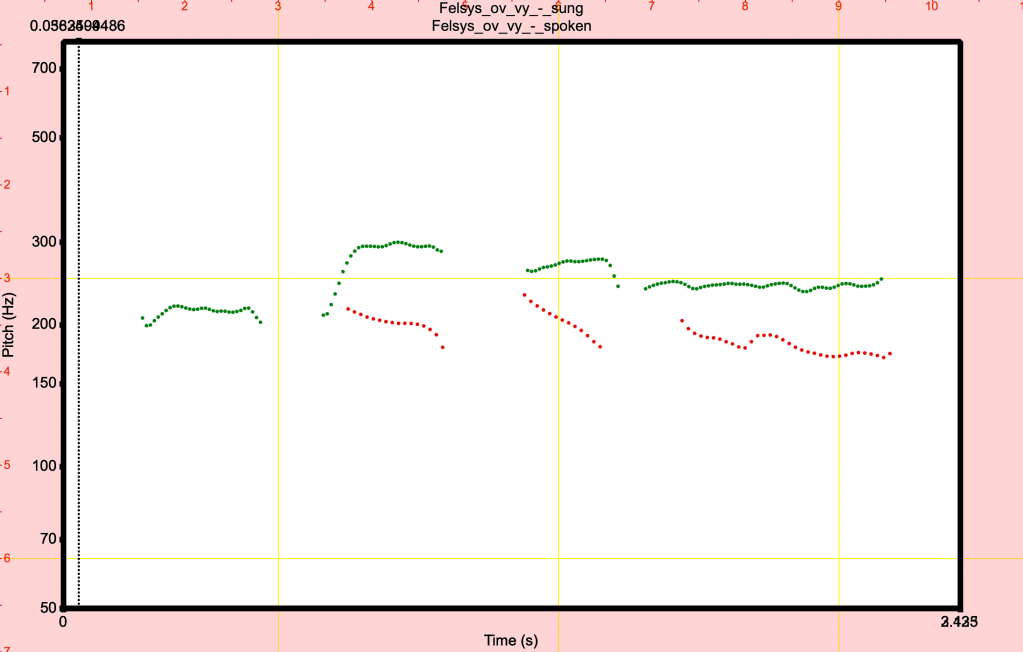
The pitch contour above is a little misleading – the first sung syllable is very close to the pitch of the first spoken syllable. The time scale along the bottom is different for each and covers the duration of the clip, so they can actually be compared better (usually) than if they were using the same scale. However, in this case, there is a silent part at the beginning of the spoken file, so the sound shapes are not lining up quite so well.
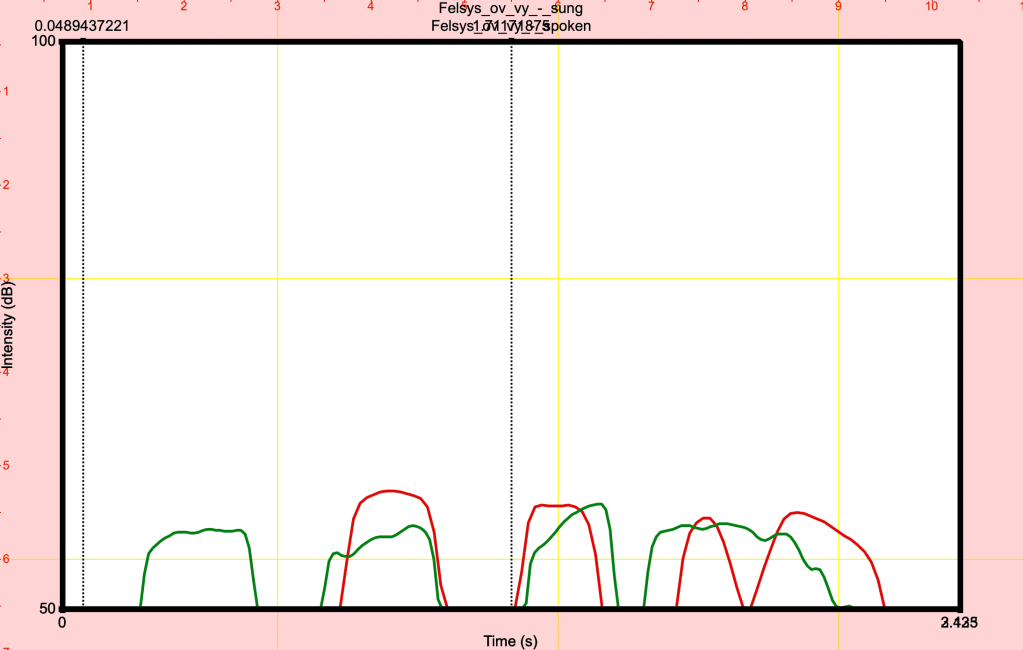
Again, the first ‘dome’ of the red spoken line should be compared with the first dome of the green sun line. The is more volume emphasis at the beginning of the spoken line than the sung one, which feels more fluid even though the syllables are as clearly distinguished as when spoken.
Next lineː
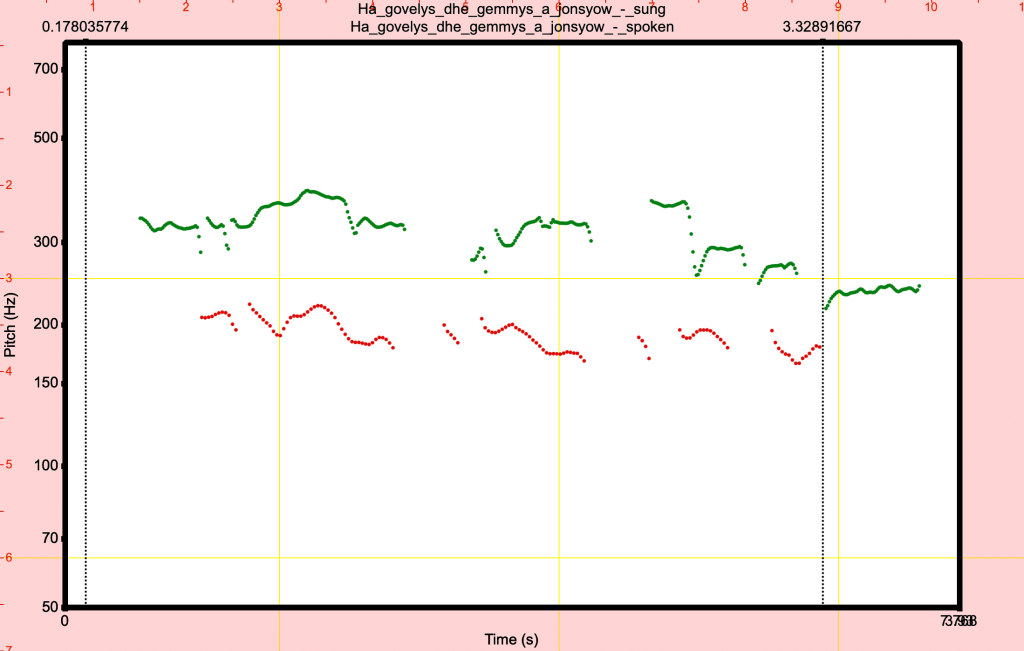
Ha govelys dhe gemmys a jonsyow [ha] [gɔv’e̹·lɪz] [ðe̹] [’ke̹miːz] [a] [‘dʒɔːnsjɔw]
And forged into so many chances
The spoken lineː
The sung lineː
A starting interval from Ab, possibly A, to E, so at least 3.5 tones, but with the general falling pattern over the phrase preservedː
The intensity contourː
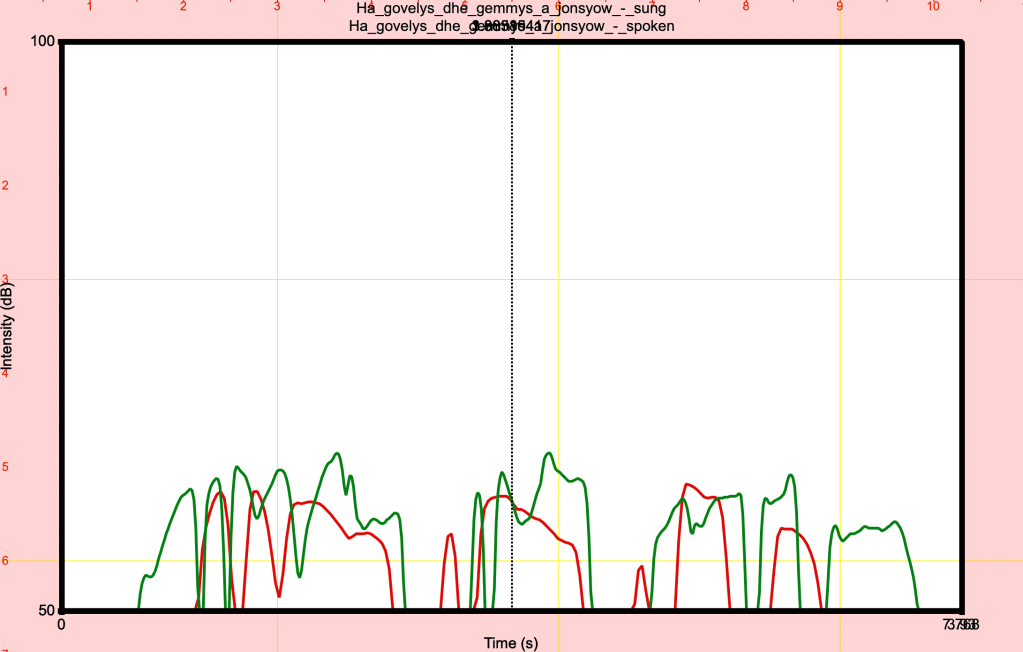
The sung line begins and ends at a similar intensity to the spoken line, but swells towards the middle.
Next lineː
Dewgh war-barth, a dhestnansow, [de̹ʊx] [war’barθ] [a] [‘ðe̹stnansɔw]
Come together, destinies,
Spoken lineː
Sung lineː
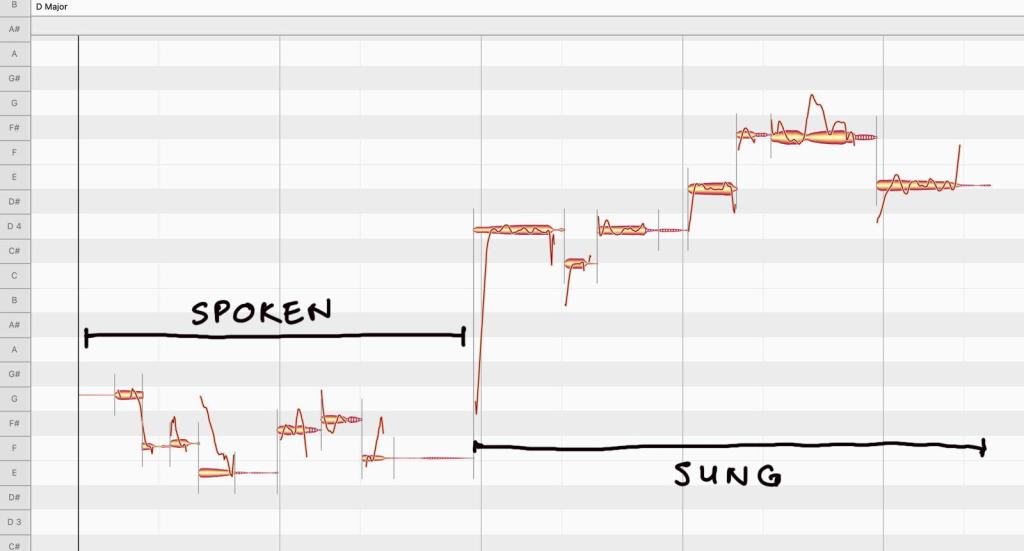
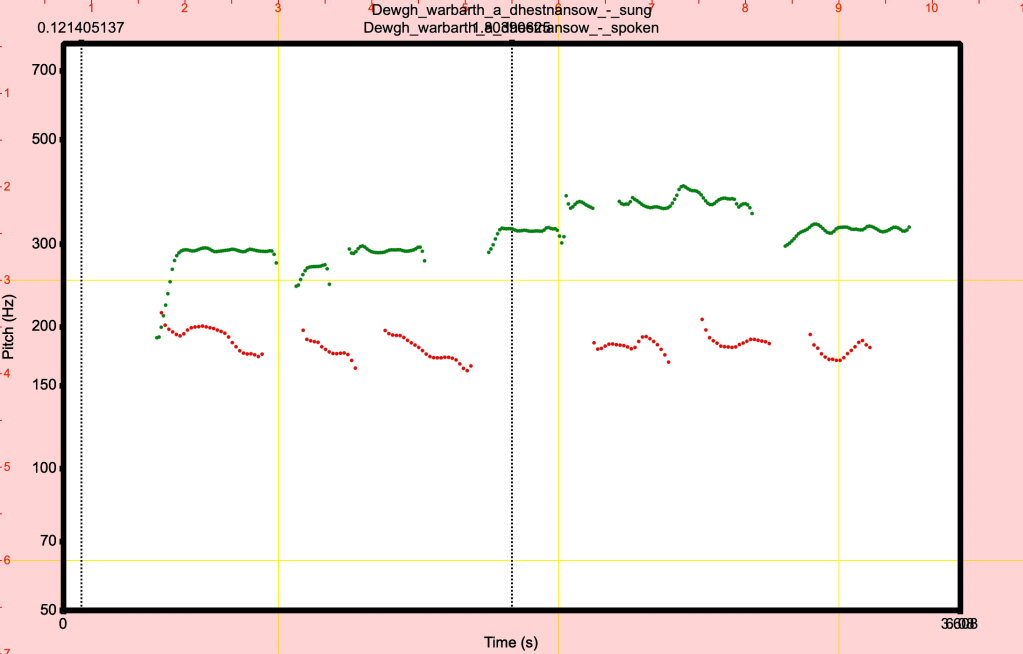
The pitch stays much the same across the spoken line, falling a little on each syllable; when sung, there is a general lift. The sung line starts 3.5 tones above the spoken line; it ends 5.5 tones above; almost an octave.
The intensity contour is markedly differentː
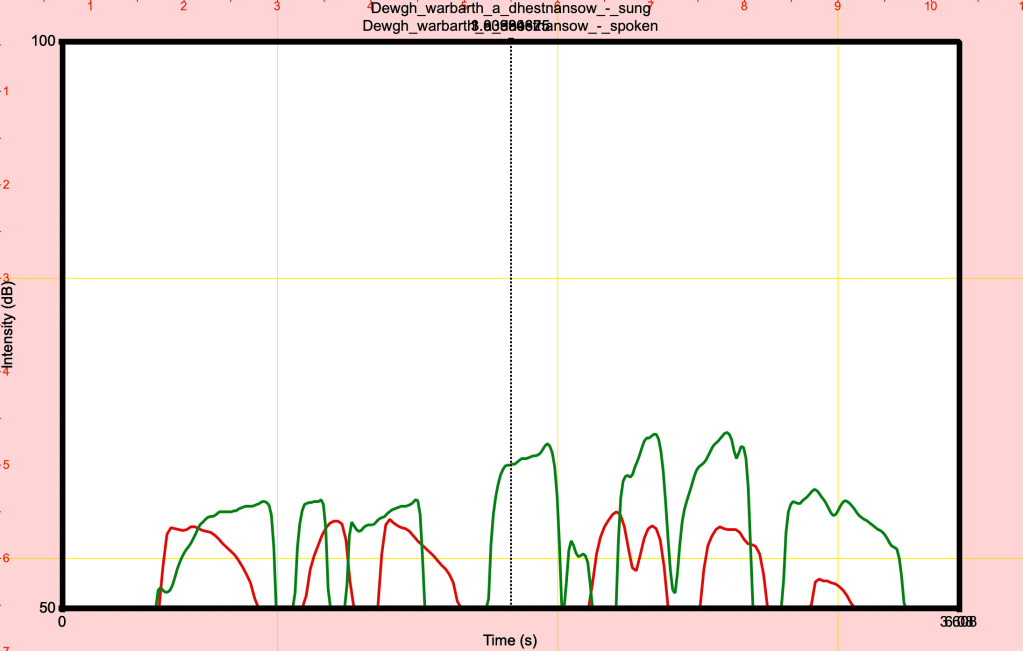
‘Dewgh warbarth a dhestnansow’ is the heartline of the poem, a command and an invocation; come together, destiniesǃ The intensity of the sung (mutated) final word, dhestnansow, is more than double that of its spoken equivalent in places.
Why? It felt natural and right to do it that way at the time is the only solid answer. It seems reasonable that the intensity – the loudness – might increase with raised emotion, for emphasis. But is this a convention of English projected onto Cornisħ? Probably not – Cornish speakers do occasionally raise their voices in Cornish at each other in temper. The volume of the singing gets louder when sung, while the pitch only changes a little. The line is a call to personal destinies, and projects the narrative beyond the contemplative position of the first part. In a sung poem, is it a verse or a stanza? There needs to be a word for it.
Next lineː
Re’gas gorriv yn bagas yn delit [re̘·gas] [‘gɔrːɪv] [ɪn] [‘ba·gaz] [ɪn] [de̹’liːt]
Let me group you in delight
Spoken lineː
Sung lineː
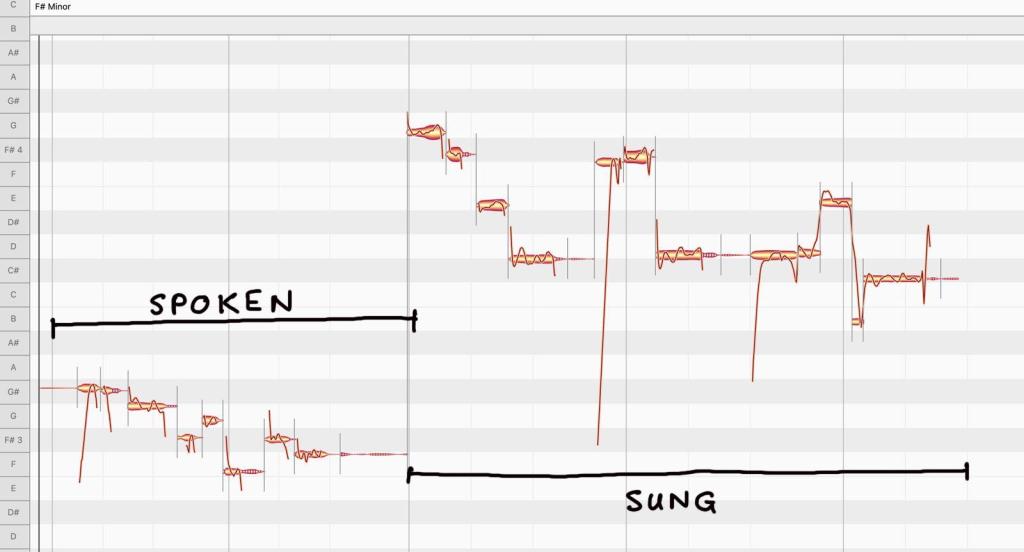
So, another big pitch rise for the sung start; almost an octave (5.5 tones). The pitch falls across the phrase for both lines, fairly evenlyː
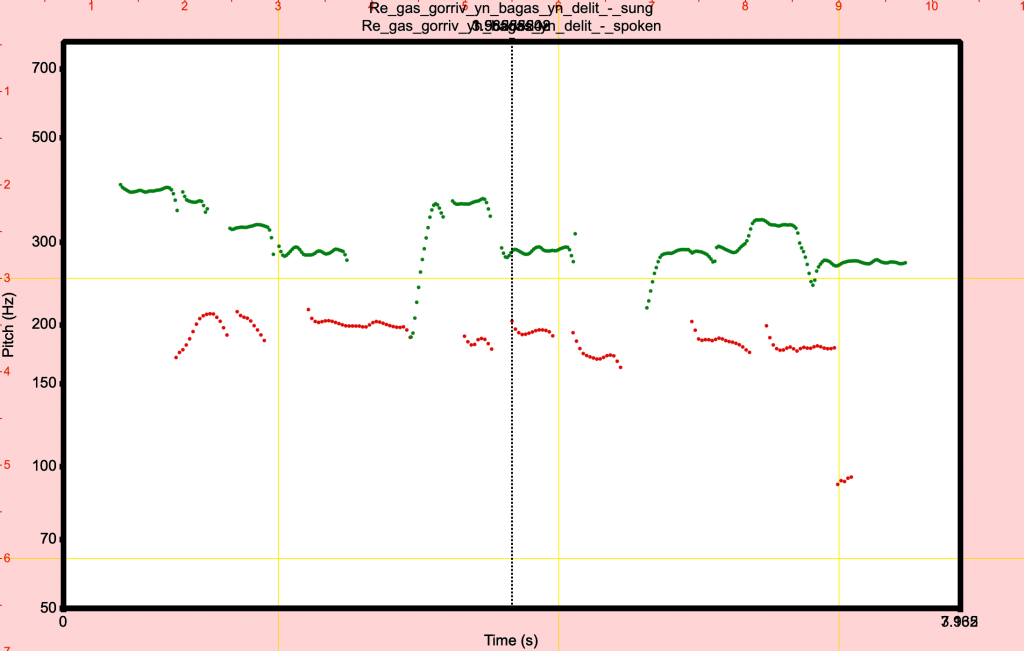
And for intensityː
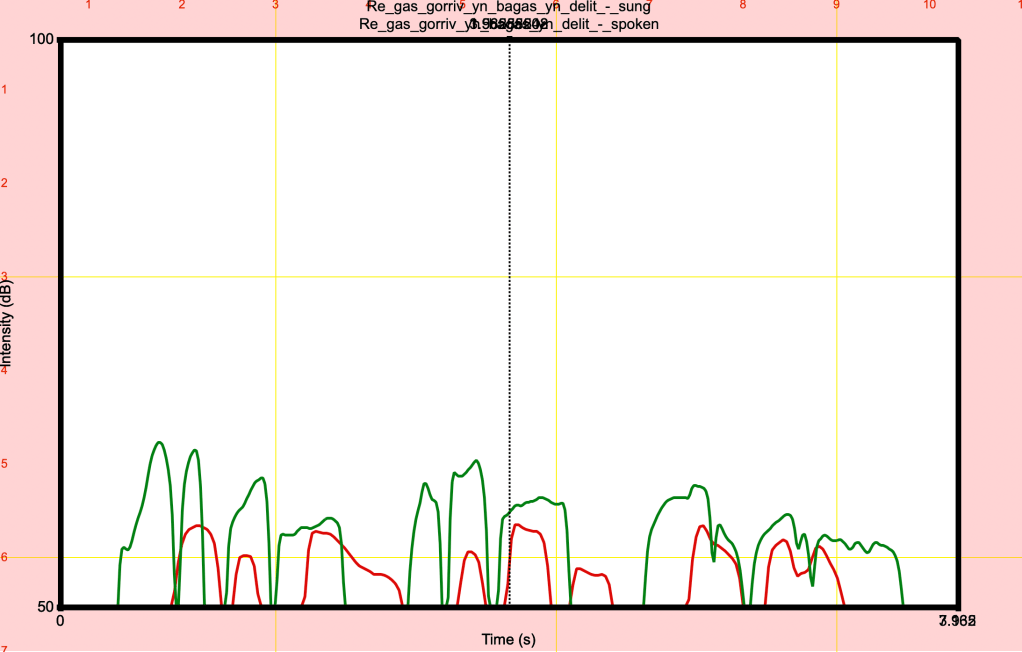
The difference between sung and spoken intensity decreases gradually over the course of the phrase. The intensity for the spoken line is fairly constant; for the sung line, it starts at a high intensity, following on from the phrase of the previous line.
Next lineː
Ha’gas shackya [ha·gas] [‘ʃa·kja]
And shake you.
The spoken lineː
The sung lineː
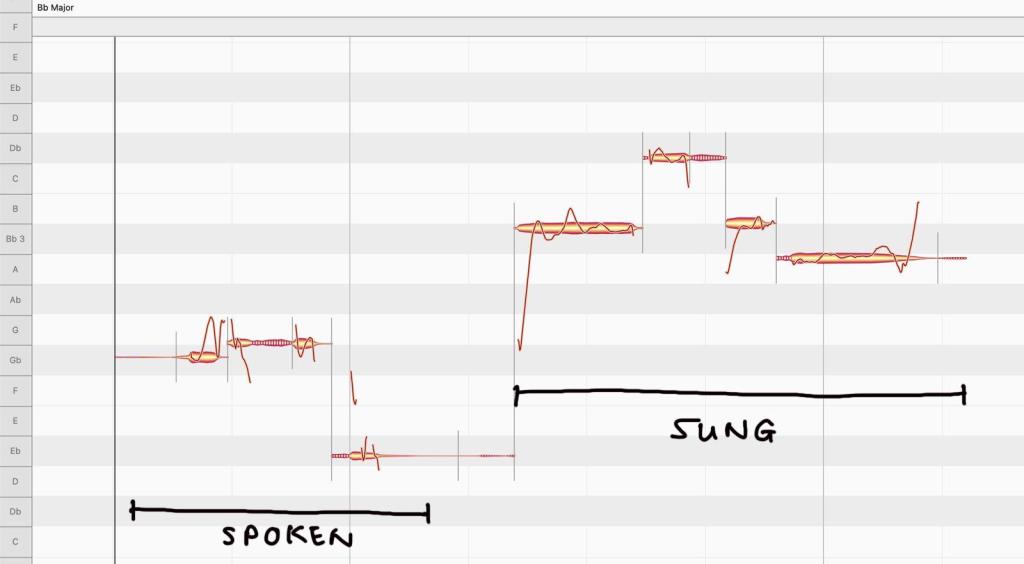
Just two tones between the starting spoken note and the starting sung note this time.
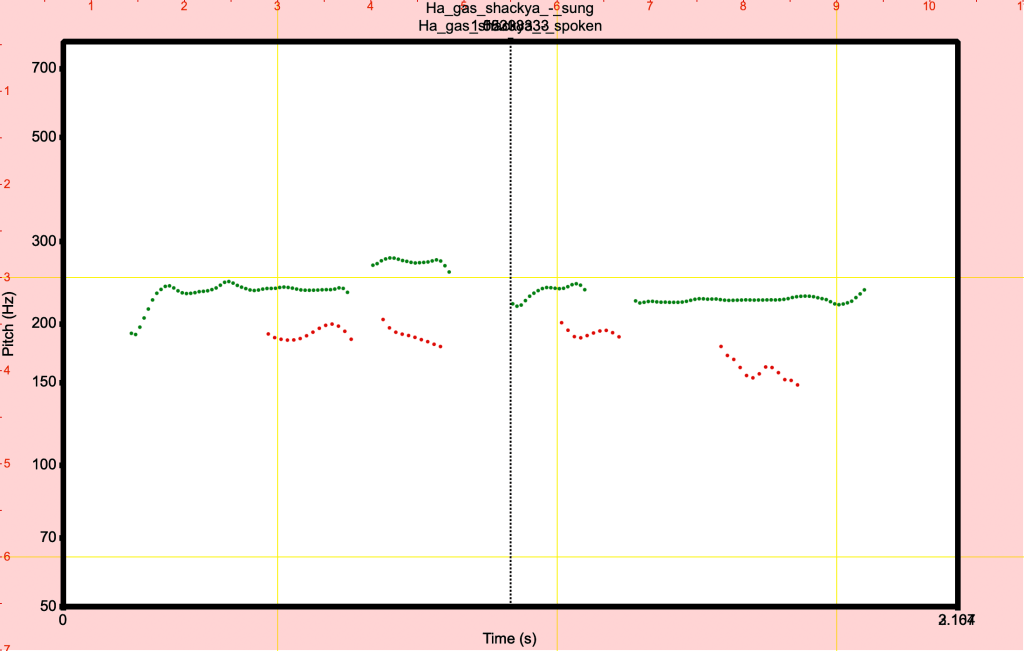
This is fairly steady for both spoken and sung; if anything, there is more variance over the phrase for the spoken. The phrase itself is a continuation in sense of the previous line – as mentioned above, it is a continuation.
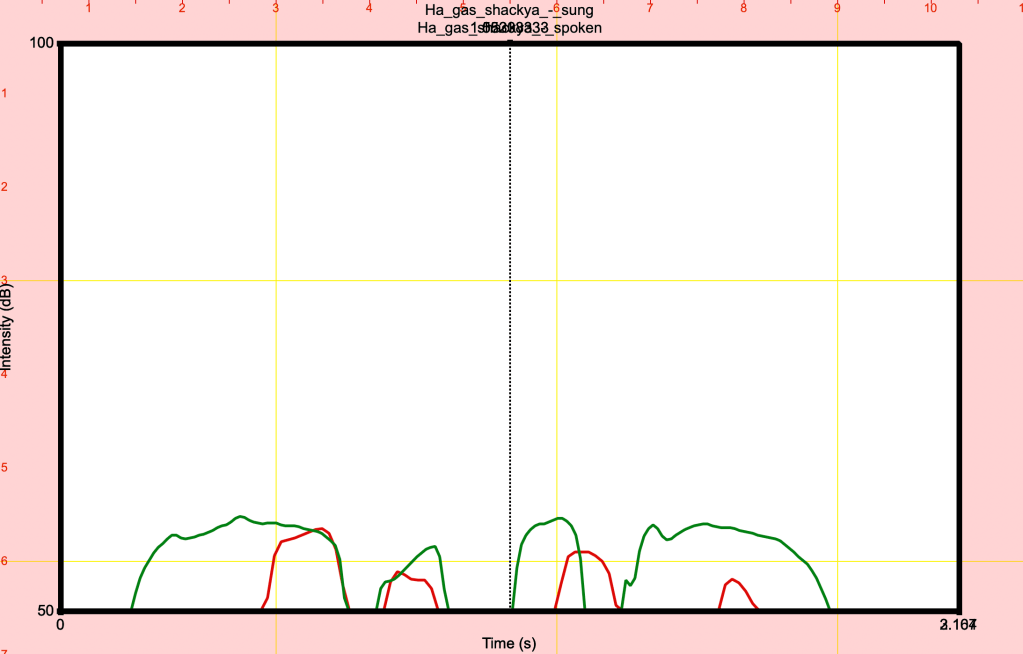
What is driving the intensity variation? The vowels being sung or the meaning? Does pitch vary with something else? Are the conventions of poetry or song dominatinɠ?
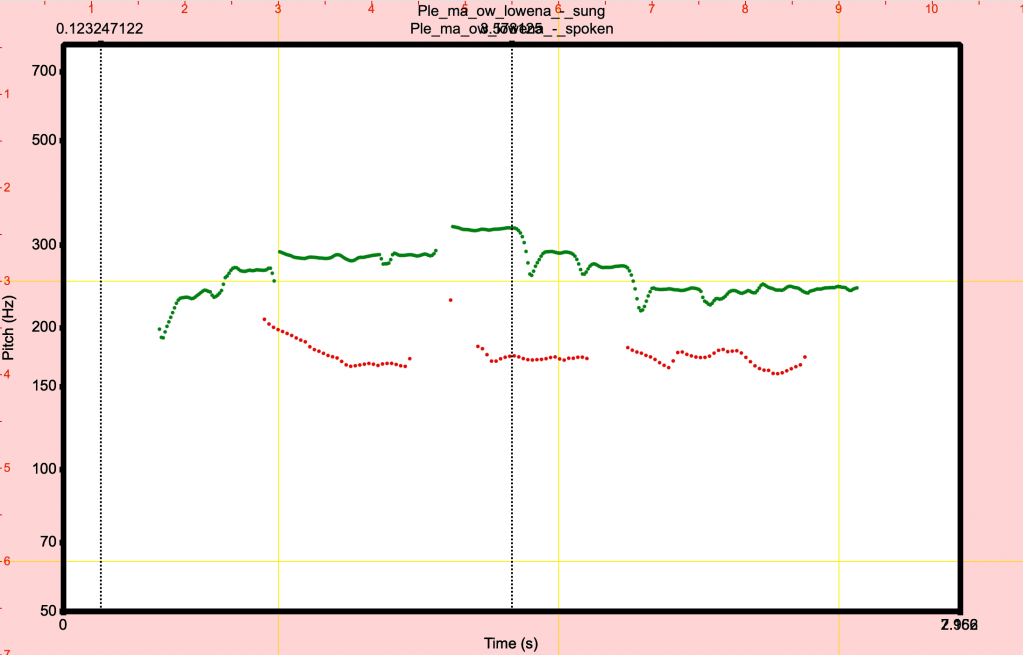
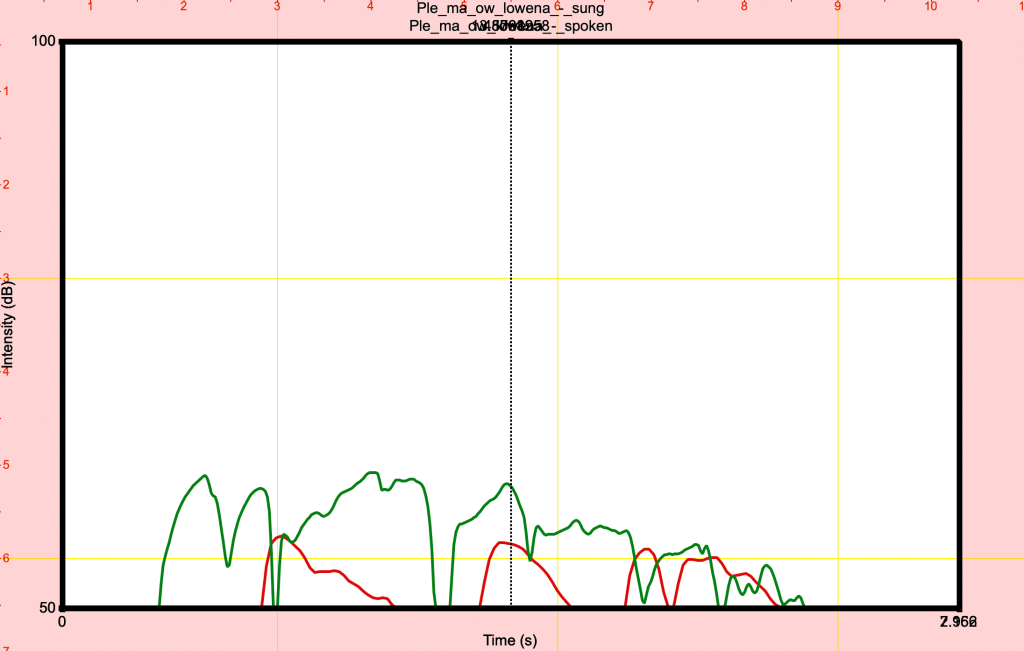
Ple’ma ow lowena? [‘ple̹ːma] [ɔw] [lɔ’we̹·na]
Where is my joy?Spoken lineː
Sung lineː
This is the final sung line of the poem. It is possibly the most self-consciously melodic of all of them, differing from the spoken line by rising in steps of pitch and then descending the same staircase. The spoken line reduces slightly and very gradually in pitch.
The intensity profiles differ between sung and spoken, too. The spoken line fades slightly. The sung line is significantly louder than the spoken line at its beginning. By the end, it, too, fades to nothing.
The final line of the poem is spoken in both the spoken and sung versions. The words come from a voice beyond the speaker; they come from the Underworld (this is part of the Inanna story). I’ve included the spoken line twice, once from when the whole poem was recorded spoken and once from when the whole poem was recorded sung; these were different occasions, a few weeks apart, last year. It is mainly to see what changes from one occasion to another when the same person reads the same words.
Perfydh yw fordhow Annown [‘pe̹rfɪð] [ɪw] [‘fɔrðɔw] [‘anːɔʊn]
Perfect are the ways of the Underworld
Spoken line from all-spoken poemː
Spoken line from sung-poemː
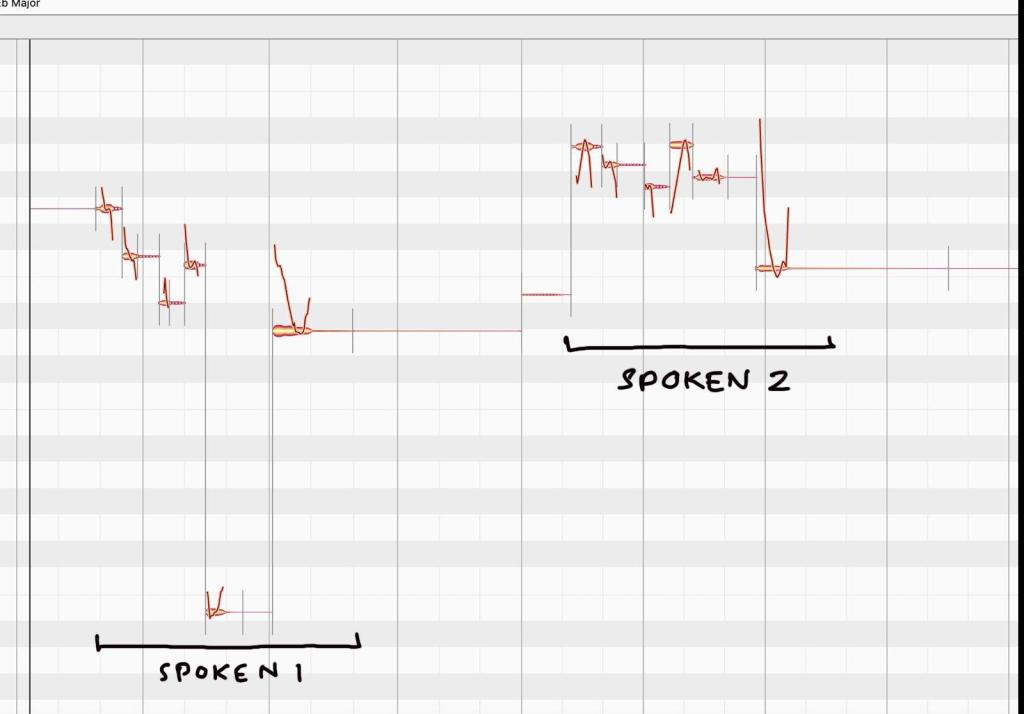
The patterns are very similar, not surprisingly. Interestingly, the second spoken line starts higher; the preceding lines of the poem had just been recorded, and they were all higher than the spoken lines, so that might have influenced it.
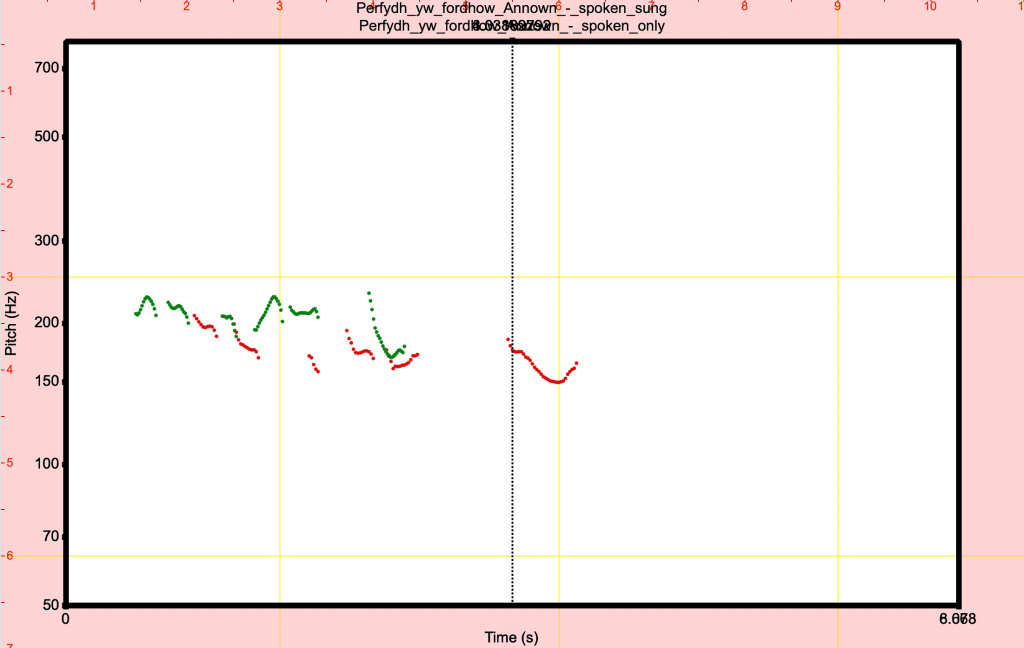
Again, these are not lined up properly. The pitches are not very different.
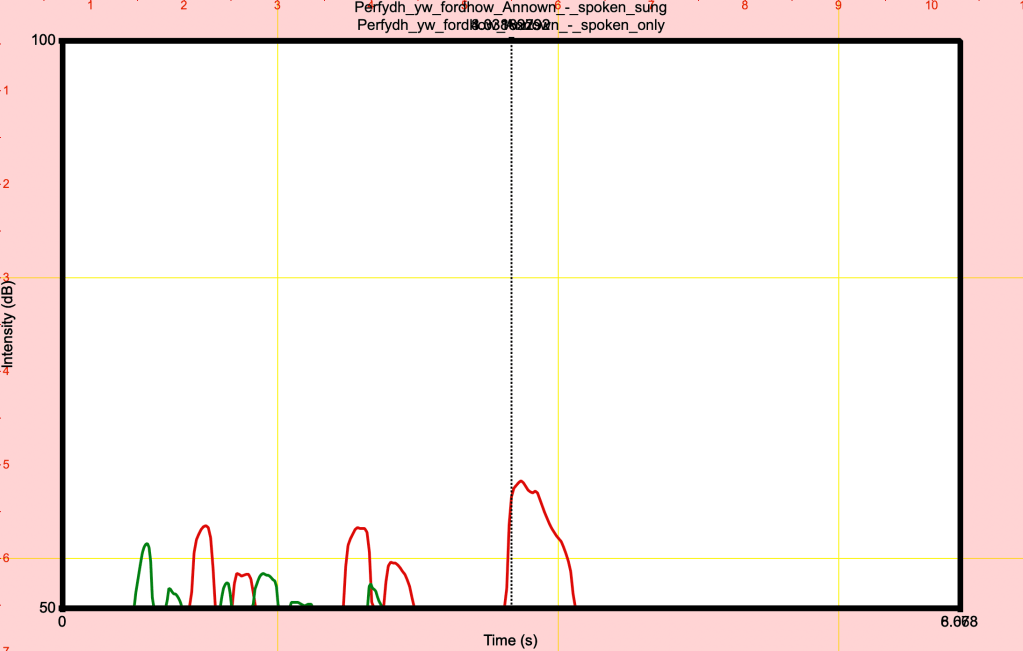
The intensity profiles are different, however. The line spoken in an all-spoken poem finishes on a crescendo. The line spoken in the sung poem starts more quietly and fades to nothing.
Final thoughts on this sung poemː
A sung poem is not a song-poem – it implies action being brought to bear on something. In this a poem is a real thing, even if it does not have form, just as the ‘house of song’ described in the introduction is a demarcated space on the ground, one with no form, and one in which a poem is made. A sung poem should be an idea that flies, not one that is pinned down under glass, and I realise that that sounds pretentious. It’s still true. Every time the poem is sung it is remade afresh, for that place or audience.
This may not offer solid conclusions on the relationship between the sounds of words and the sounds of music, but it has helped me to gain a felt insight into a personal syntax of song. I highly recommend this experiment to othersǃ
It has not answered questions so much as posed more.
For instance, is there a difference in how the person delivers the lines as they run into each other? It feels more fluid for the sung ones, with less of a ‘this line ends here’ sense. Singing feels like communication of feeling, not just of thought.
It feels as if singing the line creates an imaginary audience in a way that speaking it does not, notwithstanding my views on the supreme importance of audience. To put it another way, to sing the line to oneself feels like practising for a performance. Speaking it to oneself feels less like this. This may be a purely personal reflection. I am not sure why I feel so strongly about it. When considering a distinction of form and substance of a thing, does the context of that thing’s existence come under the form or the substance or does it unite the two? The truth of the nature of the sung-poem lies in the distinction. Singing a poem feels like a conjuration, particularly when it is a lyric poem. It is not the poet speaking to themself, it is the poet speaking to the world through themself, and that is a kind of drama, too.
Is there a synthesising, an integration of all previous experience of song styles? Especially when applying a new idea? Am I applying the rules of speech to song or the rules of song to speech or am I making it up as I go along? I feel a degree of internal logic is there, and that needs to be poked with a sharp stick, i.e. further investigation, but it is hard to know who is investigating what, and what is investigating whom.
Does the smaller sound palette of Cornish vowels reflect in greater length of vowel sounds in spoken and sung recordings? How can this be tested?
In a spoken/sung utterance, there may be particular ways of changing meaning and there may be a particular sound of a language. For instance, and rather fancifully, might consonants, as rhythmic pulse points, shape one and vowels shape the other? Might relative pitch movements signify one kind of meaning and the intensity attach significance? There are many variables to test.
 Lyric Cornish