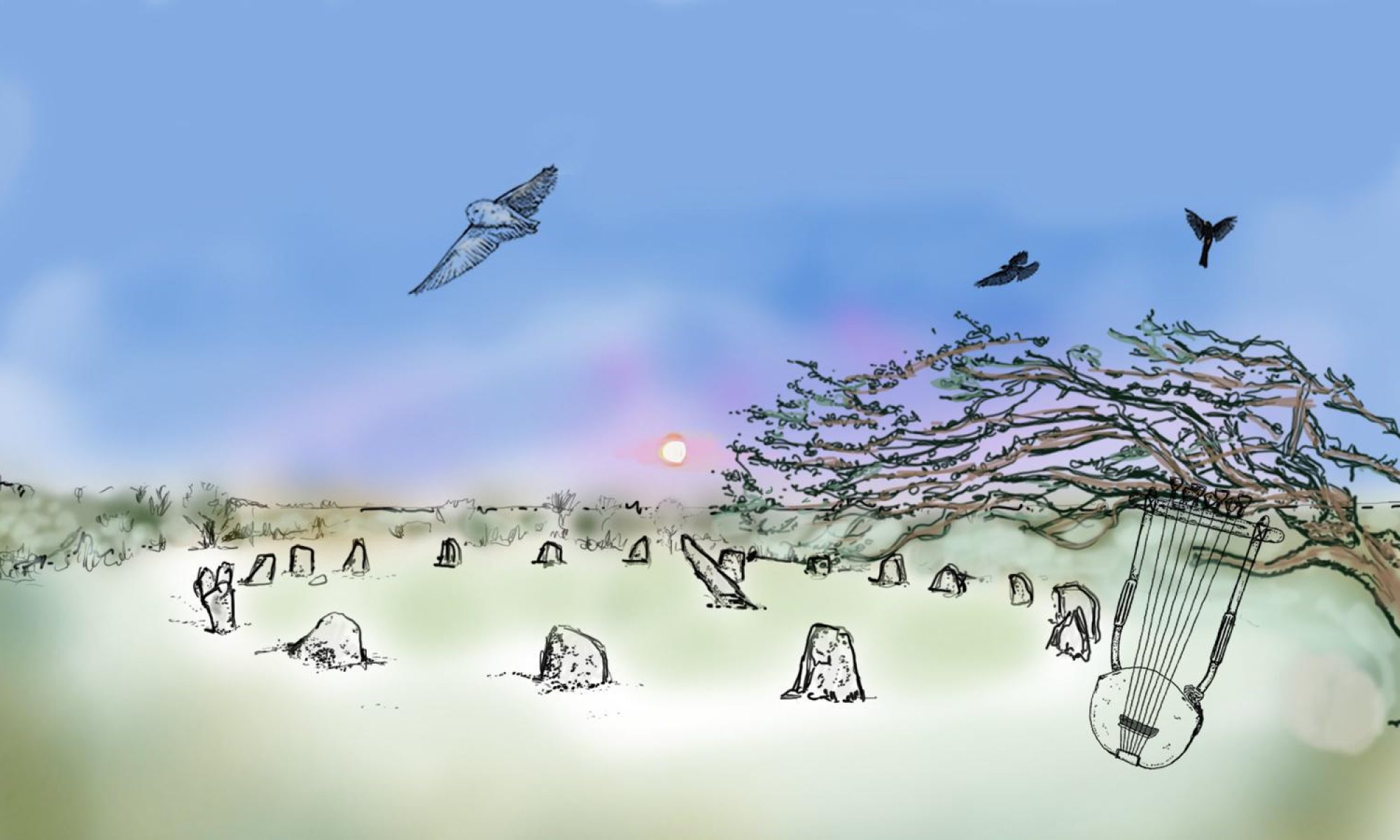
These are the consonants and semi-vowels of Cornish words, as outlined by Ken George in his Gerlyver Meur (Kernewek Kemmyn):
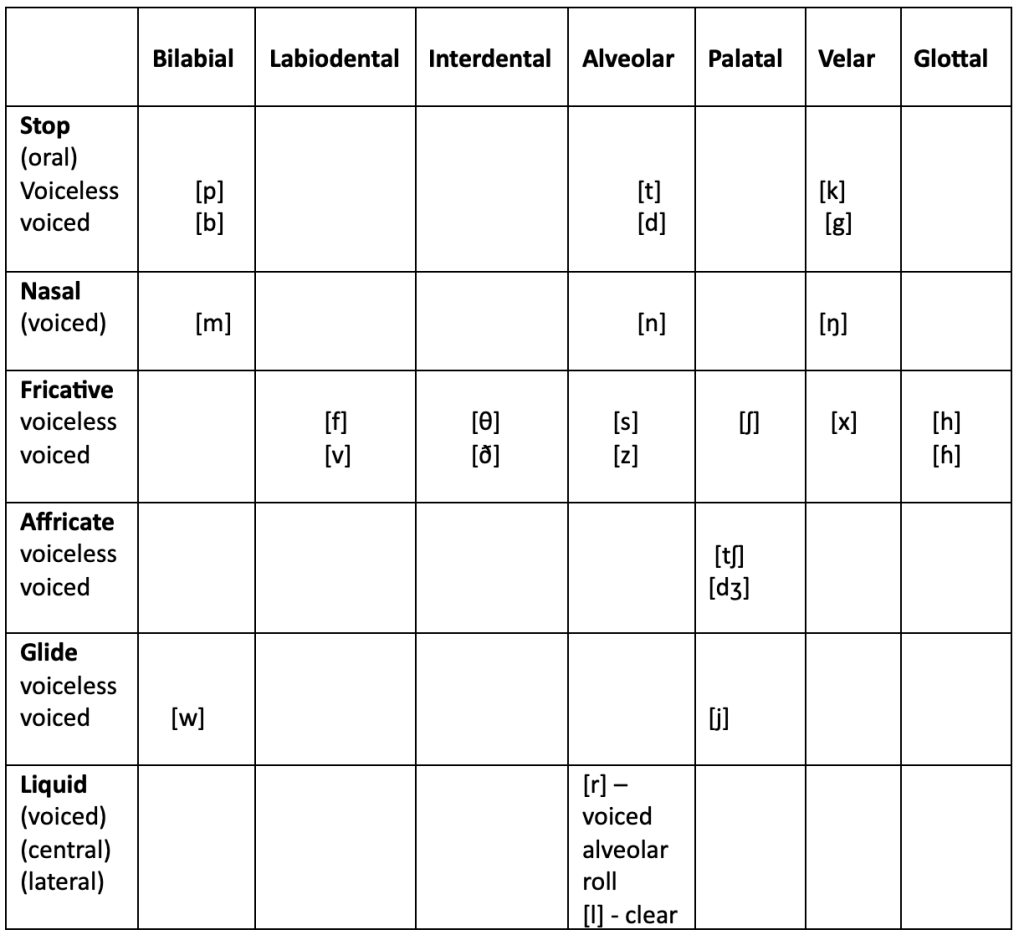
Other ways of classifying consonants:
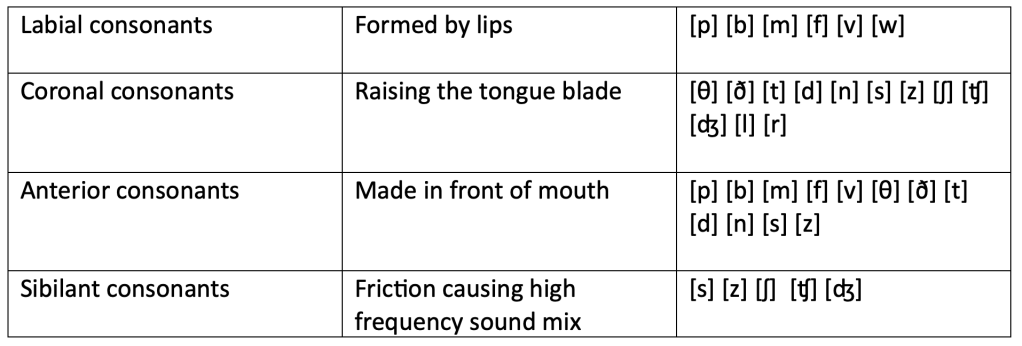
Ease of singing with resonance will depend upon how obstructed the airstream is in the oral cavity:
Articulatory changes with mutationː
Second mutation changes the unvoiced plosives /p/ /t/ and /k/ into their corresponding voiced plosives /b/ /d/ and /g/ . They are articulated in the same parts of the mouth as before.
Third mutation changes the plosives /p/ /t/ and /k/ into the fricatives /f/ /θ/ and /h/ and in each case, they are formed slightly further back in the mouth than before.
Fifth mutation will be relevant if songs use literary language with Y particle conjugation.
VOWELS make up the heart of the syllable:
onset (consonant)– peak/nucleus (vowel) – coda (consonant)
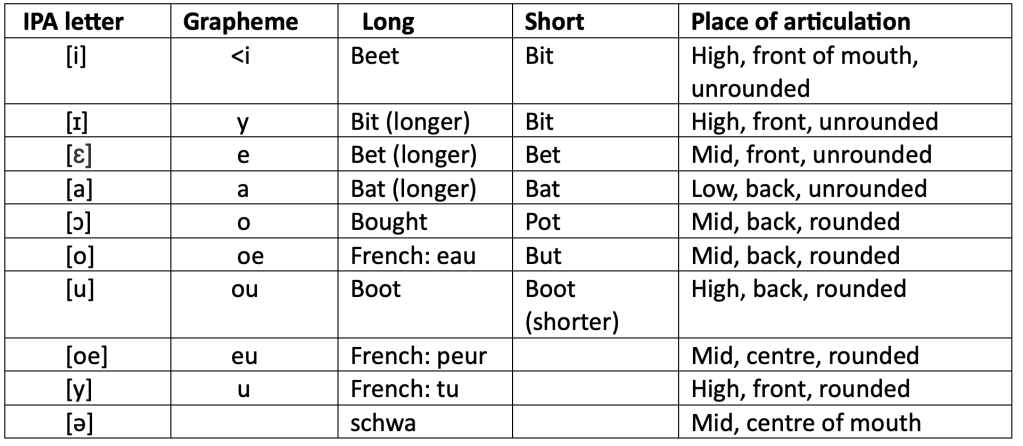
A colon indicates a longer sound; [i] = short [i:] = long [i·] = mid-length
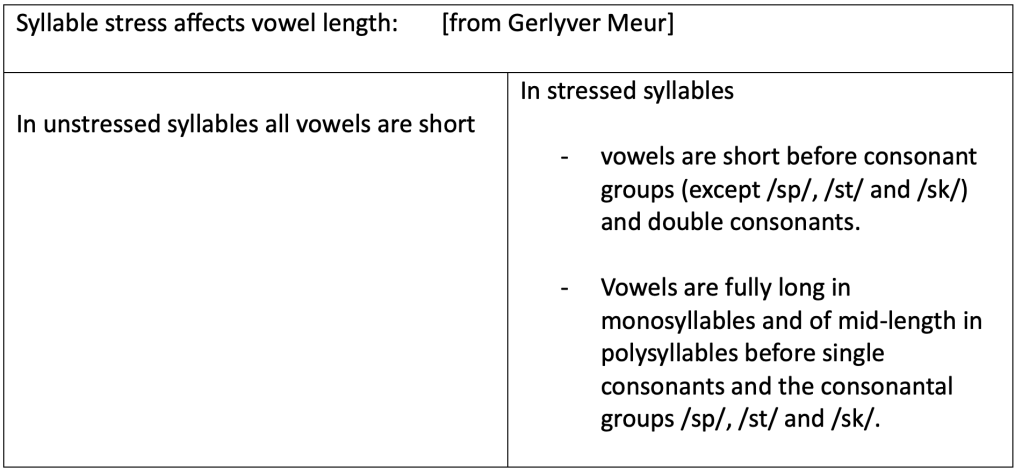
Vowel sound depends upon how far back the tongue is situated in the mouth during articulation, and also how high the tongue is in the mouth. Height can also be seen in terms of degree of openness of the jaw. An open jaw equates to a low height of the tongue.
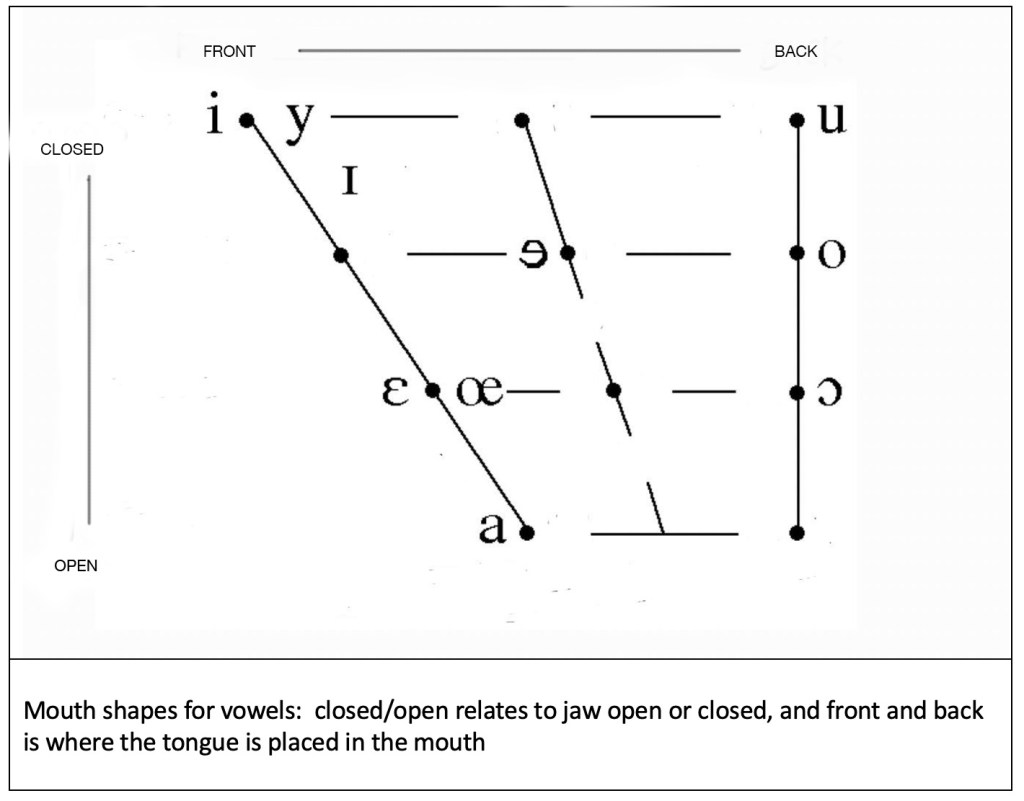
Diphthongs – vowels combined together:
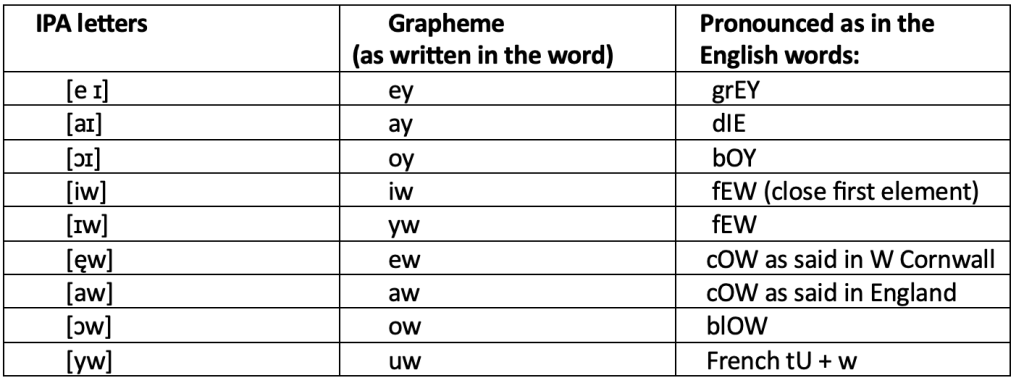
The place and manner of articulation are the segmental values of speech.
Stress, length and pitch are suprasegmental; these are the prosodic elements. Different languages use stress and pitch differently, in terms of creating meaning. A pitch-inflected language, such as ancient Greek, uses pitch to alter meaning. English uses stress; ‘desert’ can be pronounced in two ways, depending on whether the issue is abandonment or geography. ‘She chose to desert them in the desert.’
Cornish does not do this; it is considered to be a syllable-timed language, as are Welsh and Breton – and French and Spanish. The syllables in these languages tend to be much more regular in length. Stress does exist but it tends to follow the structure of the word rather than the meaning. The result is a fluid pulse of sound rather than an irregular staccato one. In English verse, the irregularity of the line is a feature that can be played with to dramatic effect. This is one reason why singing Cornish ought to work nicely for poetry – it adds all the warmth and emotion that music is considered to convey.
It follows that metre is also likely to be important in Cornish; Jenner’s notes on prosody in his 1904 Handbook of the Cornish Language show that there were accepted patterns for verse.
FORMANTS
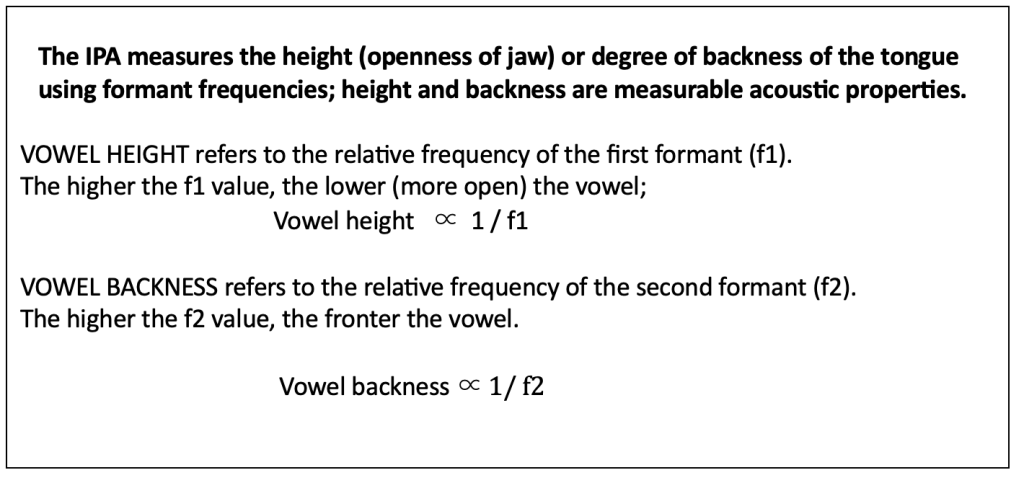
On a frequency spectrogram, vowels can be identified by horizontal dark bars that represent the frequencies of overtones, or formants. The placement of the tongue for vowel articulation changes the shape and volume of the vocal tract, with acoustic consequences:
F1, the first formant – A high F1 value indicates a vowel made low in the mouth (such as [a]) and a lower value suggests one made higher in the mouth (such as [ɪ])ː
Tongue height ∝ 1 / formant frequencies
F2, the second formant) – relates to tongue advancement/backness.
Front vowels (such as /i/ have a high F2, while back vowels have a low F2.
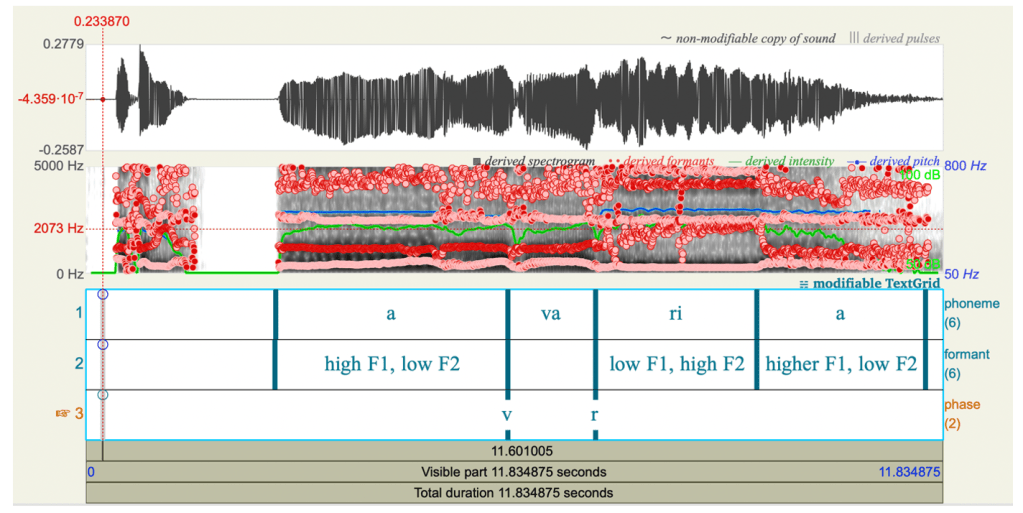
The spectrogram for the first line of A Varya (the first two bursts on the far left relate to spoken words) shows this. The blobby pink/red lines are formants and five are visible, with F1 at the bottom and F5 at the top. The extended [i:] has a lower F1 and a higher F2 than the extended [a].
Vowel Space Area (VSA): The area formed by mapping F1 and F2 of corner vowels (typically /i, u, a/), which represents the total “articulatory working space” of a language.
In speech, vowel duration can distinguish short and long vowels, although this is likely to be artificially altered in songs that are melody-driven.
SONORITY [see Devine, The Prosody of Greek Speech]
Sonority is a combination of factors, including intensity (amplitude i.e. volume), greater duration, periodicity and spectral composition. Not all high intensity sounds have greater sonority e.g. fricatives have lower sonority than nasals.
Sonority increases from the onset of a syllable to its nucleus and reduces through to the coda. If a consonant cluster is divided between coda and onset, the more sonorous consonant tends to be placed in the coda.
Decreasing sonorityː
Vowels > glides > liquids (central R types are more sonorous than lateral L types) > nasals > fricatives [voiced fricatives > voiceless fricatives] > stops [voiced stops > voiceless stops]
If phonemes are the molecules of speech, syllables are the foot soldiers of prosody. They combine and can be grouped through the divisions of the foot, the word, the phrase and the utterance.
Cornish is a syllable-timed language like Italian, rather than a stress-timed language like English.
Ultimately individual syllables that take a stress. The patterning will dictate both the meaning and the feel of the final utterance, the poem or song in question.
Other prosodic considerations:
Pitch
Stress
Conscious and unconscious melody – prosody
Metre – is there a link between rhythm in common speech and rhythm poetry? This is a complex area. It will be further complicated by introducing conscious melody.
Writing in the early 20th century, Jenner reflected upon prosodic change in Cornish verse. He observed the existence of two Welsh styles, the formal y Rheolau Caethion, and free verse y Rheolau Rhyddion.
Old Cornish was very formal in structure; the whole of the Passion was written in stanzas of eight seven-syllabled lines, although four-syllable lines could be mixed in. The pattern was similar for other works, although rhyme arrangement of the stanzas varied by work, and number of lines in the stanza.
e.g. A A B C C B or A A B A A B – Passio Christi (the second Ordinalia play)
From Jennerː
In the Drama of St Meriasek there are ten classes of stanza, counting by the number of lines to the stanza, and there are many more created by alternating or mixing seven-syllabled with four-syllabled lines in various ways, and by varying the number of sets of rhymes to a stanza and the order of those rhymes.
A specimen of one of the most elaborate (1.168-180):
It is a thirteen-lined stanza of twelve seven-syllabled lines, and one (the ninth) four-syllabled line, with four sets of rhymes, rhyming:
A B A B A B A B C [4 syllables] D D D C.
Gelwhys ydhof Conany, Called am I Conan,
Mytern yn Bryton Vyan; King in Little Britain;
Han gulascor pur yredy And the kingdom very readily
Me a beu ol yn tyan. I own all entirely.
Der avys ou arlydhy Through the advice of my lords
Mones y fannaf lemman I will go now
The Duk pen a chivalry, To the Duke the chief of knighthood.
Nesse dhymmo yn certan Second to me certainly
Par del yu ef Like as he is.
Yma maryag galosek There is a mighty marriage
Cowsys dhyn rag Meryasek Spoken to us for Meriasek
Mergh dhe vyghtern gallosek, Of the daughter to a mighty king,
Nynses brassa yn dan nef. There is not a greater under heaven.
By varying the number of lines and rhymes to a stanza, varying the distribution of the rhymes, and mixing lines of different length, an almost infinite variety may be obtained, even with only two forms of line.
Jenner notes that rhymes were often forced to fit the strict metre. This suggests that the rhythmic sound of the thing was key; audiences would, presumably, have understood the cramped/elided words in context. Jenner says that “rhyming is stricter to the eye than the ear”. Syllables were counted accurately and word stresses were ignored.
The accent pattern is TROCHAIC – the heptasyllabic lines are 3 x trochee and a long syllable.
I am interested in a means of delivery that allows for natural expression of meaning through the prosody of the words, that flows into the prosody of the music. However, it is possible that free verse is not the only answer to this. It may be that formalising one quality of verse, especially if it conforms to a regular type anticipated by an audience, frees up other aspects for innovation that may be received more readily than if the entire structure is a novelty.
*HOW ABOUT WITH ANCIENT GREEK? HOW ABOUT WITH WELSH?
The sixth song of the Breselor Stations of the Cross does, by chance, fit this patternː
Ple’ma golow Ysrael? (Where is the light of Israel?)
Dhe gowlleski an spern a dal? (To burn up the thorns that blind?)
Spern re dyvas an dinas ryel (Thorns have overtaken the citadel)
Mes yma an dinas ow sevel. (But still the citadel stands)
This shining triumph was set by the composer as a polyphon, possibly because it is short. You can hear it here:
Regarding spoken Cornish, linguists have paid a lot of attention to the prosodic shift.
Put simply, perhaps too simply, this relates to the infiltration of beautiful Cornish prosodic structures by the heathen cluckings of the Saxon invader. Much has been written about it, and quite a lot shouted about it. Some of the debate centres on when this transition might have taken place, and some as to why and how.
Mr Nicholas Williams reckons it took place before the Middle Cornish texts were written.
Mr Ken George has said that if it took place, it wasn’t before 1600 (by which time the key Middle Cornish texts were established in use).
My personal stance is pragmatic. Both Williams and George have developed systems of their own. Ken George wrote the biggest dictionary, however, and, for a writer, that is really useful. I’m going with it, albeit with SWF spelling conventions. However, Williams’ dictionary (English-Cornish only) is very good for modern vocabulary, and edges into the esoteric. So I use that too and switch the spelling to SWF, and am moderated on occasion by a proof-reader. This may be the most controversial paragraph I have ever written.
Heterodox usage aside, it is still interesting to see how things might have come about.
A syllable of a word has:
Volume (intensity/amplitude) – stress
Pitch – tone accent
Duration – quantity
An accented syllable within a word in English is generally louder and higher than other syllables, and may be longer.
In Welsh, stress and length fall on the penultimate syllable but the tone accent on the ultimate syllable.
In Breton, all three accent types are on the penultimate syllable, as in Cornish dialect and place names.
The debate lies in where the pitch rises, i.e. the tone accent, in a word, historically, in Cornish. This is going to be significant for understanding how performed verse sounded; what degree of musicality was inherent in the spoken verse?
Did the highest pitch fall on the last syllable? One argument for this being so is that the transcriptions of Edward Lhuyd, who was a Welsh speaker, do not show the neutral vowel /ə/ in unstressed final syllables. However, his Breton transcriptions did not do so, either, and Breton definitely does not have a pitch accent on the final syllable. So, did Lhuyd use a Welsh convention from personal custom, or was he representing the current state of play in Kernow?
The heart of the issue:
In Middle Cornish, stressed syllables were always longer – even if the vowel was short. The following consonant would then be longer. All stressed syllables would either contain a long vowel, or contain a long consonant after the stressed vowel, or contain a group of consonants after the stressed vowel. The upshot is a steady choppy beat.
Plosives /p/ /t/ /k/ and nasal /m/ were always long (and could only be preceded by a short vowel).
Nasal /n/ and liquids /l/ and /r/ could be long or short.
All other consonants were long.
Long vowels become half-length in a non-final syllable, where they are sped up a bit. It has been suggested that originally half-long vowels had become short in Late Cornish, as evidenced by the succeeding consonants being written doubled, implying that the preceding vowels were (by then) short.
As more and more loan words came into the language from English, they did so in typically English rather than Cornish ways, and Lhuyd notes words with long vowels followed by groups of consonants. Long vowels before /p/ /t/ /k/k and /m/ also arrived with loan words e.g. [‘kɔ·ta], coat (shown here as a half-long vowel, as in Kernewek Kemmyn).
How did Cornish syllable rules work to accommodate this influx of non-standard words?
Theory Oneː
It came to pass that all consonants could be long or short, with a shortening of preceding vowel length as necessary.
Conː it intensified the Cornish rules to deal with increasing non-Cornish subject matter, which could be seen as counter-intuitive
Theory Twoː
Consonantal length of /m/ /n/ /l/ /r/became irrelevant and people focused more upon the vowel length.
Conː All non-final vowels became short. Vowels could only be long in words of one syllable or in stressed final syllables. In practice, people did remember which words had a single and which a double syllable, as evidenced by pre-occlusion, a development not restricted to Cornwall. The previously spelled -mm- became written as -bm- and the previously spelled -nn- as -dn-.
Either way, the increasing influx of English words led to changes in the way long consonants were treated, and mm>bm, and nn>dn became commonplace.
How much weight should be placed upon all this? Can one assume that spelling conventions have generally evolved to codify the way that people speak. It seems reasonable to suppose that, as the prevalence of books and newspapers became more commonplace, usage became more standardised as people expected to find the same conventions for different sources of reading material. But how reasonable is it to assume that spelling at a particular time reflected the current pronunciation of the words in question? Does it become more reasonable to assume that to be the case in the era of newspapers and journals and more widespread literacy? And did the nature of the linguistic structure itself determine the degree to which those transcribing felt it was necessary to do so accurately? Did some linguistic features determine the way in which the spoken language would be perceived by an audience, more so than other linguistic features? In other words, were the changes in spelling convention more accurately a change in what scribes felt was important to be stressed, rather than a reflection of changes in regular usage?
CREDO
One has to draw one’s personal line in the sand, I believe, or risk some very circular investigation. So I have taken my chosen style of pronunciation and then run with it, to see where it touches down in the land of prosody. Otherwise, I could test an unfixed variable for other variables and end up with nothing useful, to me or to anyone else.
I’m also not looking at this for the purpose of establishing the purest lineage. I am interested in how Cornish can be sung. I am certainly interested in how this might have been done in the past, but mostly because it gives a clue as to the scope of the language’s innate musical capacity, rather than because I’m a great traditionalist. Further, I like working with other people and most of the new learners are speaking SWF, which is very similar to Kernewek Kemmyn. The Glasney monks and Dolly Pentreath alike might stare at us in horror, but then so would Chaucer and Alexander Pope, were they confronted with this English.
My final position on this is that there is clear evidence that sung poetry has happened in many, if not most, languages all around the world and that it is a quality of human inventiveness being brought to bear on whatever language is in use. It is fine to use ‘Cornish, as used now’. However, decisions do have to be made as to what counts as a feature of the language’s prosody that can inform the musical prosody of the sung poem; this is the hardest task. There are several broad approaches possibleː
– Listen to the sounds being made by the individual speaker and use them as a basis for development into song. This is a subjective approach; tradition is unimportant, but it will be as much a feature of that individual as of the language. I have used this approach to write songs previously, and there is always the feeling that I may be missing something by working too instinctively.
– Look at the conventions established historically, fix them, and use them as the fundamental building blocks of deriving melody from spoken prosody. This would be great, and the most objective approach, were it possible to establish the historic conventions.
– Look at the current usage by speakers in general, identify what is going on, and use the patterns as guides for projected melody. This is what I have tried to do. ‘Speakers in general’ is not an easy homogeneity, so I have attempted acoustic analysis on paired samples;
Spoken poem in English ː spoken poem in Cornish (same speaker)
Spoken poem in Cornish ː sung poem in Cornish (same poem, same singer)
Song in Cornish ː same song in English (same singer)
Spoken poem in Cornish ː same spoken poem in Cornish (two speakers)
If there is great variety within each pair, then it is likely that it is reasonable to stick at approach (i) and just develop a personal style. Two of the speakers learned KK/SWF at Klass an Hay and the third learned from one of them (the ‘contemporary Kelynack dialect’), so whether people like that Cornish or not, it will be fairly consistent across the samples.
It may not be possible to draw firm conclusions from such small samples, but really I am looking for handholds on a cliff face, rather than a calibrated ladder. This runs the risk of being pseudo-science, but if it offers a reasonable view of the terrain, is it such an unreasonable risƙ? Really, I want to see if the conventional way(s) of speaking Cornish lend themselves to singing in any particular way; an approach that is pure in heart, but not necessarily in orthodoxy.
What is happening in Wales? What is happening in Brittany? How much has the practice of bardic singing changed in Wales?
How do other languages with a tradition of sung poetry make the switch into music? Does it depend on the language structure? Does it depend on the social relevance of the process?
 Lyric Cornish