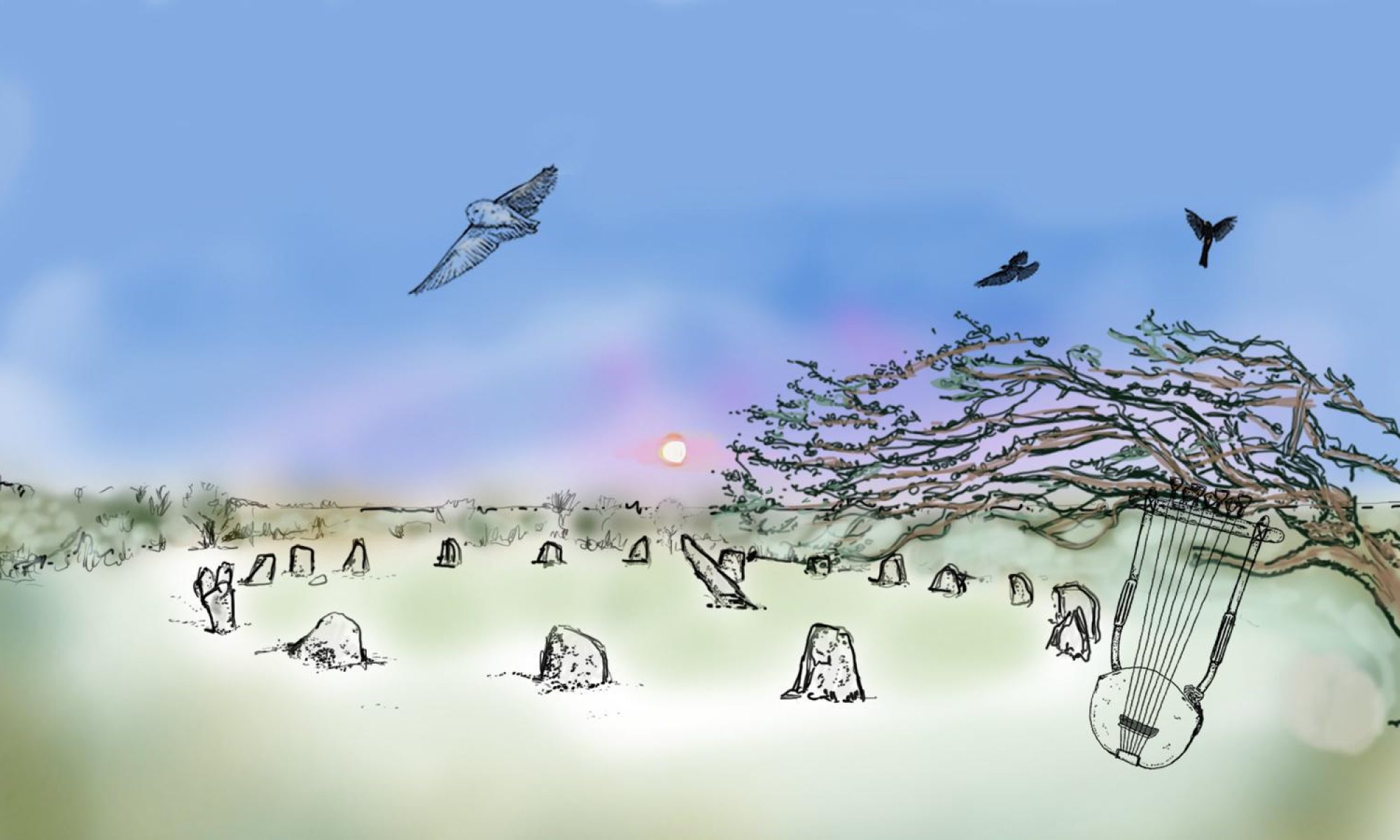
This page is all about the visual in and with poetry. Much of what is written below derives from ideas outlined in Roots of Lyric. Another key prompt has been the work of Dr Lynne Kelly, particularly The Memory Code. Kelly has investigated the possibility that many megalithic monuments, including Stonehenge, were built as memory palaces; places created as hunter-settler groups became more settled, with a reduced ability to use passage through the landscape in an older song lines-style tradition.
Again, birds are our heroes here. Swallows, apparently, when undertaking their long migration journeys, remember the starting point of each leg of the journey. As they pass certain key places (perhaps a place with great bugs, or a place with certain air currents – I don’t know what swallows consider noticeable), the memory of the next part of the journey is triggered. This is a bit like remembering texts that get spoken aloud communally, such as liturgy in a place of worship – once you get started, you can remember the next line by association, whereas writing it all down from memory might be more difficult.
Mesolithic hunters also had a lot to remember. Not only which plants were healthy to eat, but when they appeared, and where. This would mean clocks, calendars and atlases now but, in a non-literate time without any of those, the landscape and its changes during the year were the signs, and you needed to know when to look for them. A vast amount of information about animals, plants, minerals, illnesses, medicines, weather conditions, tides and currents, and astronomy, as well as genealogies, stories, songs, and dances, would have to be remembered and then passed on very systematically to the next generation.
Memory palaces, and they have had different names across cultures, are sequences of places to which memories can be assigned. Walking or a visualisation of walking through that place will then trigger the memories and datasets, much as for a sun-seeking swallow.
With the onset of farming, which did still involve some travel, especially for herders and traders, there was less regular constant passage through the landscape. At this point, memory palaces could have been created over smaller spaces; for instance, around a grove of trees. But really elaborate ones that also served as ritual performance gathering spaces, and as a means of calculating passage of time, would have been very desirable. (If you read only one non-fiction book this year, I would recommend The Memory Code as the lucky tome; it changed fundamentally how I look at the relationship between time and place.)
Artefacts can also be used to encode information diagrammatically, stylistically, abstractly; whatever conveys meaning to the user group. The artwork of First Nations Australian peoples is as famous as the song lines tradition, with at least an overlap of purpose.
This leads me to the idea of props in performance. This is not the same thing as a memory palace, or an encoded memory artefact. The performer using a prop is not generally requiring the audience to remember anything specifically. The prop is, however, designed to trigger association of context, purpose and emotion. Strewing a stage with dead fish would not in itself suggest anything definite, but it would raise questions that the audience would want to be answered. Are they meant to be revolted; is this the depiction of a slum; or a fishing port; or a seal sanctuary; or are we heading into surreal territory? The prop here is a question prompt and, once that question is answered, its continued presence endorses the answer, and that answer supports the development of the narrative.
So what does this have to do with lyric poetry? Well, here we are at Pound’s phanopoeia, and Frye’s opsis. Frye names the musical principle of the sound of lyric poetry as μέλος (melos), and its ‘root radical’ (essentialised projected core component if you reduced related possibilities down) is the charm. The organising principle of the visual is ὄψις (opsis), ‘involving imagery, pattern, and the containing spatial, and conceptual configurations associated with the eye’. Its corresponding root radical is the riddle. Welsh, who adopts Frye’s radicals, sees them as co-ordinates, rather than as a binary duad, and, personally, I find ideas that can be plotted, even in theory, pleasingly accessible, so I’m going with it.
The visual can be very literal, as in the medieval tradition of emblems. Such an emblem combined a pictorial element (stylised and coded iconographically), a verse element and a motto, often in Greek or Latin, offering a resolution of the other two. The picture is not an illustration of the verse and the verse is not a description of the picture; they complement each other, and if the connection is not obvious, the porous interplay creates the spatial configuration in the visual conjuring of an idea, in a mini-allegory.
This is also true of the riddle, which Frye considers a form of naming. Riddles are often paradoxical and good ones are complex; the complexities stimulate the reader to know something in a new way, and so Frye says that ‘it is a naming that creates a space rather than reduces it’. Unlike emblems, riddles are purely verbal in construction, yet they rely heavily on visual descriptions.
The emblem has a concrete visual that first tickles the imagination; contemplation of the more abstract verse then, with hints from the motto, should create a fuller understanding in the viewer/reader. Scenery could do this in the theatre. A backdrop might depict the literal background in a scene – a forest scene in a ballet setting, for instance. But a projected filmic backdrop could work more like a good music video; not an illustration but a stimulus for the audience to develop their own expanded vision. The films created for the Underworld Gates in the Descent of Inanna are not wholly illustrative. They were designed to conjure a feeling that the words of the sung poem could develop. There is no foreign language motto here, though – for many, the words of the Cornish song poem will be in a foreign language, and so the film is having to do a lot of emotive work. I took a leaf out of the emblematic book and used tarot cards in each film; these are as stylised, encoded and iconographic as the picture within an emblem.
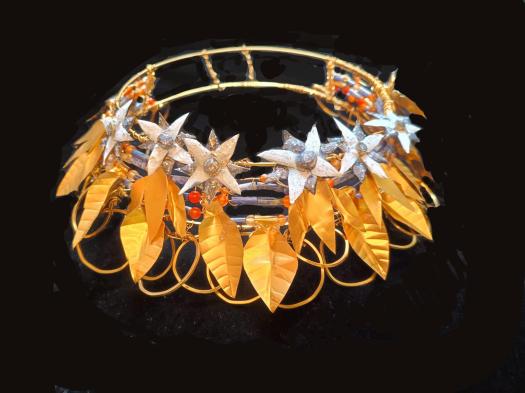
The props, too, are not emblematic designs either. These are, in fact, specified in the story – they are as much a part of the story as Inanna herself. Literally hero props. The crown that Inanna gives up at the first gate is the item that is the source of her power of rulership; it is not (in the story) a cipher that represents. It is the power.
The roots of the emblem have been claimed to be, pictorially, the hieroglyph and, intellectually, the epigram. Welsh, citing Rosemary Freeman:
“In all contemporary criticism, emblems are connected, explicitly or implicitly, with two main interests, interest in decoration and interest in rhetoric.”
It feels wrong to refer to a hieroglyph as a decoration – it represented meaning as a word or phrase does, but with a picture, instead of with a squiggle that may once have been a series of pictographs but which has reduced to an apparently arbitrary form.
Anyway, the image of the emblem corresponds with the visual metaphor of a riddle; the verbal puzzle corresponds to the rhetoric. Freeman elaborates: “The riddle’s tight paradoxes become in the emblem didactic parables, with the paradoxes partly resolved on a. general level by the motto, and the process of seeing and knowing becomes the special case of linking the concrete with the abstract.”
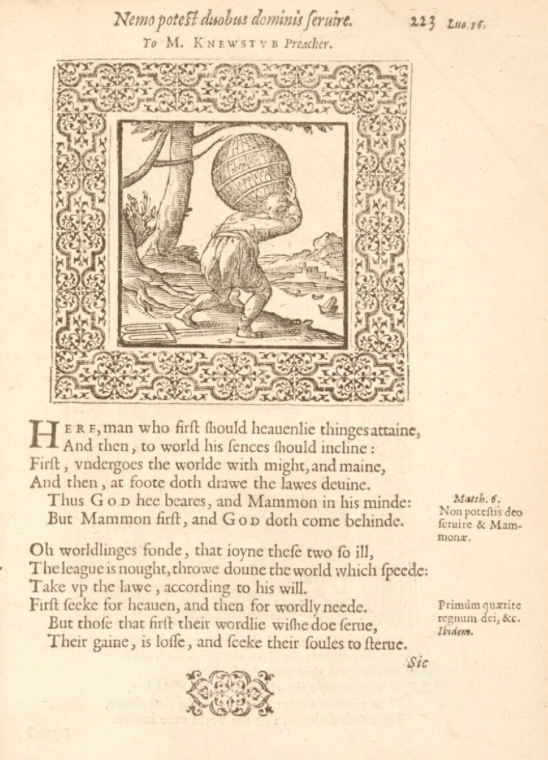
Example of an emblem from Whitney’s A Choice of Emblemes, Leiden 1586
The emblem could form the basis of a protocol for a standalone poetry film; a moving picture with verses visible or voiced. The role of the motto could be replaced by the title, which need not be in the same language as the words within the film. This dual-language approach might suit a mixed-language audience.
Introducing movement of the image could address what Welsh describes as a Marxist criticism of allegory; phanopoeia, with its emphasis on the image, promotes the spatial elements of poetry at the expense of motion, or the time element, thereby ‘dehistoricising’ it. Simply setting the picture in motion will not in itself resolve this issue, of freeing ‘caught time’, but a series of changing pictures might attempt to do so.
“Painting is silent poetry and poetry is a speaking painting,” is an aphorism that Plutarch ascribed to Simonides of Ceos. Horace also likened poetry to painting. But not everybody has agreed. In his Laocoon of 1766, Gotthold Ephraim Lessing made a distinction. Painting, he said, uses form in space, and the mimesis, for him, is taken to its limits. A visual image is represented by a created image, and the transferred spatial relationship is paramount. Poetry, however, articulates sound in time (when spoken aloud or read internally). But an image that complements a narrative is probably alluding to more than a single instant within that narrative, as narratives involve action through time.
Welsh identifies a root complex in lyric poetry, phanopoeia, based upon:
- the sense of an image or picture
- the sense of intellectual patterning
- the sense of time caught in space
The idea of time caught in space brings to mind archetype and specifically the archetype of dream, in which time does not progress normally. It jumps. The archetypes of myth also transcend ordinary temporal considerations. Although mythical narratives might have a defined sequence of actions, they are often set in places where time does not move in the same way as the mundane world. Heroes return from a year in fairyland to find that their descendants are already old people etc. Some myths are set at the beginning of time, representing an archetypal process which we must repeat in order to rejoin our idealised antecedents.
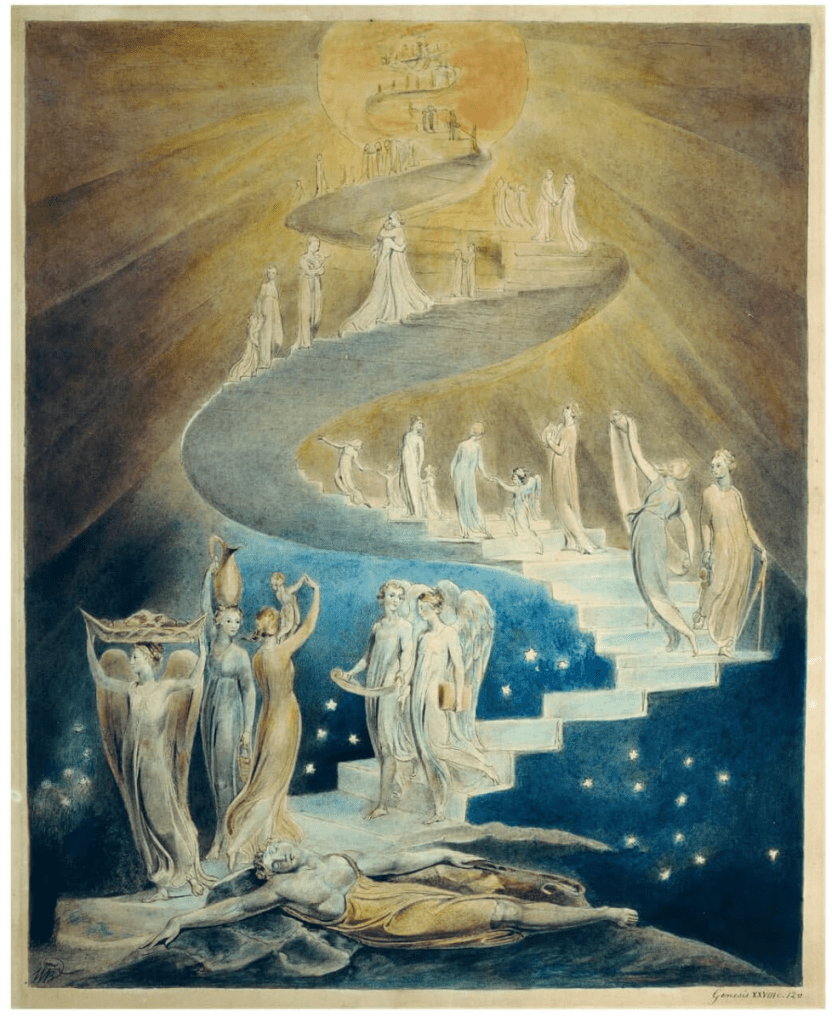
William Blake’s poetry comes close to mythical archetypal patterning. As Welsh puts it:
“… his poetry affirms the power of the human imagination to create and organise time in its own image, and his painting affirms the centrality of the human body as the structural principle of space.”
Imagism
Ezra Pound described an image, in a lyrical context, as ‘that which presents an intellectual and emotional complex in an instant of time’. Here, an image or impression can be described using a language of pattern that may derive from a description of something else; the pattern is transferred to the subject, by way of metaphor or other figure of speech. The element of paradox, describing one thing in terms of something else, is similar to that of the riddle, the simpler, earlier construction that keeps popping up; the ‘root radical’ of opsis.
My interest in this is not so much to understand the antecedents of superb lyrical poetry as to see what lyrical poetry is trying to do, and possibly why, and see if there are other ways of supporting that, other than through a verbal language of pattern.
Timelessness and archetypal patterning are features of myth. A poem may not directly refer to archetype, but cross-referencing of images relies upon it. When Pound describes his scene ‘In a Station of the Metro/The apparition of these faces in the crowd/Petals on a wet, black bough/’ he is not describing a particular wet, black bough. He is conjuring one up in the reader/listener’s imagination – whether they have consciously registered a wet, black bough in the past or not. He is referring them to an archetype.
Welsh discusses haiku, which interested Pound greatly. Significantly, while a haiku might not describe a particular image, it may evoke it – and this Welsh describes as a ‘phanopoeic sense of picture’. There is a sense of looking at something from the side, not straight on, and this is something in common with a dream,
Now, perhaps this is all a terribly roundabout way of saying that lyric poetry has been considered to have a strong visual element that plays with ideas to say something else, and so therefore it is perfectly ok to use real visible things to augment the sound of poetry in a multidisciplinary sort of a way. It is quite a jump, but an artist, if not a scholar, ought to take the odd leap of faith.
If we do consider object and painting as phanopoeic input to a poetry performance, then what else is there that is not marked with the opsis coordinate?
One visual image, when seen, may contextualise the next; it may lead to audience expectation. Multiple images can themselves create a paradox. Using a sequence of real imagery extends the possible associations very greatly, and can set riddle against riddle against riddle, even if set against the same patterning text.
“A riddle is not simply the ‘answer’ but the process,” says Welsh, “a way of seeing that creates a space for fuller knowing.”
“The image is not an idea,” said Pound. Which seems clearly wrong to the point that it is difficult to make its wrongness clearer, just as it is harder to satirise modern American politics than it used to be. An image is chosen, or assembled, for a reason, and that gives it a context, or a set of contexts. If something has a context, then it is part of a patterning logic. If, on the other hand, an image presents itself spontaneously and generates other forms of expression, then it was either assigned a context within the process, so drawing it into a patterning logic, or it was held to be linked to one already and the poet went with that. One of the roots of the haiku is the koan, and on this occasion, the sound of one hand clapping (from the well-known koan) is probably the sound of the reader sobbing. Everything that is perceivable has a context, maybe many contexts, simply because we are alive in the world. Our interdependence with the world is the heart of the human condition.
Perhaps Pound is making the image a point, an instant, something that is discrete and atomic. Perhaps he is suggesting that its ionic potential depends upon the liberating valency of words. I still don’t care. And nor would a swallow.
“The discovery of names through the paradoxical structures of riddles, and the naming of complex spaces of human experience in the structure of Images, remain forms of phanopoeia, a power of the visual imagination.” (Welsh) And.. “True naming is not arbitrary, not the giving of names but the discovery of names.”
And, most interestingly, Welsh suggests that a sense of motion is ‘caught and held’; “The temporal dimensions of poetry – movement, progression, change – are still there, but seen in phanopoeic pattern”.
The elaborated riddle may (the emblem) or may not (the Imagist poem) refer to actual visual material, but a sense of the visual is the basis of patterning within the poetic construction.
The dynamic stasis found in some Imagist poems could also be found in a mythic narrative, where the images of the present are projected onto the past to create a sort of eternal now.
Using literal imagery as part of a mythical construction is not about illustration, but about expanding further the conceptual space of the work.
The Seventh Gate to the Underworld is where Inanna gives up the last of her sense of identity. The filmic backdrop I made for this gate is not about a goddess or about the Underworld. It is literally about abusive norms arising systemically from patriarchal social systems. The films are all on the Blood Lyric page, but you can also see this one here:
This is clearly about compromised identity and powerlessness, and moving towards vulnerability. It just isn’t about Inanna; at least, not directly. It focuses upon abuse of the earth, mother of all, and of gendered abuse of people I am confident that Inanna would consider these things to be matters of importance.
In terms of time, the images relating to homophobia are arranged chronologically, but they all point to now, the only time that we can handle, and the one that must be addressed. They all point to a collapse.
The performance took place in a dilapidated neo-classical Victorian gentlemen’s club (the Saint Just Scientific and Literary Institution, or the Lafrowda Club). There is no raised stage and no curtains; the stage area was demarcated with a fence made of black and yellow hazard tape. The film was projected onto a large wall mounted screen behind the stage area. While the films played, Inanna is inside her magic circle – yes, an actual magic circle cast inside the taped area, with an altar – relinquishing items of power at the various gates, before dying (that is another matter).
In my opinion, all stages are temples, demarcated areas where humanity can interface with its dreams of itself, so one might as well play to that. Performance is a ritual enactment of whatever myth is under consideration.
The myth of Inanna’s descent to the Underworld is hardly new. But every telling of a story is both a new story and a substantiation of the aspect of our incarnation that makes the story relevant and meaningful at all. Even the dramatisation of a recent news story is creating a fresh interface between the remembered event and our way of thinking about it, and the reframed narrative is then integrated into our magic net of impressions of that story-event. All stories refer back to create our current situation. This might not be what Welsh meant by a dynamic stasis, but the scenes of a performance might be seen as the movement of a concertina of time, that can be played close or far apart.
ALTAR
Inanna’s altar. The symbols/colours are those of the four elements. The altar represents Earth – our eternal point of departure. It isn’t modelled on anything Sumerian, just on what felt like an altar to me, based on what was to hand. Choosing what to make real and what to leave arbitrary is key to creativity and, quite honestly, it feels very liberating!
“Poetry,” said Jeremy Rothenberg, “can make-things-present by naming them.” And that is magic. If this naming happens in the visual imagination, as suggested by Welsh (and Pound), then it is done not only by the writer and performer, but, on the other side of the window, by the audience, too. Performance is essentially a group activity. The acts committed on stage are those of the performer and willed, one assumes, by the director, but the impression of them takes place in the imaginations of the audience members. If a person finds a performance moving, then something has happened inside their own head. If a person hates what they have just seen, the thing that they hate is probably not the same thing that somebody else loves, even taking different tastes into account. They will have weighted it differently; they will have seen and associated it differently. And they will have named it differently. Playing with images/naming conventions is part of the game, and creates dramatic tension, but, like the one hand clapping, magic needs company. Audience participants bring their own banks of imagery and association to the party and the calculus that they perform with the proferred data is likely to yield different results. There must be other ways of seeing this, but that is how I am seeing it.
 Lyric Cornish