Melos is the complement of opsis, and it is Frye’s ‘root radical’ of lyric melopoeia, and this is where I am starting, in terms of considering how music might flow naturally from words.
My initial interest in Ancient Greek music stemmed from wanting to see how the poets went about things in a culture known for utilising the music of its language. So it might make sense to start ‘in the beginning’ with ancient music. In the end, after a lot of reading around on sung poetry traditions, I decided not to. It feels more honest to start with where I am, in the twenty-first century – well, with the thoughts of poetry scholars and critics from the twentieth century – looking back at the roots of where we are now, and poking around from there. Ancient Greek music is a subject to be considered in right of itself, even though there is a lot of relatively modern harking back to Aristotle. Aristotle has high, noble ideals of artistic narrative integrity and is very pragmatic as to how they might best be achieved (happily using Euripides to show bad practice) – this pragmatism bodes well. Poetics talks about how best to do things that self-evidently need to be done. I am also interested in why we do things, and how that could change. In a changing world, what is constant? Media (rhythm, language and melody) and objects of mimesis (people doing people things) may be constant in provocation, but interpreted differently; the manner of imitation is certainly up for grabs.
Further, the methods and usages of μουσική could not have been the beginning. Sung poetry happens in non-literate cultures across the world and the sophistication of Greek music and poetry would have developed from earlier artistic structures. I don’t know where the beginning is, but I know, or feel comfortable with my sense of, where now is. So, back to Frye! Incidentally, his book The Anatomy of Criticism starts with a ‘Polemical Introduction’ favouring a synoptic view of literary criticism (another point in his favour, and possibly mine), and, as well as considering the radicals of lyric (melos and opsis), he has an essay on the theory of myth. He also observes that “the critical theory of genres is stuck precisely where Aristotle left it” and so “… we find ourselves in the position of the Renaissance doctors who refused to treat syphilis because Galen said nothing about it”.
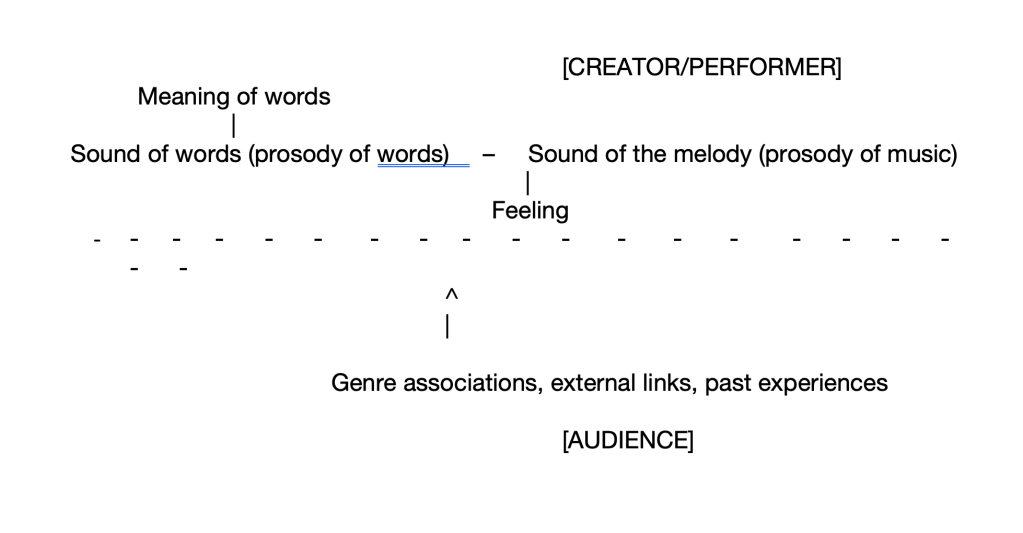
Going back to looking at the prosody and meaning link, with prosody split between prosody of words and prosody of music, here is the relationship again (it was on the Introduction page), with more emphasis on the permeability of the performer/audience line:
To me (currently), Aristotle comes across as an engineer working with a wiring diagram drawn by the gods. He is both really idealistic and really down to making sure everything is balanced nicely and nobody gets hurt (except a few dramatic reputations). Personally, I am interested in Aristotle as he has provided the blueprint for discussion about poetics and performance, and is still the basis for development of the topic. So, selfishly, I can see where I stand in relation to a communal map of unfamiliar terrain.
Aristotle doesn’t say much about the audience, other than that the general perception (then) is that cultivated people like epic (it’s all words) and the oiks need more action on stage – although he feels that that is simplistic. But other than educated and non-educated, he seems to see the audience as a receiver, not a filter. This may be because the individual quirks of the audience are irrelevant in a world where moral rectitude has been defined and safe-guarded by standing in right communion with the gods. Over two thousand years later, it doesn’t feel especially daring to want to take this further.
Aristotle also seems to be making the assumption that the timeframe of a play/recitation as a dramatic event is the time it takes to perform, being keen to ensure that the narrative scope is scaled accordingly. This does not consider the time it takes to write, which is relevant if the production is conceptual as well as performative. If the clock of the opus is considered to start ticking with the first inkling in the mind of the creator(s) and to stop with the curtain down, then all of the filtering that the writer does-with-the-audience-in-mind is relevant. Things are constructed according to projected expectations. The audience may or may not expect these things, which may be cultural norms or might be anticipated personal biases of a particular group, but they feed into the creative process. The process may or may not count as the artistic product, but the shape of the artistic product will have a relation to the patterning of the process. The construction time, in and of itself, isn’t really the issue in a quantitative fashion, only that it bounds the process.
Frye talks of the poet’s initiative, or group of initiatives, and subsequent decisions made relating to a variety of poetic elements, at the outset of producing a poem. This would start with what theme and what genre to write in. I would add that deciding why to write, and for whom, precedes that. Only a fool writes for anything but money, said Samuel Johnson, and that assumes expectation on the part of the audience. Any loftier ambition will have a particular audience in mind.
In the diagram above, the top left section corresponds more or less to Aristotle’s lexis (diction), with the dissociated aspects as opsis and melos.
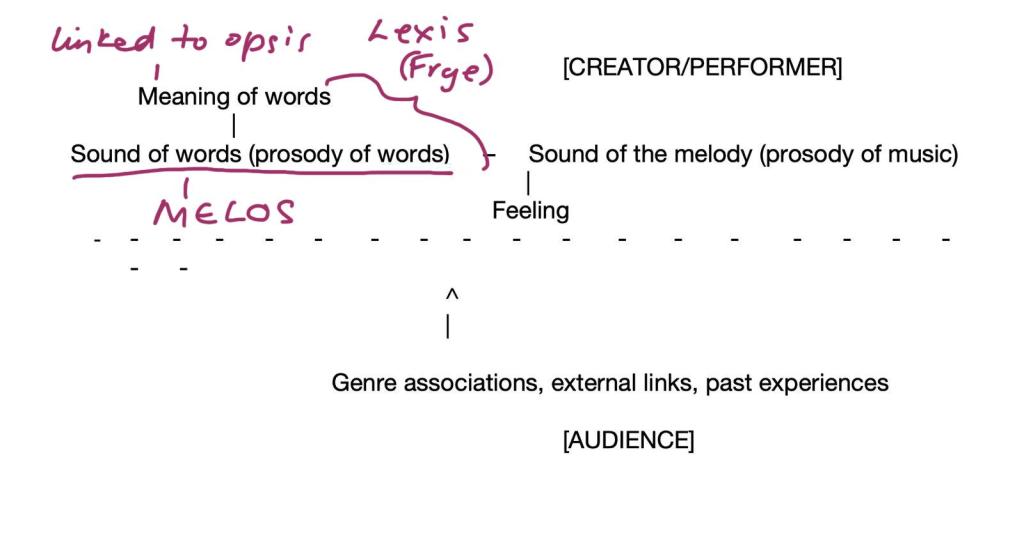
The action at the top and the bottom of the diagram happens outside of performance time, the contextualising of writing and the context that the audience brings to bear, with the central action being the performance.
It might be that in Ancient Greece, all poetry was performed and the audience was a given. Nowadays, most written work is experienced in its written form, not its dramatised or recited form (if it has one), and so an actual audience is a thing to be considered. Recorded work, songs or poems, are experienced by individuals as individuals.
Frye describes the lexis aspect of opsis as ‘”imagery” when we are thinking of it as forming a simultaneous pattern of meaning apprehended in an act of mental “vision”‘.
Well, the basis for that apprehension is built up over a lifetime. and the interface of experience of life with experience of the mimetic act is the performance time. However, the actual sound of the diction, ‘a narrative sequence of sounds caught by the ear’ happens must more closely within the timeframe of the performance. I might hear an aria sung in a language I do not speak, and so experience the heard-sound aspect, but I will not appreciate the opsis aspect of diction. (This is opsis using Frye’s quoted definitions, and is not the opsis of Spectacular Effects that might take place on stage.)
So, does Frye’s melos constitute only the heard-sound or is there ‘auditory meaning’ involved as well? The answer may determine how much the sound may be considered to be arbitrary. It is likely that it cannot, anyway. Rhythms that sit close to that of a heartbeat may be perceived very differently to those that sound like gunfire. Sound also has its associations; they simply are not verbal. Animals react to sounds, sounds that may be presented as abstracted spectrograms, but which, as phenomena, may be more real than words in representing impending action.
The question that I want to answer, from the point of view of creating art, is: how reasonable is it to treat the sound of words as independent of the meaning of them? I suspect that the answer may depend upon the reason for asking the question.
So, can I let the natural way of expressing words-as-speech, which are coded with meaning through natural vocal expressiveness (this may need defining) be treated as pure sound? The spoken phrase has its natural music; can this be extended or otherwise exaggerated as the basis for musical delivery, with accompaniment?
Frye considers melos in poetry primarily in terms of the musical effect of stress accents creating rhythm. There is no consideration of pitch. Frye does say that he is considering the point from the perspective of English, although he hoped that it might apply in other languages. Well, it would be most relevant to stress-timed languages; English is one but Cornish is not, and nor was Greek for Aristotle. Frye is talking about poetry that might be read at a recitation but is most often read by a private reader. It is likely that while rhythm is inferred from the text itself, pitch will depend upon the voice of the individual reader, or, their voice as they hear it in their own head.
My doomed love for Northrop Frye will keep this by way of consolation:
“It is more likely to be the harsh, rugged, dissonant poem (assuming of course some technical competence in the poet) that will show in poetry the tension and the driving accented impetus of music. When we find a careful balancing of vowels and consonants and a dreamy sensuous flow of sound, we are probably dealing with an unmusical poet. Pope, Keats, and Tennyson are all unmusical.”
Where the sound of a line conveys an impression of the sense of the meaning, as imitative harmony, or onomatopoeia, then this is more akin to opsis than melos.
Perhaps, if that quality of sound is transferred to the music that poetry may be set to, in a sung poem, then there is an alchemically-sounding relationship of ‘opsis of melos’. As in ‘Water of Fire’, and so on. This complicates things, as if every element is being seen through a series of planes, each plane relating as the natural home of one of the qualities in the performance dynamic.
Frye: “Recurrently in the history of rhetoric some theory of a ‘natural; relation between sound and sense turns up. It is unlikely that there is any such natural relation, but that there is an onomatopoeic element in language which is developed and exploited by the poet is obvious enough.”
I would not try to find any natural relation between sound and sense; I want to find a natural relation between melodic sound of words and melodic sound of music, that goes beyond rhythmic stress.
Frye: “The main reason for the confused use of the term musical in literary criticism is that when critics think of music in poetry, they seldom think of the actual music contemporary with the poetry they are discussing, with its stress accent and dance rhythm, but of the (very largely unknown) structure of Classical music, which was presumably closer to song and to pitch accent. We have stressed imitative harmony because it illustrates the principle that while in Classical poetry sound-pattern or quantity, being an element of recurrence, is part of the melos of the poetry, it is part of the opsis in ours.”
Finally, Frye identifies two primary rhythms in any poem: the recurring rhythm, a ‘complex of accent, metres, and sound-pattern’. (A feature of epos, recited verse.) ‘There is also the semantic rhythm of sense, or what is usually felt to be the prose rhythm’. Too much emphasis on the former, says Frye, when speaking poetry aloud, lends a sing-song effect, while too much of the latter sounds pompous.
In prose, Frye talks of ‘the rhythm of continuity’; in drama, ‘the rhythm of decorum’. Lyric poetry holds ‘the rhythm of association’. “The lyric is the genre in which the poet, like the ironic writer, turns his back on his audience.” I would contend that while this is true of the poetic address itself, it does not follow that the poet has forgotten that the audience is there. It is like an infatuation, where the obsessed is looking at themself through their beloved, but it is a two-way mirror. I think that, in producing lyric poems, we look at the world through ourselves, and ourselves through the world, in order to make fragile peace with how we see our place in it.
He talks of the ‘loosening of rhyme’, and the liberation of a distinctive rhythm, as developed with the advent of free verse. This is “the articulation of an independent rhythm equally distinct from metre and from prose”, and it is what prevents a poem from becoming prose when it loses regular metre. It is linked to lyric in τὰ μέλη, ‘poems to be sung’, but Frye is keen to point out the modern loss of the pitch accent that ‘marks the domination of music by poetry’, in English, at least. Therefore, he suggests a better translation is ‘poems to be chanted’, with an emphasis on words as words. This is indeed what I am after, and not the ‘neutral and conventional words’ of song, with ‘rhythmical organisation taken over by music’. Yeats called it ‘cantillation’; the chanting of poetry, to get the sound of the words to the maximum.
At the far end of verbal abuse in music Frye puts the madrigal; words are used as landfill, voices may be interchanged with instruments. Isolating them in a melodic line paved the way for opera, but true emphasis on the verbal rhythm still tends towards chant.
It may be time to dial back and now consider Frye’s radical of melos; the charm. Frye famously refers to the basis for melos and opsis as babble and doodle. These are his elements of subconscious association, and the informal, childlike quality of babble and the sketchiness of doodle suggest something happening ahead, even if just ahead, of the formal creative process. “In babble, rhyme, assonance, alliteration, and puns develop out of sound-associations. The thing that gives shape to the association is what we have been calling the rhythmical initiative, though in a. free verse poem it would be rather a sense of the oscillations of rhythm within an area which gradually becomes defined as the containing form.”
Babble is rhythmic and into this sound-space the poet pours words grouped by association; for example, puns that play with both sound and sense. The balancing of form and substance at the subconscious level has a dream-like quality; the root radical of melos is considered to be the charm. When the associations are shoe-horned in consciously, they turn into doggerel.
This reverses how I had envisioned music deriving from image. I have wanted to find a way to derive, or predict, melody from the sound of words-as-words. However, it is very likely to be the basis for the sung poetry that has manifested around the world and that neither justifies nor prevents an attempt to reverse-engineer the phenomenon.
Welsh, in his consideration of charm, suggests that there are three roots of melos for lyric poetry; song-melos, where words fit the rhythm and melody of music; charm-melos, where the words are intoned as by a magician, and; speech-melos, the music of the spoken language. While song is shaped by the external rhythm of the music, which in turn may be linked to the requirements of dance and drama, the rhythm of a magical chant derives from its inherent purpose.
Chant relies heavily upon repetition, which is the basic structural principle of melopoeia, as spatial juxtaposition is to phanopoeia within the visual imagination. Over time, Welsh suggests, certain words may have acquired a context of specialness for the purpose of magic, and been sequestered for esoteric use. This bodes well for the way in which the actual sounds of lyric can impact the audience (human or divine), but it is not necessarily a flow that derives from the words-as-words, once already charged with meaning.
Charm and chant are particular forms of sung poem and can be considered elsewhere as part of an overview of examples of sung poetry.
While the organisation of rhythm develops inside the language itself with melopoeia, most Western song suppresses this in favour of the rhythm of the music. Welsh recognises that this “may well have been different in the Greek lyric, and again in the Provencal troubadour lyric, where the melodic line of the music followed the patterns of poetic meters and the words measured out the length of the musical notes.” This is exactly what I am after but, while speech-melos might be supposed to be the driver for it, Welsh appears to be saying that it is not routinely to be found these days. He flags up Thomas Campion, the Elizabethan song-poet, who deplored “the vulgar and easie kind of Poesie which is now in use throughout most parts of Christendome, which we abusively call Rime and Meeter”. (From Observations in the Art of English Poesie, 1602).
Although he did not gain much traction with his contemporaries, Campion experimented with reintroducing the primary position of language in song in his ‘ayres’. Welsh suggests that others might try the same:
“The most interesting situation to study would be that of someone who was skilled in both the art of poetry and the art of music, who conceived words and music together and carefully tried to integrate the rhythms of one with the rhythms of the other.”
 Lyric Cornish